System Design
Tilt Angle Optimization
Learn how to choose the best solar tilt angle using latitude rules, seasonal adjustment formulas, yield trade-offs, and site-specific constraints.
Tilt angle optimization sounds like a precision problem, but for most fixed solar arrays it is really a trade-off problem.
Yes, panel tilt affects how much sunlight reaches the module surface across the year. But the uncomfortable truth is that many roofs cannot use the mathematically perfect angle anyway, and the good news is that they often do not need to. In many practical installations, being within about 10 degrees of the theoretical optimum changes annual production only modestly.
That is why tilt optimization is less about chasing a perfect number and more about understanding what matters, latitude, season, site goals, roof shape, and whether manual adjustment is actually worth the effort.
This guide explains the common latitude rules, more refined seasonal formulas, what kind of gain seasonal adjustment can really deliver, and when site constraints matter more than pure geometry.
The Basic Principle
Section titled “The Basic Principle”Tilt angle changes the angle at which sunlight hits the module surface.
The closer the panel faces the sun’s effective path over the course of the year, the more irradiance it can capture. That is why the classic rule of thumb says:
Annual optimal tilt ≈ local latitudeThis works because latitude roughly reflects the average solar path geometry for a fixed array.
It is not perfect, but it is a strong starting point.
Why the Exact Number Often Matters Less Than People Think
Section titled “Why the Exact Number Often Matters Less Than People Think”One of the most useful practical findings in tilt-angle design is that annual energy yield usually changes slowly near the optimum.
In many reference models, moving the tilt angle within about ±10° of the theoretical best value reduces annual output by less than about 1.5%.
That is why fixed roof installations often perform perfectly well even when the roof pitch is not mathematically ideal.
In other words, tilt optimization is real, but it is usually a shallow hill, not a razor edge.
Method 1, The Simple Latitude ±15° Rule
Section titled “Method 1, The Simple Latitude ±15° Rule”One classic approximation uses latitude directly for seasonal adjustments.
Winter tilt = latitude + 15°Summer tilt = latitude - 15°For a location near 48° latitude, such as Munich:
- Winter tilt ≈
63° - Summer tilt ≈
33° - Annual fixed reference ≈
48°
This rule is popular because it is easy to remember and works well enough for many manual-adjustment systems.
Method 2, The More Refined Multiplier Formula
Section titled “Method 2, The More Refined Multiplier Formula”Another common approach uses a multiplier on latitude:
Winter tilt = latitude x 0.9 + 29°Summer tilt = latitude x 0.9 - 23.5°Using 48° latitude:
- Winter tilt ≈
72.2° - Summer tilt ≈
19.7°
This method can produce more aggressive seasonal angles than the simpler ±15° rule, especially in mid-latitude locations.
The real lesson is not that one shortcut is universally best. It is that seasonal tilt targets can shift quite a lot once the design objective changes from annual average to winter capture or summer bias.
A Practical Latitude Reference Table
Section titled “A Practical Latitude Reference Table”Broad planning data often looks like this:
| Latitude | Approximate annual tilt | Summer tilt | Winter tilt | Gain from adjusting twice per year |
|---|---|---|---|---|
25° | Around 22° | Around 2.3° | Around 41.1° | About 4% to 6% |
35° | Around 32° | Around 11.6° | Around 49.8° | About 4% to 6% |
40° | Around 37° | Around 16.2° | Around 54.2° | About 4% to 6% |
45° | Around 42° | Around 20.9° | Around 58.6° | About 4% to 6% |
48° | Around 45° to 48° | Around 23° | Around 62° | About 4% to 6% |
50° | Around 47° | Around 25.5° | Around 63° | About 4% to 6% |
These are useful orientation numbers, but good software such as PVGIS or PVWatts is still better for real projects.
Fixed Tilt vs Seasonal Adjustment
Section titled “Fixed Tilt vs Seasonal Adjustment”This is where optimization becomes a practical design choice instead of a theoretical one.
Fixed annual tilt
Section titled “Fixed annual tilt”Best for:
- Most rooftop systems
- Low-maintenance installations
- Grid-tied homes
- Projects where roof pitch already dictates the panel angle
Two adjustments per year
Section titled “Two adjustments per year”Best for:
- Ground-mount systems
- Accessible arrays
- Off-grid systems where winter energy matters more
- Owners willing to make a simple spring and autumn adjustment
Typical annual gain, often about 4% to 6%
More frequent adjustment
Section titled “More frequent adjustment”Monthly or near-monthly changes can add more yield, but the gain curve flattens relative to the added effort.
Some studies show:
- About
3.6%improvement from limited multi-step annual adjustments in some climates - Roughly
6.9%to11%from monthly adjustment in stronger theoretical cases
That is meaningful, but many home systems will never recover the extra labor or mechanical complexity.
What Seasonal Adjustment Really Buys You
Section titled “What Seasonal Adjustment Really Buys You”The main benefit of seasonal tilt is not magic. It is simply better alignment with the sun when the seasonal solar path changes.
For a 6 kW system, a 4% gain can mean roughly 240 to 300 kWh more production per year.
That can be worthwhile when:
- Power is expensive
- Winter generation matters a lot
- The array is ground mounted and easy to reach
But on many rooftops, the real-world gain is too small to justify manual adjustment hardware or repeated labor.
The Stanford Global Tilt Study
Section titled “The Stanford Global Tilt Study”One of the better-known global references in this topic comes from Jacobson and Jadhav’s work on optimal fixed tilt angles.
A useful approximation from that research is:
Optimal fixed tilt ≈ latitude x 0.764This pattern is especially informative across tropical to mid-latitude regions, where the optimum often ends up shallower than the old simple latitude-equals-tilt shortcut would suggest.
The broader takeaway from global studies is consistent:
- Higher latitudes usually want steeper tilt
- Tropical zones often want quite shallow tilt
- Near the equator, the optimum can be close to flat
Low Latitudes Work Differently
Section titled “Low Latitudes Work Differently”In tropical and near-equatorial regions, steep tilt can actually hurt performance because the sun path stays much higher in the sky through the year.
That is why many low-latitude systems do better with shallow tilt angles, often somewhere in the 0° to 15° range depending on local climate, cleaning needs, and structural conditions.
This is also where dust management can become part of the tilt conversation. A very low tilt may be geometrically good for solar capture, but a slightly steeper installation can improve rain cleaning and reduce soiling buildup.
Bifacial and Special Cases
Section titled “Bifacial and Special Cases”Bifacial systems add another layer.
A somewhat higher tilt can improve rear-side contribution in the right environment, especially when the ground surface has good reflectivity. But that does not mean bifacial systems always want a dramatically steeper angle.
In some tropical studies, low tilt combined with reflective ground treatment performed very well even for bifacial systems.
That is why special module architecture can influence tilt, but the site still matters more than any universal bifacial rule.
Roof Constraints Often Override Theoretical Optimum
Section titled “Roof Constraints Often Override Theoretical Optimum”Many real installations do not get to choose their tilt freely.
Site constraints may include:
- Existing roof pitch
- Wind loading rules
- Aesthetic requirements
- Mounting system limitations
- Self-shading on flat roofs
- Local snow-shedding needs
This is why the right tilt is often the best achievable tilt, not the perfect laboratory angle.
A Practical Decision Framework
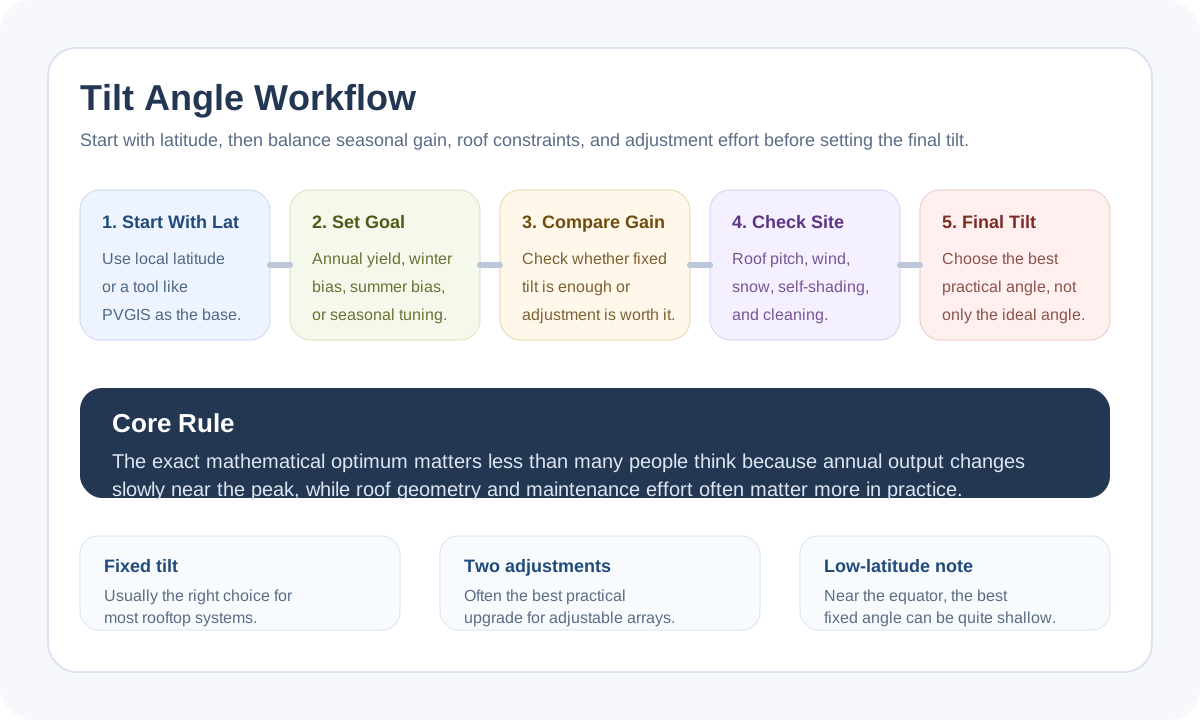
Section titled “A Practical Decision Framework”Use this order and tilt decisions usually stay grounded.
- Start with latitude or an address-based tool estimate
- Decide whether the system is fixed, seasonally adjustable, or tracked
- Check whether the goal is annual output, winter-biased output, or summer-biased output
- Compare the likely energy gain against the mechanical and labor cost of adjustment
- Let roof geometry, wind, snow, and shading constraints finalize the angle
That sequence keeps the project from over-optimizing a number that may only affect a small slice of annual yield.
Common Tilt Optimization Mistakes
Section titled “Common Tilt Optimization Mistakes”- Treating the exact theoretical optimum as critical on a fixed rooftop array
- Ignoring that being near the optimum is often good enough
- Using annual-average tilt when the real goal is winter-heavy off-grid performance
- Installing adjustable hardware where the gain is too small to justify the hassle
- Forgetting self-shading, structural limits, or cleaning behavior
Most tilt mistakes come from optimizing geometry in isolation from the rest of the system.
Where This Page Connects to the Rest of the Design
Section titled “Where This Page Connects to the Rest of the Design”Tilt angle affects system yield, but it is only one part of performance.
It works together with:
That is why tilt should be chosen as part of a whole-system design loop, not as a standalone geometry exercise.
Related Guides in Focus Solar
Section titled “Related Guides in Focus Solar”- Solar System Sizing
- Shading & Loss Analysis
- Load Estimation
- Inverter Sizing
- How to Choose Solar Panels
- Panel Output Estimator
Watch or Read More
Section titled “Watch or Read More”Key Takeaways
Section titled “Key Takeaways”- A strong first-pass rule is that annual fixed tilt is close to local latitude.
- For many fixed arrays, being within about
10°of the optimum changes annual yield only modestly. - Seasonal adjustment can add useful output, but two adjustments per year often capture most practical value.
- Low-latitude and bifacial systems may need different tilt assumptions than standard mid-latitude rooftop arrays.
- Roof constraints, shading, and maintenance realities often matter more than chasing the perfect calculated angle.
Sources Used for This Page
Section titled “Sources Used for This Page”This page was expanded using the research notes and source list provided for this project, especially the following references.
- PVGIS, Solar Panel Tilt Angle Calculation
- Sinovoltaics, How to Calculate Solar Panel Tilt Angle
- SolarTap, Solar Panel Angle Calculator
- SolarPanelTilt.com
- Jacobson and Jadhav, World Estimates of PV Optimal Tilt Angles
- Scientific Reports, Optimizing Tilt Angle Using ML
- ScienceDirect, Optimizing Solar Panel Tilt Angles for Enhanced Energy Production
- YouTube, How to Determine the Best Tilt Angle of Solar Panels