Components
Cables & Connectors
A guide to solar cables and MC4 connectors covering cable ratings, connector compatibility, common mistakes, and what to check before installation.
Solar cables and connectors look boring right up until they are the part that fails.
That is the uncomfortable truth.
Panels get most of the attention.
Inverters get most of the technical questions.
But a badly chosen DC cable, a poor crimp, or a mismatched connector pair can quietly create voltage drop, water ingress, overheating, or a hard-to-find fault that drags the whole array down.
That is why this page treats cables and connectors as system-critical components, not accessories.
It walks through what solar cable needs to be rated for, what MC4 really means in practice, how sizing and voltage-drop logic connect to the hardware choice, and which installation mistakes create the biggest real-world risk.
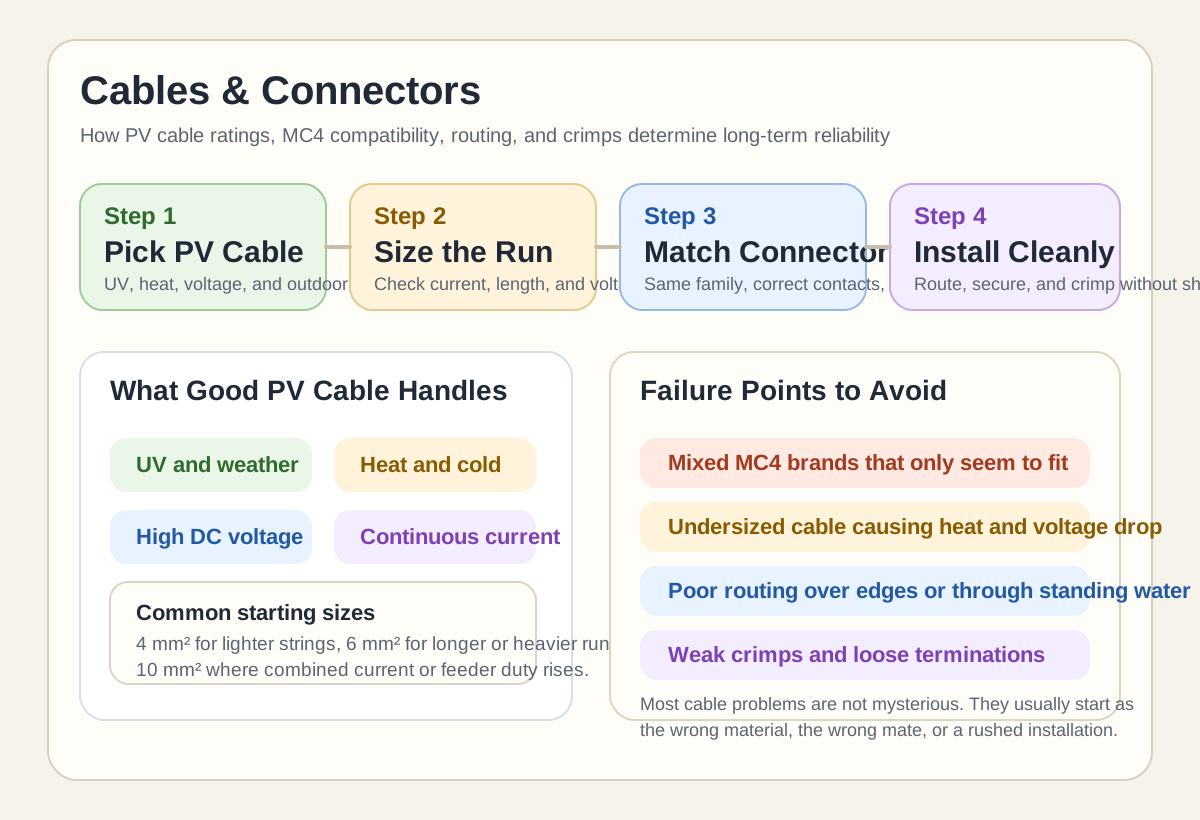
Why Solar Cable Is Not Just Ordinary Wire
Section titled “Why Solar Cable Is Not Just Ordinary Wire”Solar DC cable lives a harder life than a lot of general-purpose building wire.
It has to handle:
- outdoor
UVexposure - wide temperature swings
- long periods of continuous current
- high
DCvoltage - movement, vibration, and rooftop heat
That is why proper PV cable is usually built around tinned copper conductors with solar-specific insulation and jacket materials such as XLPE or XLPO, rather than whatever generic wire happened to be available.
The goal is not just conductivity.
It is long-term survival in a harsh environment.
The Core Cable Specs That Actually Matter
Section titled “The Core Cable Specs That Actually Matter”When you read a solar cable datasheet, the practical fields usually boil down to:
- conductor material
- insulation and jacket type
- voltage rating
- temperature rating
UVand weather resistance- water ingress rating or outdoor suitability
- cross-sectional area
- current-carrying capacity
If those are unclear, the cable is hard to trust.
Conductor and Insulation Basics
Section titled “Conductor and Insulation Basics”For modern solar work, the common expectation is a single-core tinned copper conductor with insulation designed for photovoltaic service.
Why tinned copper?
Because rooftop systems are not friendly to bare copper over long periods, especially where moisture and environmental exposure matter.
Why solar-specific insulation?
Because the cable needs better resistance to:
UV- ozone
- heat
- cracking
- mechanical wear
That is why solar cable often looks more specialized than ordinary appliance or indoor building wire.
It is.
Voltage Ratings, Why 600 V, 1000 V, and 1500 V Matter
Section titled “Voltage Ratings, Why 600 V, 1000 V, and 1500 V Matter”Solar DC cable is commonly rated somewhere in the 600 V to 1500 V DC range depending on the product and market.
That rating has to be compatible with the highest real DC voltage the circuit may see.
Just like inverter input limits, cable voltage rating is not a number you compare casually against a nominal system label.
You compare it against the maximum realistic circuit voltage the installation can produce.
If the system is being built around modern higher-voltage strings, a cable intended for lower-voltage work is simply the wrong part.
Temperature and Outdoor Ratings
Section titled “Temperature and Outdoor Ratings”This part matters more than new buyers expect.
Solar cable is often expected to tolerate conditions roughly in the zone of:
- very cold outdoor starts
- very hot rooftop service
- temporary overloads or short high-temperature exposure
Many PV cable products are designed around operating windows that stretch from deep subzero conditions up to hot-roof environments, with even higher short-duration thermal tolerance.
That is one reason ordinary indoor wire is such a bad substitute.
It may carry current fine in a benign setting, but that is not the same thing as surviving years of UV, heat, and rooftop abuse.
Common Cable Sizes, and What They Are Really Telling You
Section titled “Common Cable Sizes, and What They Are Really Telling You”On solar material lists, the sizes most people run into are often:
4 mm26 mm210 mm2
Or in AWG terms:
- about
12 AWG 10 AWG8 AWG
Those are useful orientation points, but they are not magic answers by themselves.
The actual choice still depends on:
- current
- route length
- voltage-drop target
- bundling and conduit conditions
- ambient temperature
So if someone says 4 mm2 is standard, the correct response is:
standard for what run, at what current, over what distance?
A Practical Starting Table
Section titled “A Practical Starting Table”The ranges below are good starting points for quote review, not final engineering answers.
| Cable size | Rough current range in common solar use | Typical use case |
|---|---|---|
4 mm2 | Often used around smaller residential string currents | Single-string residential runs |
6 mm2 | Useful when current or route length starts climbing | Longer string runs or heavier rooftop circuits |
10 mm2 | Often used where combined current is higher | Main DC feeders, combiner output, heavier runs |
The moment strings are paralleled or distances get long, the comfortable answer can move up fast.
That is why cable sizing cannot be reduced to a one-line rule.
Why Voltage Drop Still Drives the Conversation
Section titled “Why Voltage Drop Still Drives the Conversation”Even on the component side, you cannot really talk about solar cable without talking about voltage drop.
Good practice usually tries to keep voltage drop low enough that the cable is not quietly stealing system performance.
A common design target is to stay under about 3%, with tighter targets often preferred on important DC runs.
That is why cable choice is not only about whether the wire is technically safe on current.
It is also about whether the run is efficient enough to justify the installation.
If you want the full design workflow, use the dedicated Cable Sizing guide as the mathematical companion to this page.
What MC4 Means in Practice
Section titled “What MC4 Means in Practice”MC4 is the connector family most people think of when they picture solar DC connectors.
In practice, MC4 became the industry default for good reasons:
- field-proven locking design
- weather-resistant sealing
- touch-safe connector geometry
- broad compatibility with modern module leads and extension cables
A proper MC4-style connector is designed to help the system stay safe outdoors, stay sealed, and resist accidental unplugging.
That is a much bigger job than just connecting two wires.
The Connector Specs Worth Checking
Section titled “The Connector Specs Worth Checking”On a connector datasheet, the useful fields usually are:
- voltage rating
- current rating
- conductor size range
- contact material
- ingress rating, often
IP67orIP68 - operating temperature range
- locking and release method
Good connectors usually use copper alloy or tinned copper contacts inside an insulated housing intended for outdoor exposure.
That sounds mundane until you remember the connector is carrying live DC current in a hot, wet, dirty environment.
Then it stops sounding mundane very quickly.
The Biggest MC4 Mistake, Cross-Mating Different Brands
Section titled “The Biggest MC4 Mistake, Cross-Mating Different Brands”This is one of the most important warnings on the page.
Many installers and technical references caution against mixing connector brands or mixing parts that are only marketed as MC4-compatible.
Why?
Because connectors that look physically similar are not always certified as a tested pair.
The danger is not just theoretical mismatch.
It is increased contact resistance, poor locking, water ingress, arcing risk, or long-term heating at the joint.
That is why the safest rule is simple:
use the same connector family and certified mating pair rather than assuming every MC4-looking connector belongs together.
Why Locking and Tool Release Matter
Section titled “Why Locking and Tool Release Matter”Modern solar connector systems are intentionally not supposed to unplug like a household extension cord.
That is part of the safety logic.
Depending on the code framework in use, tool-release or locking requirements may be part of compliance expectations for rooftop PV work.
The practical lesson is straightforward:
if the connector system is designed to lock, treat that as a feature, not an inconvenience.
It reduces accidental disconnects and makes rooftop DC connections less casual, which is exactly what you want.
Installation Practices That Matter More Than People Think
Section titled “Installation Practices That Matter More Than People Think”This is where a lot of future failures are created.
Use Actual Solar Cable
Section titled “Use Actual Solar Cable”Do not substitute ordinary wire just because the conductor size looks similar.
Solar cable is chosen for electrical reasons and for environmental survival.
Skipping that part is a false economy.
Respect Bend Radius
Section titled “Respect Bend Radius”Cables should not be forced around tight corners or dragged across sharp edges.
A good rule is to avoid overly aggressive bends and keep the routing gentle enough that the insulation is not being stressed constantly.
Protect the Route
Section titled “Protect the Route”Good routing usually means:
- avoiding sharp metal edges
- avoiding standing water traps
- avoiding chronic contact with hot surfaces
- securing the cable so it does not flap, sag, or rub
- using proper conduit or protection where exposure demands it
Make Clean, Correct Crimps
Section titled “Make Clean, Correct Crimps”A weak crimp is not a cosmetic problem.
It is a resistance problem.
And resistance at a connector becomes heat.
That is why solar connectors should be terminated with the correct tool and the correct contact size, not improvised with generic pliers and optimism.
Do Not Connect or Disconnect Under Load
Section titled “Do Not Connect or Disconnect Under Load”Live DC circuits are much less forgiving than people assume.
If connection work is being done, the circuit should be made safe first rather than treated casually.
The Most Common Solar Cable Mistakes
Section titled “The Most Common Solar Cable Mistakes”These are the mistakes that keep repeating across buyer guides, installer writeups, and field troubleshooting.
Using Cable That Is Too Small
Section titled “Using Cable That Is Too Small”This creates extra voltage drop and extra heat.
The system may still run, but it is running with avoidable loss and avoidable stress.
Using Non-Solar Cable Outdoors
Section titled “Using Non-Solar Cable Outdoors”This often fails as an environmental problem before it fails as a conductivity problem.
UV damage, cracked insulation, and degraded jackets are the usual story here.
Poor Routing
Section titled “Poor Routing”Bad routing creates abrasion, water retention, and mechanical wear.
A perfectly good cable can fail early if the route is careless.
Mixing Connector Families
Section titled “Mixing Connector Families”This is the classic it fit, so we assumed it was fine mistake.
Physical fit is not the same thing as certified compatibility.
Loose or Low-Quality Terminations
Section titled “Loose or Low-Quality Terminations”A loose contact turns into heat, and heat at a connector is one of the most common early-warning signs of a bad joint.
What to Check on a Real Quote or Material List
Section titled “What to Check on a Real Quote or Material List”If you are reviewing a solar proposal, this short checklist is usually enough to catch a lot of weak details.
- Is the cable clearly identified as
PVor solarDCcable rather than generic wire? - Is the cable size stated clearly in
mm2orAWG? - Does the run length justify that size, or does it feel suspiciously thin?
- Are the connectors identified clearly, rather than just described as
MC4 compatible? - Is there any sign that different connector brands will be mixed on site?
- Does the route protection look intentional, especially near roof edges and hot equipment?
That is often enough to separate a thoughtful material plan from a vague one.
Related Guides in Focus Solar
Section titled “Related Guides in Focus Solar”- Cable Sizing
- How to Read a Panel Datasheet
- How to Read an Inverter Datasheet
- Load Estimation
- System Voltage Selection
Watch or Read More
Section titled “Watch or Read More”Key Takeaways
Section titled “Key Takeaways”- Solar
DCcable should be selected as outdoor photovoltaic cable, not treated as generic wire. - The right cable choice depends on voltage rating, temperature tolerance, current, distance, and voltage-drop goals together.
MC4connectors are effective when the mating pair, crimp quality, and locking method are handled correctly.- One of the highest-risk mistakes is mixing connector brands just because they appear to fit physically.
- Many cable and connector failures start as installation shortcuts rather than as dramatic component defects.