System Design
Cable Sizing
Learn how to size solar cables using current, voltage drop, route length, temperature derating, and common wire-size rules for PV, battery, and inverter circuits.
Cable sizing is one of the least glamorous parts of solar design, but it has an outsized effect on safety and performance.
If the cable is too small, it creates avoidable voltage drop, heat, and long-term stress on insulation and connectors. If it is too large, the system still works, but the project spends more money than it needs to. Good cable sizing is the middle ground between electrical safety and practical efficiency.
This guide walks through the core DC voltage-drop formula, the Isc x 1.25 current rule, common cable-size ranges for different parts of a solar system, and the real-world corrections that often get missed.
Why Cable Sizing Matters
Section titled “Why Cable Sizing Matters”Every wire has resistance. As current moves through that resistance, the system loses energy as heat.
That matters for three reasons:
- Too much resistance wastes production and lowers delivered power.
- Too much heat accelerates insulation aging and can create fire risk.
- Overly conservative cable choices raise material cost without adding much value.
In solar projects, this issue is especially important on the DC side because current can be continuous for long periods rather than short intermittent bursts.
Practical design guidance often targets:
DCvoltage drop at3%or less, with1%to2%preferred where practicalACvoltage drop at about1.5%or less for critical runs
The Three Checks Behind Good Cable Sizing
Section titled “The Three Checks Behind Good Cable Sizing”Good cable sizing is never only a table lookup.
You usually need to check three things together:
- Current-carrying capacity, can the wire safely carry the expected current
- Voltage drop, will the circuit lose too much voltage over the route length
- Installation conditions, will temperature, conduit fill, or bundling reduce the cable’s usable rating
If any of those three checks fail, the cable is not really sized correctly.
Start With Design Current, Not Only Nameplate Current
Section titled “Start With Design Current, Not Only Nameplate Current”For solar DC circuits, a common rule is to size conductors from short-circuit current, Isc, multiplied by 125%.
Design current = Isc x 1.25This matters because solar conductors can see sustained current under strong irradiance, so the design current should include code and safety margin rather than only nominal operating current.
For example:
Isc = 18 ADesign current = 18 x 1.25 = 22.5 AThat design current becomes the number you carry into both ampacity and voltage-drop checks.
The Core DC Voltage-Drop Formula
Section titled “The Core DC Voltage-Drop Formula”For a two-wire DC circuit, the current travels out and back, so the route length is effectively doubled.
Vdrop = 2 x L x I x RWhen resistance is expressed per km or per kft, the formula is often written with a unit-conversion factor:
Vdrop = (2 x L x I x R) / 1000Where:
Lis one-way cable lengthIis design currentRis cable resistance from a datasheet or standard table
Then convert that result into a percentage:
Voltage drop (%) = Vdrop / system voltage x 100That percentage is the number you compare against your design target.
Worked Example
Section titled “Worked Example”Using the example from the research notes:
| Item | Value |
|---|---|
Short-circuit current, Isc | 18 A |
| System voltage | 24 V |
| One-way cable length | 40 ft |
| Cable chosen | 10 AWG |
| Cable resistance | 0.000395 ohm/ft |
| Target voltage drop | Less than 3% |
Maximum allowed drop:
24 V x 3% = 0.72 VCalculated drop:
2 x 40 x 18 x 0.000395 = 0.57 VPercentage drop:
0.57 / 24 x 100 = 2.37%So in this example, 10 AWG is acceptable because the final voltage drop stays below the 3% target.
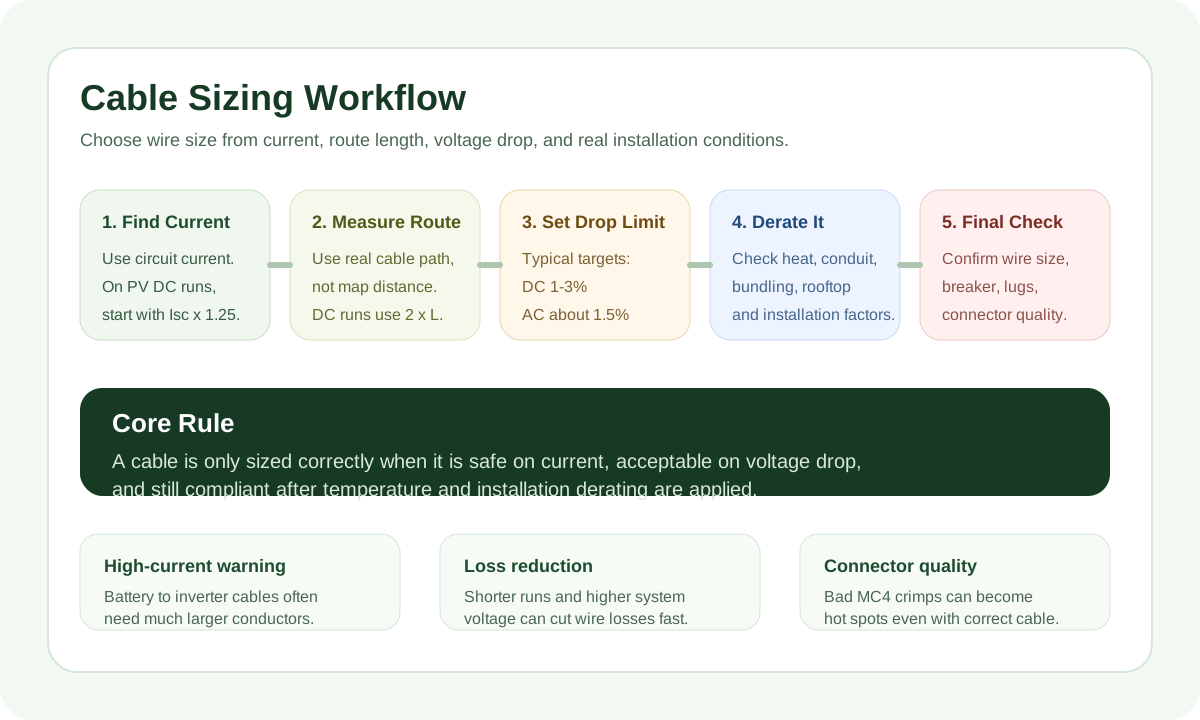
A Practical Sizing Workflow
Section titled “A Practical Sizing Workflow”Use this sequence and cable sizing usually becomes much easier to audit.
- Find the circuit current, often
Isc x 1.25on the solarDCside - Measure the actual route length, not a rough straight-line estimate
- Set an acceptable voltage-drop target
- Check a candidate cable size against both ampacity and voltage drop
- Apply temperature and bundling derating if relevant
- Re-check connectors, breakers, lugs, and terminals so the whole circuit matches
That order prevents one of the most common mistakes in solar layouts, picking wire from habit before doing the route and loss math.
Typical Wire Sizes by System Segment
Section titled “Typical Wire Sizes by System Segment”The exact answer always depends on current, length, ambient temperature, and local code, but these ranges are useful starting points.
Common metric ranges
Section titled “Common metric ranges”| Circuit segment | Typical starting size | Notes |
|---|---|---|
| Panel string to combiner or array junction box | 4 mm2 | Often a standard starting point for a single string |
| Combined string run after multiple strings merge | 10 mm2 or larger | Current rises quickly once strings are paralleled |
| Charge controller to battery | 10 mm2 to 16 mm2 | Very sensitive to current and route length |
Inverter to battery, smaller 24 V systems up to about 3 kW | Around 25 mm2 | Battery-side current is often high |
Inverter to battery, 48 V around 5 kW | Around 16 mm2 | Higher voltage helps reduce current |
Inverter to battery, 48 V around 10 kW | Around 35 mm2 | Large battery-inverter links need close checking |
Inverter to AC load or grid connection | 2.5 mm2 to 4 mm2 | Still check local code, breaker size, and run length |
Common AWG starting ranges
Section titled “Common AWG starting ranges”| Scenario | Typical starting range | Notes |
|---|---|---|
| Small residential panel strings | 10 AWG to 12 AWG | Common when runs are short and current is modest |
| Higher current or longer string runs | 8 AWG to 6 AWG | Helps control voltage drop |
Large systems or very long DC runs | 4 AWG to 2 AWG | Often used where distance dominates |
Battery-to-inverter runs above about 100 A | 2/0 AWG or similar | Current can get very high on low-voltage battery systems |
Those values are useful for orientation, but they are not substitutes for calculation.
Why Battery-Side Cables Get Large So Fast
Section titled “Why Battery-Side Cables Get Large So Fast”One reason solar newcomers underestimate cable size is that battery-side circuits can carry huge current even in medium-sized systems.
The quick relationship is:
Current = power / voltageA 3 kW inverter on a 24 V battery system can demand roughly:
3000 / 24 = 125 AThat is why short battery links often need much thicker cable than the panel strings feeding the same project.
This is also why moving from 12 V or 24 V up to 48 V can reduce cable size pressure so dramatically.
Temperature Derating and Installation Corrections
Section titled “Temperature Derating and Installation Corrections”Cable ampacity is not fixed forever. It changes with installation conditions.
High ambient temperature, conduit fill, bundled conductors, rooftop heat, and poor ventilation can all reduce the usable current rating of a cable.
A simple way to think about it is:
Corrected current capacity = rated capacity x derating factorIn practice:
- Hotter environments reduce allowable current
- Bundled or tightly packed cables shed heat less effectively
- Extra coils of unused cable can trap heat and add unnecessary resistance
That is why real cable selection should use temperature and installation correction tables from the applicable code or cable manufacturer, not just a nominal room-temperature rating.
Design Choices That Reduce Cable Losses
Section titled “Design Choices That Reduce Cable Losses”Sometimes the smartest cable-sizing decision is not a thicker wire, but a better layout.
Shorten the run
Section titled “Shorten the run”A shorter route cuts resistance directly. This is why charge controllers are often placed as close as practical to the battery bank.
Raise the system voltage
Section titled “Raise the system voltage”For the same power, a higher-voltage system carries less current. Because resistive loss follows I2R, reducing current has an outsized effect on heating and voltage drop.
Use proper solar cable
Section titled “Use proper solar cable”Outdoor PV circuits should use cable built for UV, weather, insulation, and temperature conditions expected in solar installations. General indoor building wire is not always a good substitute.
Pay attention to connector quality
Section titled “Pay attention to connector quality”A poor MC4 crimp or a loose termination can become a high-resistance hot spot even when the cable itself is sized correctly.
Common Cable Sizing Mistakes
Section titled “Common Cable Sizing Mistakes”- Using only breaker size and skipping the voltage-drop calculation
- Forgetting that
DCruns are out-and-back circuits, so the length is effectively doubled - Sizing panel strings carefully but underestimating battery-to-inverter current
- Ignoring rooftop heat or conduit derating
- Leaving long coils of spare cable in place
- Treating generic wire tables as final answers without checking the actual product resistance
- Mixing connector brands or using poor crimps at
MC4terminations
Most cable problems do not come from complicated math.
They come from skipping one of the correction steps.
Related Guides in Focus Solar
Section titled “Related Guides in Focus Solar”- Load Estimation
- System Voltage Selection
- Inverter Sizing
- Battery Sizing
- Cables and Connectors
- Cable Size Calculator
Watch or Read More
Section titled “Watch or Read More”Key Takeaways
Section titled “Key Takeaways”- Cable sizing should satisfy current capacity, voltage-drop targets, and installation derating at the same time.
- On the solar
DCside, a common starting current isIsc x 1.25. DCvoltage-drop math uses the full out-and-back route, not only one-way distance.- Battery and inverter links often need much larger conductors than panel strings because current rises quickly at lower voltages.
- Better layout, shorter runs, higher system voltage, and good connector work can cut losses just as effectively as moving to a much larger cable.
Sources Used for This Page
Section titled “Sources Used for This Page”This page was expanded using the research notes and source list provided for this project, especially the following references.
- ELEK Software, DC Cable Sizing with Examples
- VAZPO, How to Calculate Cable Size for Solar System
- EasySolar, Solar Cable Sizing Basics
- Sunstore, What DC Wire Sizes to Use for Solar PV
- Solar Inverter Manufacturers, Inverter Wire Size Guide
- OptiSolex, Beginner’s Guide to Solar Cables
- University of Malaya, Optimal Solar Cable Selection for PV
- YouTube, Cable Size for Solar Panels