Buying Guide
How to Choose an Inverter
Learn how to compare inverter types, size an inverter correctly, and check battery, monitoring, and grid compatibility before you buy.
The inverter is the control center of a solar system. Panels may get most of the attention, but the inverter is what turns solar production into usable electricity, manages system behavior, enables monitoring, and often determines how easy it will be to add battery storage later.
That is why choosing an inverter is not only a hardware question. It is a system design question.
If you choose the wrong type, you can end up with avoidable clipping losses, weak shade performance, limited monitoring, or an awkward battery retrofit later on.
This guide walks through the real decision path, inverter type, inverter size, and the less obvious buying details that matter over the long life of the system.
Start With What the Inverter Needs to Do
Section titled “Start With What the Inverter Needs to Do”Before you compare brands, answer these questions first.
- Is the roof simple and mostly unshaded, or complex and partially shaded
- Is the system grid-tied only, or do you want battery storage now or later
- Do you care about panel-level monitoring, or is system-level monitoring enough
- Are there export limits, unusual grid conditions, or future expansion plans
- Is the project optimized mainly for low upfront cost, or for flexibility and long-term control
These answers usually narrow the right inverter family much faster than shopping by brand alone.
The Three Main Inverter Types
Section titled “The Three Main Inverter Types”Most residential buyers are comparing three inverter categories.
| Type | Strength | Limitation | Best fit |
|---|---|---|---|
| String inverter | Lowest installed cost, high efficiency, simple architecture | Shade on one panel can affect the string unless the design mitigates it | Simple roofs with low shading |
| Microinverter | Strong shade tolerance and panel-level monitoring | Higher upfront cost and more electronics on the roof | Complex roofs or buyers who want module-level visibility |
| Hybrid inverter | Combines solar conversion with battery-ready or battery-integrated operation | More design complexity and often higher cost than plain string systems | Homes planning for storage or backup |
The key point is that none of these is universally best.
A string inverter can be the smartest answer on a clean, open roof.
A microinverter can make more sense on a segmented roof with mixed orientation or periodic shading.
A hybrid inverter becomes especially attractive when battery compatibility and future expansion matter from the start.
String vs Micro vs Hybrid
Section titled “String vs Micro vs Hybrid”If you want a sharper comparison, the trade-offs usually look like this.

Inverter decisions sit much closer to electrical system design than to simple product shopping. Photo by Bulat843 on Pexels.
| Factor | String inverter | Microinverter | Hybrid inverter |
|---|---|---|---|
| Peak efficiency | Commonly around 97.5% to 98% | Commonly around 97% to 97.8% | Commonly around 98% |
| Shade handling | Weakest of the three unless the design is optimized | Strongest because each panel works independently | Moderate, depends on design and architecture |
| Monitoring | Usually system-level | Usually panel-level | System-level and often battery-aware |
| Battery readiness | Often needs extra equipment later | Usually not the easiest battery path | Strongest starting point for future storage |
| Warranty pattern | Often around 10 to 12 years | Often much longer, sometimes up to 25 years | Commonly around 10 years with extension options |
That is why inverter choice is often really a question about roof conditions and future plans.
If the site is simple, low-cost string architecture can be excellent.
If the roof is messy, microinverters may earn their higher price.
If battery storage is part of the roadmap, hybrid deserves serious attention early.
If you want a deeper component-level explanation, read String vs Microinverter and Hybrid Inverter Explained.
Inverter Size, the Most Misunderstood Spec
Section titled “Inverter Size, the Most Misunderstood Spec”Many buyers assume the inverter must match panel wattage one-for-one.
That is not usually how real solar design works.
In practice, designers often use a DC/AC ratio above 1.0, which means the panel array on the DC side is somewhat larger than the inverter’s AC rating. This is sometimes called DC oversizing.
Typical residential ratios often land around 1.15 to 1.25, though the acceptable range depends on the inverter, climate, roof orientation, and local design rules.
That is why a 6 kW solar array might reasonably be paired with a 5 kW inverter.
The idea is straightforward.
- Panels do not operate at their nameplate maximum all the time
- A slightly smaller inverter can still capture most of the useful energy across the year
- Oversizing the DC side often improves economics and energy yield relative to cost
The trade-off is inverter clipping during strong peak production periods. That is not automatically a design flaw. In many cases it is a normal and efficient choice.
A Simple Way to Think About Clipping
Section titled “A Simple Way to Think About Clipping”Clipping happens when the panels could produce more DC power than the inverter is able to convert to AC at that moment.
That sounds bad at first, but it needs context.
If clipping happens only during a small number of high-production hours, a slightly undersized inverter may still produce better value overall than a larger, more expensive unit.
This is why serious proposals should not only tell you the inverter size. They should explain the expected energy yield and why the chosen DC/AC ratio makes sense for your site.
What to Check in Inverter Sizing
Section titled “What to Check in Inverter Sizing”- Inverter
ACrating - Maximum
DCinput power allowed by the manufacturer - Recommended or acceptable
DC/ACratio - Number of panel strings and string voltage window
- Startup voltage and MPPT operating range
- Whether future array expansion is likely
If you want to go deeper into the math, read Inverter Sizing Guide.
Why MPPT Count Matters
Section titled “Why MPPT Count Matters”Maximum Power Point Tracking, or MPPT, is one of the most practical inverter specs buyers overlook.
Multiple MPPT inputs matter when the roof has different orientations, different tilt angles, or shading conditions that affect panel groups differently.
For example, if one part of the array faces east and another faces west, a multi-MPPT inverter can track those sections more effectively than a simpler unit trying to manage them as one electrical behavior.
That is why extra MPPT channels can be more than a nice-to-have. They can make the design more flexible now and easier to expand later.
Battery Compatibility Is a Future-Proofing Decision
Section titled “Battery Compatibility Is a Future-Proofing Decision”Even if you are not buying a battery today, it is worth deciding whether you want the system to be battery-ready.
This is where inverter choice can quietly shape the next ten years of the system.
- A standard string inverter may need a more awkward AC-coupled battery retrofit later
- Microinverter systems can support storage, but the path may be less direct depending on the ecosystem
- Hybrid inverters are usually the cleanest path when you already expect storage or backup to matter
If the budget does not allow batteries today but the household expects EV charging, time-of-use shifting, or outage protection later, it can be worth choosing an inverter architecture that leaves that door open.
Monitoring, Data, and Fault Visibility
Section titled “Monitoring, Data, and Fault Visibility”Monitoring is not just a fancy app feature.
It affects how quickly you notice faults, how much insight you have into system performance, and how easy it is to judge whether the system is actually doing what the quote promised.
Think about monitoring at three levels.
| Monitoring level | What you see | Best fit |
|---|---|---|
| Basic system-level | Whole-system production | Buyers who only want broad performance visibility |
| String-level | Output by string or input group | Useful for more complex layouts |
| Panel-level | Output from each module | Best when shade, diagnostics, or detail tracking matters |
Microinverters usually shine here because panel-level visibility is part of the appeal. Hybrid systems add another dimension by tracking battery behavior as well as solar production.
Efficiency Still Matters, but Not in Isolation
Section titled “Efficiency Still Matters, but Not in Isolation”Inverter efficiency is worth checking, but it should not overpower the rest of the decision.
If one inverter is clearly weaker on efficiency, that matters over a long operating life. But small efficiency differences do not automatically beat better shade handling, better monitoring, or better battery readiness for your specific site.
Think of efficiency as one line in the buying table, not the only one.
Other Specs Worth Checking
Section titled “Other Specs Worth Checking”- Grid voltage and frequency compatibility for your market
- Outdoor protection level, such as
IPrating - Operating temperature range
- Noise level if the inverter is mounted near living space
- Firmware update path and remote support options
- Brand reputation, service coverage, and warranty claim practicality
These are the sorts of details that rarely headline the sales pitch but often shape the ownership experience.
Questions to Ask Before You Sign
Section titled “Questions to Ask Before You Sign”- Why was this inverter type chosen for my roof rather than the other options
- What
DC/ACratio is being used and why - How many
MPPTinputs does this design use - How does the inverter behave if I add battery storage later
- What level of monitoring will I get
- What is covered by product warranty and what is covered by installer workmanship
- What service or troubleshooting support is available after commissioning
A good installer should be able to answer these without hand-waving.
Common Buying Mistakes
Section titled “Common Buying Mistakes”- Choosing the cheapest inverter without checking future battery compatibility
- Assuming all shading problems can be solved just by buying more panels
- Comparing inverter efficiency but ignoring
MPPTcount and monitoring - Accepting a sizing choice without understanding the
DC/ACratio - Treating warranty years as equal without checking support quality and claim process
Most inverter regret comes from mismatch, not from a single bad spec.
A Good Default Decision Framework
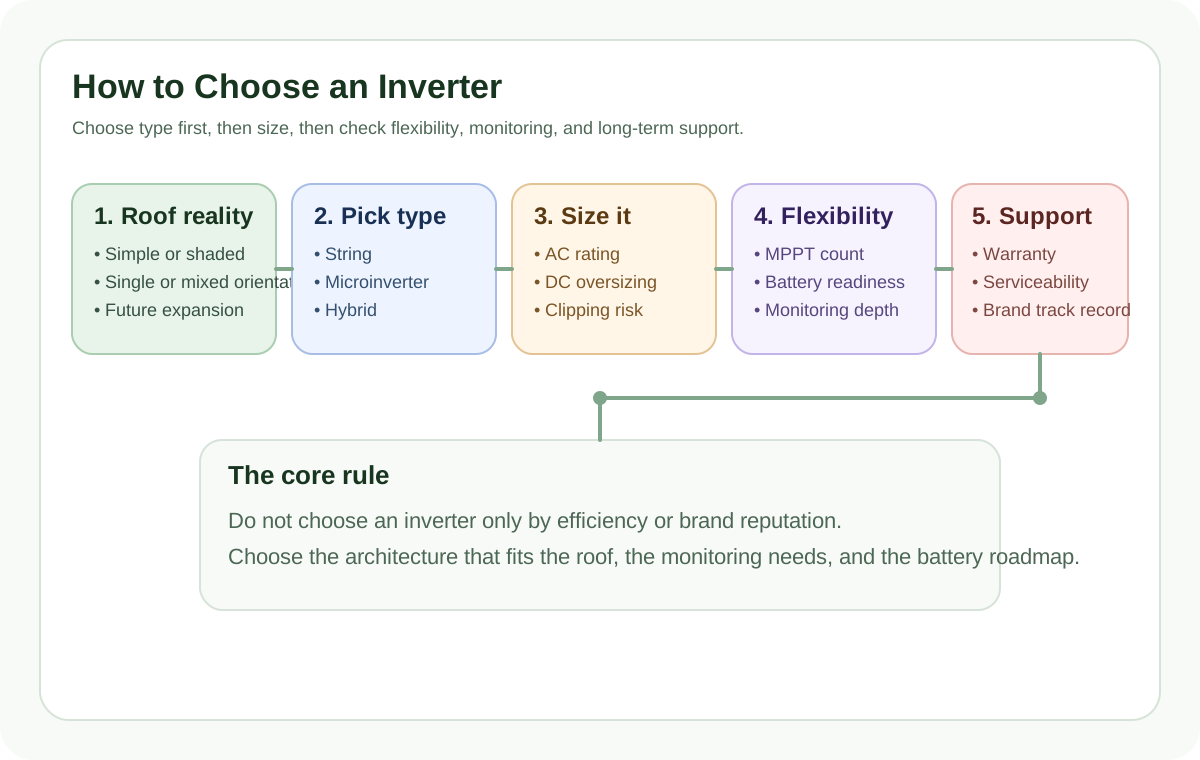
Section titled “A Good Default Decision Framework”If you want a compact rule set, use this order.
- Match inverter type to roof complexity and battery plans
- Check
DC/ACratio and sizing logic - Confirm
MPPTcount and electrical compatibility - Review monitoring depth and diagnostics
- Compare warranty, service support, and brand reputation
That sequence usually surfaces the real differences faster than comparing brochures side by side.
Related Guides in Focus Solar
Section titled “Related Guides in Focus Solar”- How to Choose a Solar System
- How to Choose Solar Panels
- How to Choose a Battery
- Hybrid Inverter Explained
- Inverter Sizing Guide
- String vs Microinverter
Watch or Read More
Section titled “Watch or Read More”Key Takeaways
Section titled “Key Takeaways”- Start by matching inverter type to the roof, shade pattern, and battery roadmap.
- String, microinverter, and hybrid designs each make sense in different situations.
- Inverter sizing is usually about
DC/ACratio and annual performance, not about matching panel watts exactly. MPPTcount, monitoring depth, and battery compatibility matter more than many buyers expect.- A good inverter choice is not just efficient. It is also flexible, supportable, and well matched to the system around it.
Sources Used for This Page
Section titled “Sources Used for This Page”This page was expanded using the research notes and source list provided for this project, especially the following references.
- CNET, Best Solar Inverters 2025
- EnergySage, Best Solar Inverters
- Aurora Solar, Choosing the Right Size Inverter
- Powmr Community, String vs Microinverter vs Hybrid Solar Inverter
- Afore Energy, Types of Solar Inverters
- Afore Energy, How to Determine the Right Solar Inverter Size
- SRNE Solar, String vs Micro vs Hybrid
- YouTube, How to Choose the Right Solar Inverter for Your Home