Components
String vs Microinverter
Compare string inverters and microinverters on upfront cost, shading behavior, monitoring detail, maintenance trade-offs, and when each architecture makes more sense.
The simple version is still true.
String inverters are usually the lower-cost, cleaner choice for straightforward roofs with little shade.
Microinverters are usually the more flexible choice when the roof is complicated, partial shading is real, or panel-level visibility matters.
But the full answer is more nuanced than that.
Modern string inverters are not as helpless under shade as people sometimes assume, especially when they are paired with strong MPPT logic or module-level electronics. And microinverters are not automatically the best financial answer just because they look more advanced.
This guide compares the two architectures where the decision actually gets made: cost, shading, monitoring, service, expansion, and the type of roof you are really building on.
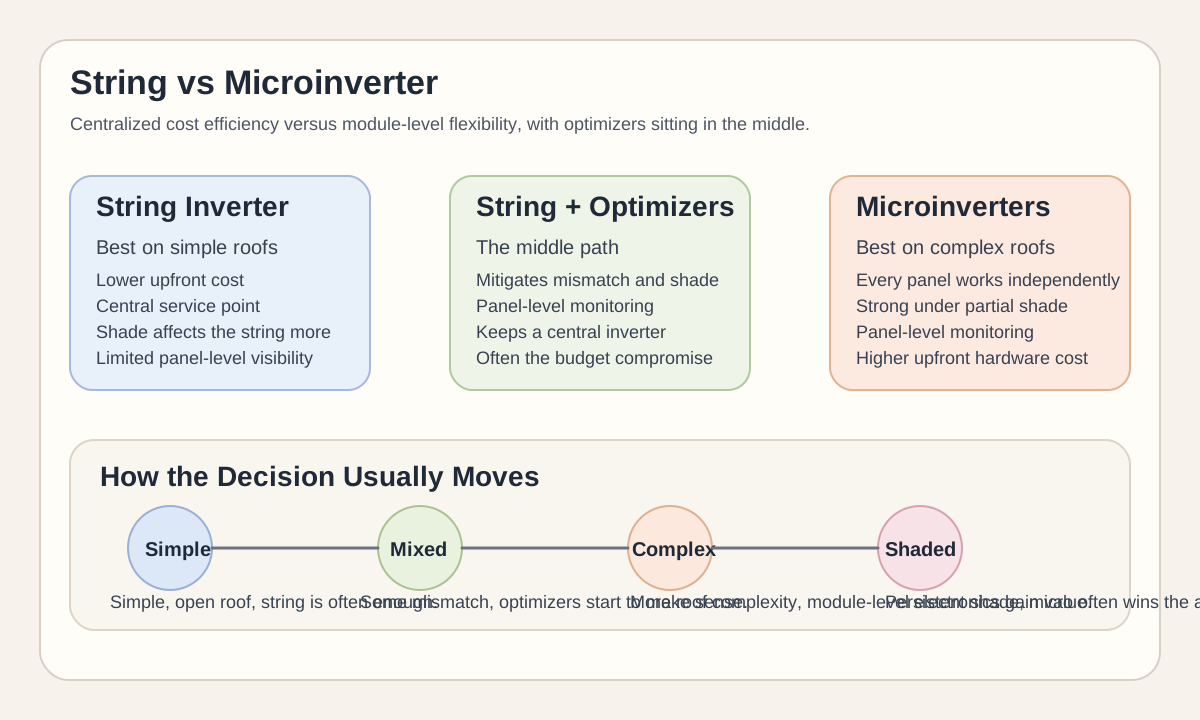
What Changes Between the Two Architectures
Section titled “What Changes Between the Two Architectures”The core difference is where the conversion happens.
With a string inverter, multiple panels are wired together and send DC power to one centralized inverter.
With microinverters, each panel has its own inverter and does the DC-to-AC conversion at the module.
That single architectural change reshapes almost everything else:
- how shade affects output
- how much monitoring detail you get
- how easy expansion is
- where failures show up
- how service work is done
String Inverters, the Centralized Baseline
Section titled “String Inverters, the Centralized Baseline”String inverters still dominate a lot of normal rooftop and larger-scale designs because the architecture is simple and cost-efficient.
They tend to make the most sense when:
- the roof is simple
- the panels share the same orientation
- shade is limited
- the project wants the lowest-cost inverter path
Enphase’s own comparison page still acknowledges that string inverters are easier on simple roofs and carry lower upfront equipment cost.
That matters, because many roofs really are simple enough that the extra complexity of module-level electronics is not needed.
Microinverters, the Distributed Option
Section titled “Microinverters, the Distributed Option”Microinverters move conversion and tracking down to each panel.
That changes the behavior of the system in ways that are easy to feel in the real world.
They are especially attractive when:
- the roof has multiple orientations
- one section gets seasonal or intermittent shade
- the owner wants panel-level monitoring
- future expansion is likely
Enphase highlights these exact strengths from the manufacturer side: every panel operates independently, monitoring is available for every panel, expansion is easier, and rapid shutdown is built in.
Cost, Where String Usually Starts Ahead
Section titled “Cost, Where String Usually Starts Ahead”At the buyer level, this is still the clearest pattern.
A standard string inverter system is usually the cheaper starting point.
That is not because string is always better.
It is because a single centralized inverter is usually less expensive than putting electronics under every module.
SMA’s string-versus-micro comparison makes the same broad economic case from the opposite side of the market: for larger systems and straightforward roofs, string systems usually produce the shorter payback path.
The important caveat is this:
lower upfront cost is not the same as lower lifetime cost.
If a roof is awkward enough that a string system leaves meaningful production on the table, the cheaper architecture can stop being the better deal.
Shading, Where the Real Debate Starts
Section titled “Shading, Where the Real Debate Starts”This is the section most buyers care about first, and for good reason.
With a string inverter, panel mismatch and shade can affect the whole string more easily.
Enphase describes this in plain terms: if one linked panel is obstructed, production from the string is dragged down toward the weakest panel.
With microinverters, each panel operates independently, so a shaded module mainly hurts itself rather than the rest of the array.
That is the real reason microinverters are so often recommended on roofs with chimneys, vents, trees, dormers, or multiple roof planes.
Microinverters Usually Gain More as Shade Gets Worse
Section titled “Microinverters Usually Gain More as Shade Gets Worse”The best clean technical evidence here is still NREL’s shading work.
In its 2012 shading testbed report, NREL compared identical 8 kW arrays using a string inverter and microinverters and weighted the results against annual shade assumptions. In that test, the microinverter setup improved production by about 3.7% under light shading, 7.8% under moderate shading, and 12.3% under heavy shading.
That does not mean every shaded roof gets exactly those gains.
It does mean the performance advantage of module-level electronics tends to widen as shading becomes more serious.
But Micro Does Not Automatically Crush Modern String Designs
Section titled “But Micro Does Not Automatically Crush Modern String Designs”This is where the simplistic version of the debate breaks down.
SMA’s comparison argues that a well-designed string inverter with strong shade-tracking logic can narrow the gap more than many buyers expect.
In SMA’s summary:
- under normal unshaded conditions, a correctly sized string system can slightly outperform a correctly sized micro system
- under light shade, the advantage of micro can be very small
- under heavier shade, the advantage grows, but it is still something you should weigh against cost
Their published figures put the micro advantage around roughly 1% in light shade and roughly 4% in heavier shade for the scenarios they summarize.
The fair conclusion is not that one source cancels the other out.
The fair conclusion is that shading performance is real, but it depends on how bad the roof actually is and how capable the string-side design really is.
Monitoring, Panel-Level vs System-Level Visibility
Section titled “Monitoring, Panel-Level vs System-Level Visibility”This is one of the easiest differences to understand.
Microinverters give you panel-level visibility much more naturally.
Enphase explicitly lists monitoring for every solar panel as a core strength. That makes diagnostics easier when one module is dirty, shaded, underperforming, or faulty.
A basic string inverter setup usually gives you system-level or string-level visibility instead.
That is often enough on a simple roof.
But if you want to know exactly which module is underperforming, microinverters have the cleaner answer.
Maintenance and Service, Centralized vs Distributed Headaches
Section titled “Maintenance and Service, Centralized vs Distributed Headaches”String and micro systems fail differently.
With a string inverter, the main inverter is a single point of failure. If it fails, the whole array can stop producing until it is repaired or replaced.
That sounds bad, but there is a service advantage too: the inverter is centralized and usually easier to access from the ground or near the electrical equipment.
Microinverters flip that trade-off.
If one microinverter fails, the rest of the array usually keeps running. But the failed unit is on the roof, under a panel, so diagnosis and replacement can involve more labor and roof access.
SMA makes this maintenance trade-off very directly in its comparison, while Enphase pushes the other side by emphasizing low failure rates, plug-and-play replacement, and a 25-year warranty.
So the right reading is:
- string systems concentrate risk
- micro systems distribute risk
Neither of those is automatically better without the context of the roof, installer access, and owner priorities.
Expansion, Where Microinverters Often Feel Easier
Section titled “Expansion, Where Microinverters Often Feel Easier”This is one of the most practical real-world advantages of microinverters.
Enphase emphasizes that expanding a microinverter system is modular. You can usually add new panels with their own microinverters without replacing a central inverter just to make room for them.
That matters for owners who may add:
- an EV later
- more electrified appliances
- extra panels after a renovation
String systems can also expand, but expansion is often less graceful because the central inverter and string design still have to make sense after the change.
The Middle Option, String Plus Power Optimizers
Section titled “The Middle Option, String Plus Power Optimizers”This is the part many comparisons leave out, even though it is often the real answer.
Power optimizers sit between pure string and pure micro architectures.
SolarEdge’s optimizer pages frame them as a way to mitigate shading, reduce mismatch loss, and add panel-level monitoring while keeping a string-based inverter architecture.
That makes optimizer systems attractive when:
- the roof has moderate shade
- panel-level visibility matters
- the budget does not justify full microinverters
- the project still wants a centralized inverter topology
So in practice, the real comparison is often not just string vs micro.
It is:
- plain string
- string plus optimizers
- microinverters
A Practical Decision Table
Section titled “A Practical Decision Table”| Roof or project condition | Best default fit | Why |
|---|---|---|
| Simple roof, little shade, cost-sensitive | String inverter | Lowest-cost architecture and often the cleanest design |
| Moderate shade or some roof complexity | String plus optimizers | Keeps a centralized inverter while improving module-level behavior |
| Multiple roof planes, recurring shade, high monitoring expectations | Microinverters | Independent panel operation and panel-level visibility |
| Future expansion likely | Microinverters or optimizer-based system | Easier modular growth than a tightly sized plain string setup |
| Large straightforward arrays | String inverter | Economics usually favor centralized conversion |
The Most Honest Conclusion
Section titled “The Most Honest Conclusion”If the roof is clean, open, and consistent, a string inverter is still usually the rational first choice.
If the roof is chopped up, partially shaded, or expected to grow later, microinverters become much more compelling.
If the answer sits in the middle, that usually means you should not force a fake binary. That is where power optimizers earn their place.
The wrong way to make this decision is to treat it like a brand war.
The right way is to ask what the roof is actually like, how much monitoring you really want, and whether the extra hardware earns its keep over time.
Related Guides in Focus Solar
Section titled “Related Guides in Focus Solar”- Inverters
- Hybrid Inverter Explained
- How to Read an Inverter Datasheet
- Inverter Sizing Guide
- Shading & Loss Analysis
Watch or Read More
Section titled “Watch or Read More”Key Takeaways
Section titled “Key Takeaways”- String inverters are usually the better starting point for simple, unshaded, cost-sensitive roofs.
- Microinverters usually gain their strongest advantage on roofs with meaningful shade, multiple orientations, or strong panel-level monitoring needs.
- Shade benefits are real, but the size of the gain depends on the actual roof and on how capable the string-side design is.
- A string inverter concentrates failure in one box, while microinverters spread failure risk across many rooftop devices.
- Power optimizers are often the practical middle option when plain string feels too basic and full micro feels too expensive.
Sources Used for This Page
Section titled “Sources Used for This Page”- Enphase, “Types of solar inverters: microinverters vs string inverters”
- SMA Sunny Blog, “String versus Micro – Which is the Right Choice?”
- NREL, “Photovoltaic Shading Testbed for Module-Level Power Electronics”
- SolarEdge, “Residential Power Optimizers”