Getting Started
On-Grid vs Off-Grid Systems
Compare on-grid and off-grid solar systems, including cost, battery needs, outage behavior, and which setup makes sense for your site.
Choosing between an on-grid and an off-grid solar system is one of the first big design decisions in any project. On paper, the distinction looks simple. One system connects to the utility grid, the other does not. In practice, the choice affects almost everything else, including upfront cost, battery requirements, outage behavior, maintenance, and how much freedom you have from the power company.
If you only remember one thing from this page, remember this. On-grid systems are usually the most economical option where the utility grid is stable. Off-grid systems are for places where the grid is unavailable, too expensive to extend, or too unreliable to trust.
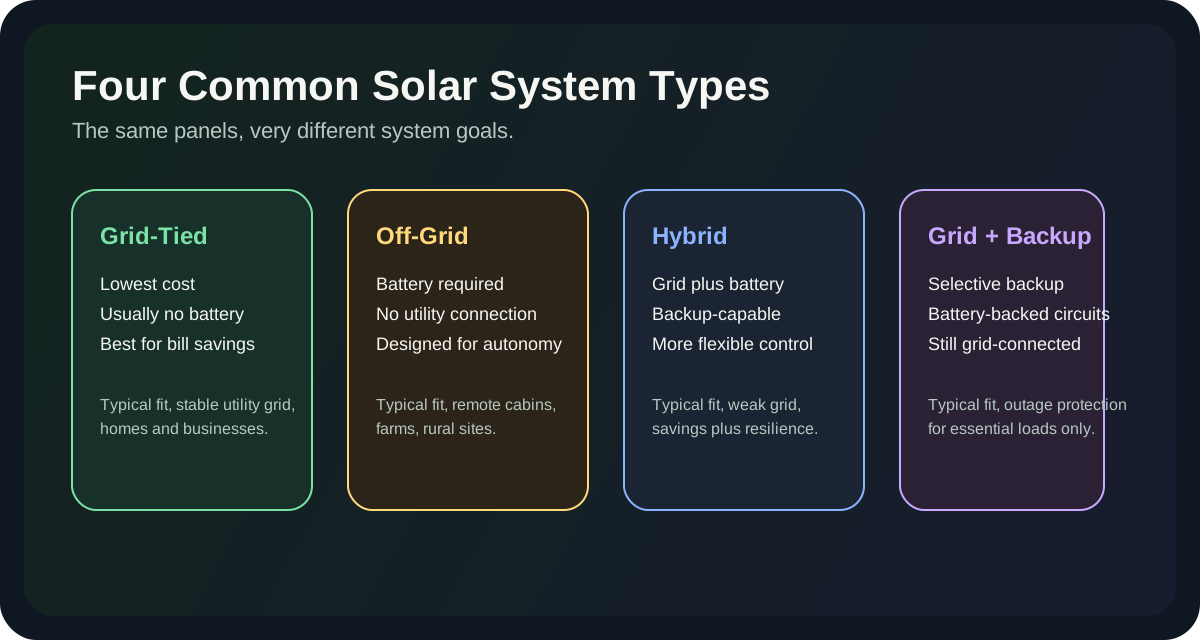
The Short Answer
Section titled “The Short Answer”Here is the quick comparison.
| Topic | On-grid solar | Off-grid solar |
|---|---|---|
| Connection to utility | Yes | No |
| Battery required | Usually no | Yes |
| Works during a grid outage | Usually no | Yes, if designed correctly |
| Upfront cost | Lower | Higher |
| Energy independence | Partial | Full |
| Best fit | Homes and businesses with stable grid access | Remote sites or locations with frequent outages |
That is the headline. The real decision comes down to how your site uses electricity and what problem you are trying to solve.
What an On-Grid System Is
Section titled “What an On-Grid System Is”An on-grid system, also called a grid-tied system, stays connected to the utility network. Solar panels generate DC electricity, an inverter converts it to AC, and the building uses that power first. If the solar system produces more than the building needs, the surplus can often be exported to the grid. If solar production is not enough, the building imports power from the grid as usual.
In most cases, an on-grid system includes these core components.
| Component | Role in the system |
|---|---|
| Solar panels | Generate DC electricity from sunlight |
| Grid-tied inverter | Converts DC power to grid-compatible AC power |
| Main distribution panel | Feeds solar power to loads in the building |
| Utility meter, often bidirectional | Measures imported and exported electricity |
This is why on-grid solar is so popular in cities and suburbs. You get the benefit of solar production without having to build a complete stand-alone power system.
Why On-Grid Systems Usually Cost Less
Section titled “Why On-Grid Systems Usually Cost Less”The biggest reason is simple. Most on-grid systems do not need a battery bank.
Batteries add major cost, extra design work, more equipment, and future replacement planning. Once you remove that layer, the system becomes easier and cheaper to install. Maintenance is also lower because there is no battery bank to monitor, protect, and eventually replace.
That lower cost is one reason on-grid systems often have a faster financial payback than off-grid systems, especially in places with stable utility service and favorable electricity prices.
What Net Metering Does
Section titled “What Net Metering Does”Many people hear that grid-tied solar lets you use the grid like a battery. That is not literally how it works, but it is a useful way to think about the economics.
With net metering, excess electricity exported to the grid earns bill credits under the rules set by the local utility or regulator. Later, when your solar production drops, such as at night or during cloudy weather, you draw electricity from the grid and those credits may offset part of your bill.
The details matter a lot. Some utilities offer near one-to-one crediting. Others pay less for exports than they charge for imports. Some have monthly true-up rules, annual settlement rules, export caps, or separate fixed charges. So the value of an on-grid system depends not only on sunlight, but also on local tariff design.
That is why two systems with the same hardware can produce very different savings in different markets.
Why On-Grid Solar Usually Turns Off During a Blackout
Section titled “Why On-Grid Solar Usually Turns Off During a Blackout”This is one of the most common misunderstandings in residential solar.
People assume that if the sun is shining, the house should still have power. But a standard grid-tied inverter usually shuts down during a utility outage. This is an anti-islanding safety requirement. The inverter must stop exporting power so it does not energize power lines while utility crews are working on them.
So yes, a plain on-grid system can reduce electricity bills very effectively, but it usually does not provide backup power.
If backup is important, the conversation usually shifts from on-grid versus off-grid to whether you actually need a Hybrid Inverter Explained setup or another grid-connected system with storage.
What an Off-Grid System Is
Section titled “What an Off-Grid System Is”An off-grid system operates independently of the utility grid. It has to generate, store, and manage all the electricity the site needs on its own.
That makes the component list longer.
| Component | Role in the system |
|---|---|
| Solar panels | Generate energy during daylight hours |
| Charge controller | Regulates charging current into the battery bank |
| Battery bank | Stores energy for nighttime and low-sun periods |
| Inverter | Converts stored DC power into AC for loads |
| Backup generator, often recommended | Supports the system during prolonged bad weather or heavy loads |
This is a very different design philosophy. An on-grid system is usually optimized for economics. An off-grid system is optimized for self-sufficiency and reliability without utility support.

Off-grid solar is often most valuable on remote cabins and rural sites. Photo by Hillebrand Steve, U.S. Fish and Wildlife Service, via Wikimedia Commons, public domain.

Why Batteries Change Everything
Section titled “Why Batteries Change Everything”In off-grid design, the battery bank is not a nice extra. It is part of the foundation.
The system has to cover nighttime use, cloudy weather, seasonal variation, and load spikes. That means battery sizing becomes one of the hardest and most important design tasks. Designers usually think in terms of daily consumption, usable depth of discharge, inverter surge needs, and autonomy days, meaning how many days the system can operate without significant solar input.
For many off-grid systems, designing for 2 to 3 days of autonomy is a common starting point, though the right number depends on climate, load criticality, and whether a generator is available.
If you want to go deeper on that part, see Battery Sizing and Charge Controllers.
Why Off-Grid Systems Cost More
Section titled “Why Off-Grid Systems Cost More”The reason is not just the battery itself, though that is a large part of it.
Off-grid systems usually need all of the following.
- A larger battery bank
- More protection and control hardware
- More careful sizing of loads and surge capacity
- Larger solar oversizing margins in some climates
- Often a backup generator for resilience
Many off-grid references estimate that batteries alone can represent roughly 30 to 40 percent of total system cost. In practice, a properly designed off-grid system can easily cost much more than a simple on-grid installation with the same solar array size.
That higher cost does not make off-grid a bad choice. It just means the value proposition is different. You are paying for independence and resilience, not only for a lower energy bill.
Where Off-Grid Makes Sense
Section titled “Where Off-Grid Makes Sense”Off-grid solar is often the right answer in places where extending the utility network is impractical or extremely expensive.
Typical examples include the following.
- Remote cabins
- Farms far from the nearest distribution line
- Telecom or monitoring equipment in isolated areas
- Sites with extremely unreliable grid service
- Small buildings where full utility connection costs more than a stand-alone system
In those cases, comparing off-grid solar to a normal city rooftop installation can be misleading. The real comparison may be off-grid solar versus diesel fuel, generator dependence, or the cost of bringing in new utility infrastructure.
The Real Trade-Offs
Section titled “The Real Trade-Offs”At a high level, on-grid and off-grid systems solve different problems.
| Decision factor | On-grid system | Off-grid system |
|---|---|---|
| Main goal | Reduce electricity cost | Operate independently from the grid |
| Lowest-cost path | Usually yes | Usually no |
| Backup during outage | No, unless paired with storage and backup hardware | Yes, if battery and inverter are sized correctly |
| Design complexity | Lower | Higher |
| Long-term maintenance | Lower | Higher because batteries require monitoring and replacement planning |
| Best environment | Stable utility service | No grid access or poor grid reliability |
This is the part people sometimes miss. Off-grid is not automatically better because it sounds more independent. If the grid at your site is stable and affordable, an off-grid system may be paying a large premium to solve a problem you do not actually have.
On the other hand, if your site loses power all the time or has no practical grid connection, an on-grid system may be the wrong tool from the start.
Which One Is Better for Homes
Section titled “Which One Is Better for Homes”For most homes in areas with a reliable grid, on-grid is the more practical answer. It is simpler, cheaper, and easier to justify financially. If the homeowner mainly wants lower bills, faster payback, and less system complexity, this is usually the path that makes sense.
But there is an important caveat. If the homeowner says backup power matters because outages are frequent, a standard grid-tied system may disappoint them. In that case, it is better to compare a pure on-grid system with a hybrid system rather than pretending that plain grid-tied solar solves resilience.
That is also why Types of Solar Systems is a helpful next read after this page.
Which One Is Better for Remote Sites
Section titled “Which One Is Better for Remote Sites”For remote cabins, agricultural loads, water pumping sites, and areas where utility extension costs are high, off-grid often becomes the logical option. Not because it is cheap, but because every alternative is also expensive or unreliable.
In that context, good off-grid design starts with load discipline.
- Reduce unnecessary consumption
- Separate essential and non-essential loads
- Match appliance choices to system size
- Plan battery reserve for bad-weather periods
- Decide early whether a generator is part of the strategy
This is where many projects succeed or fail. Off-grid systems reward careful planning and punish vague assumptions.
A Simple Way to Decide
Section titled “A Simple Way to Decide”If you are choosing between the two, these questions usually bring clarity quickly.
- Is there an existing utility connection at the site, and is it reasonably reliable
- If not, what would it cost to extend the grid there
- Do you mainly want lower energy bills, or do you need true energy independence
- How important is backup power during outages
- Are you willing to pay for batteries, replacement planning, and more complex system design
If your answers point toward lower bills and low complexity, on-grid usually wins.
If your answers point toward self-reliance, remote access, or poor utility service, off-grid becomes much easier to justify.
A Note on Hybrid Systems
Section titled “A Note on Hybrid Systems”Some projects sit right in the middle.
Maybe the site has a utility connection, but outages are frequent. Maybe the owner wants bill savings and backup power. Maybe export compensation is weak, so storing part of the solar energy on-site makes more sense.
That is where hybrid systems enter the picture. They combine solar, batteries, and a grid connection. If you find yourself wanting the low running cost of on-grid solar and the resilience of off-grid storage, you are probably not choosing between only two categories anymore.
Watch or Read More
Section titled “Watch or Read More”Key Takeaways
Section titled “Key Takeaways”- On-grid systems connect to the utility and are usually the lowest-cost way to use solar where grid service is stable.
- Off-grid systems require batteries and more careful system design because they must operate independently.
- Standard grid-tied systems usually shut down during blackouts for safety reasons.
- Net metering can make on-grid solar financially attractive, but the actual value depends on local utility policy.
- Off-grid systems make the most sense where the grid is unavailable, unreliable, or too expensive to extend.
Further Reading
Section titled “Further Reading”- How Solar Panels Work
- Types of Solar Systems
- Charge Controllers
- Hybrid Inverter Explained
- Battery Sizing
Sources Used for This Page
Section titled “Sources Used for This Page”This page was expanded using the research notes and source list provided for this project, especially the following references.
- On-Grid vs Off-Grid vs Hybrid Solar System
- On-Grid VS Off-Grid VS Hybrid Solar System
- Grid-Tie System and Net-Metering: EXPLAINED
- On Grid vs Off Grid Solar: What is the Difference
- EnergySage, Net Metering
- EcoFlow, What Is Net Metering in Solar Power
- Unbound Solar, Off-Grid Solar Pros and Cons
- Anern, Grid-Tied vs Off-Grid: A Complete Cost-Benefit Analysis
- AltE Store, Off-Grid Solar System Sizing Calculator