Pricing & ROI
Solar Payback Period
Learn how to calculate solar payback, what shortens or lengthens it, and why simple payback and real-world payback are not always the same.
“How long until solar pays for itself?” sounds like a simple question.
And at a basic level, it is.
But the honest answer gets more interesting the longer you look at it, because solar payback is not driven by one number. It changes with your system cost, local electricity rate, incentives, solar production, export policy, and even how fast utility prices rise over time.
That is why two homes with the same roof and the same panel count can still land years apart on payback.
This guide shows the basic formula first, then explains what actually moves the number in real projects, and why a “headline payback period” is useful only if you know the assumptions behind it.
The Core Formula
Section titled “The Core Formula”At the simplest level, solar payback means this:
the time it takes for cumulative savings to equal what you spent.
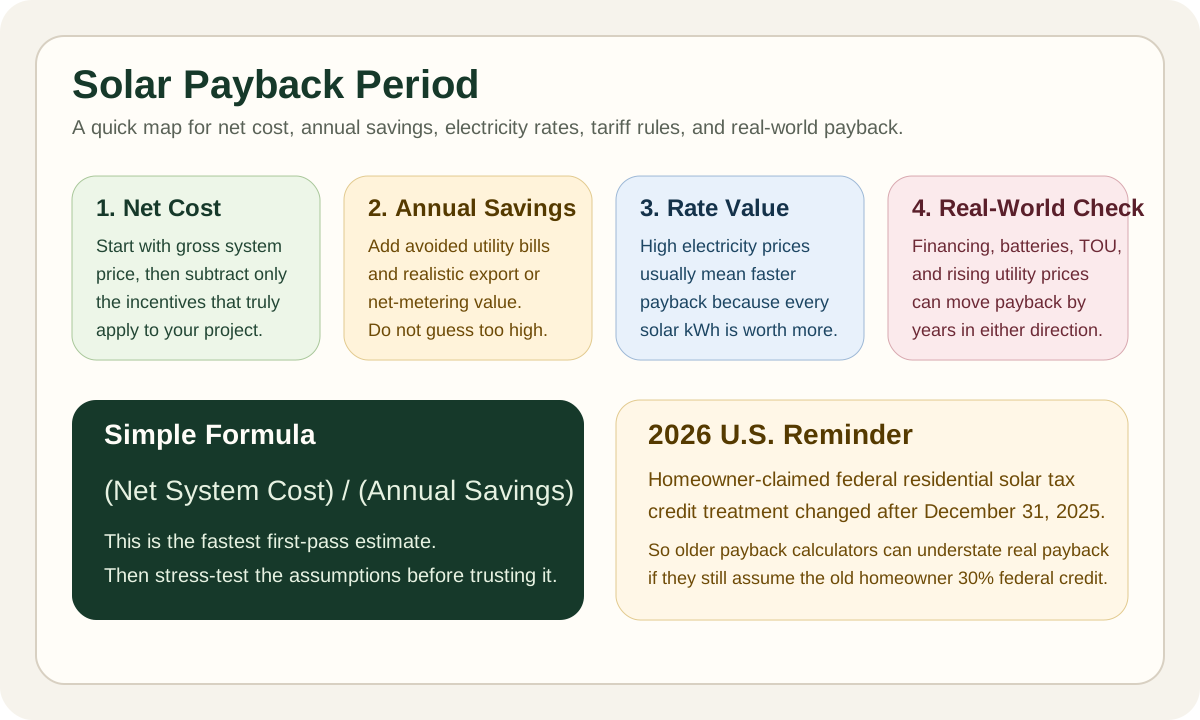
The cleanest simple-payback formula is:
(total system cost - incentives and rebates) / annual savings = payback periodGood Energy Solutions frames it as:
combined costs / annual benefits = solar panel payback periodThose are the same idea expressed in slightly different language.
The Three-Step Method
Section titled “The Three-Step Method”If you want the cleanest practical workflow, it looks like this.
-
Calculate your net system cost
Start with the gross installed price, then subtract any rebates, incentives, or tax credits that actually apply. -
Calculate your annual benefits
Add together your avoided electricity purchases and any export or net-metering value you realistically receive. -
Divide net cost by annual benefits
That gives you a simple payback estimate in years.
This is the fast version most consumer guides start with because it is intuitive and usually good enough for an initial screen.
A Simple Worked Example
Section titled “A Simple Worked Example”Palmetto gives one of the clearest numerical examples:
$17,000 installation cost- $5,000 incentives= $12,000 net costThen:
$12,000 / $1,200 annual savings = 10-year paybackThat is a clean example because it shows the logic without extra finance modeling.
Good Energy Solutions gives a second simple example:
$10,000 combined costs / $1,200 annual benefits = 8.3 yearsBoth examples show the same principle.
What Payback Period Actually Means
Section titled “What Payback Period Actually Means”Payback period is just the break-even point.
It is the moment when your cumulative solar savings catch up to your net investment cost. After that point, the system is no longer “paying itself back.” It is producing net financial benefit.
That distinction matters because simple payback is not the same thing as total value.
A system with a 10-year payback and 25+ years of useful life can still produce a very strong long-term return.
The Big Current U.S. Baseline
Section titled “The Big Current U.S. Baseline”EnergySage’s January 27, 2026 payback guide gives one of the strongest current U.S. reference points:
- the average EnergySage shopper breaks even in about
10 years - average savings over
25 yearsare about$61,093
That makes a good national orientation point, but it should not be treated as a personal forecast.
Some buyers break even in around 5 years.
Others take closer to 15.
The gap comes from the variables below.
The Five Variables That Matter Most
Section titled “The Five Variables That Matter Most”SolarReviews lays out a particularly useful five-factor framework for calculating a more accurate payback period.
1. Average electricity usage
Section titled “1. Average electricity usage”Your usage determines how large the system needs to be, and how much expensive grid electricity you can realistically offset.
2. Total system cost
Section titled “2. Total system cost”Higher install cost almost always means longer payback, unless it comes with meaningfully better production or tariff alignment.
3. Incentives and tax credits
Section titled “3. Incentives and tax credits”Anything that reduces net upfront cost shortens payback.
4. Energy production
Section titled “4. Energy production”The more electricity the system produces, the more potential bill value it can create, assuming the tariff supports that value.
5. Electricity price and rate inflation
Section titled “5. Electricity price and rate inflation”This is often the biggest practical driver.
If grid electricity is expensive, every kWh your system offsets is worth more money, which compresses payback sharply.
Electricity Price Is Often the Real Lever
Section titled “Electricity Price Is Often the Real Lever”If you want to know why payback varies so much, look at utility rates before anything else.
Solar.com’s city comparison makes this brutally clear.
Its current metro table shows:
- U.S. national average:
16.9¢/kWhand about9-10 years - New York City metro:
25.1¢/kWhand about7-8 years - San Francisco metro:
34.9¢/kWhand about4-5 years - San Diego metro:
47.5¢/kWhand about3-4 years
That is the same core technology, but very different avoided-cost economics.
State-Level Differences Are Huge
Section titled “State-Level Differences Are Huge”EnergySage’s state table shows how wide the spread can be even inside the United States.
Examples from its current table include:
- Alabama: about
14.4 years - California: about
7.54 years - Washington, D.C.: about
5.25 years
So even a national “10-year average” can be very misleading if you are trying to make a decision in one specific utility territory.
Simple Payback vs Real-World Payback
Section titled “Simple Payback vs Real-World Payback”This is where many articles stop too early.
Simple payback assumes annual savings stay flat.
Real life usually does not.
Utility rates often rise over time, which means future solar savings can be worth more than first-year savings. That usually shortens real-world payback versus the flat-savings version.
SolarReviews notes that U.S. electricity prices have increased by about 2.5% per year on average over the past 25 years, though the number varies by location. It also notes that some states have seen much faster increases than that.
That matters because a flat-savings payback estimate is often conservative if grid prices keep rising.
Why Export Policy Matters So Much
Section titled “Why Export Policy Matters So Much”Not every kWh of solar electricity is valued the same way.
In a strong net-metering environment, exported energy can be credited near the retail rate. That makes it much easier for a solar system to create full bill value.
In weaker export-credit or net-billing environments, excess solar may be credited at a much lower rate. That lengthens payback unless the system is carefully sized around daytime self-consumption or paired with storage and smart load shifting.
This is one reason why payback discussions that ignore tariff design can become misleading very quickly.
Batteries Usually Lengthen Simple Payback
Section titled “Batteries Usually Lengthen Simple Payback”Battery storage can absolutely improve resilience, self-consumption, and tariff optimization.
But for many homeowners, it also increases upfront cost more than it increases annual savings.
That usually means:
- solar-only systems pay back faster
- solar-plus-battery systems may have better resilience value
- payback alone is often the wrong way to judge a battery purchase
Energize Solar’s UK example captures that logic well. It uses:
£20,000 net cost / £1,500 annual savings = 13.3 yearsand also points out that battery storage changes the economics materially.
Financing Changes the Meaning of “Payback”
Section titled “Financing Changes the Meaning of “Payback””One of the most overlooked points in payback discussions is financing.
If you pay cash, the simple payback formula is relatively straightforward.
If you finance with a loan, the analysis becomes more layered because now you are balancing:
- loan payments
- dealer fees or interest
- tax treatment
- annual savings
EnergySage explicitly notes that how you pay for solar affects payback. A low-cash-outlay financing structure may improve affordability while stretching or complicating the break-even timeline.
That does not make financing bad. It just means the simple formula is no longer enough by itself.
The 2026 U.S. Incentive Reality
Section titled “The 2026 U.S. Incentive Reality”This point matters because older payback articles often assume the old homeowner federal tax credit is still available.
Solar.com’s January 14, 2026 tax-credit FAQ says the homeowner-claimed federal residential solar tax credit, 25D, was terminated on December 31, 2025.
That means:
- systems installed in 2025 could still qualify for the full
30% - systems installed after December 31, 2025 do not qualify for a federal residential solar tax credit claimed directly by the homeowner
So if a 2026 payback calculator still assumes a homeowner 30% federal credit without checking ownership structure, it may understate the real payback period.
Tesla’s current payback page reflects this shift clearly. Its 2026 state payback table says the averages shown exclude the expired federal residential solar tax credit.
A Better Way to Estimate Your Own Payback
Section titled “A Better Way to Estimate Your Own Payback”If you want a practical consumer workflow, use this order.
- Get the gross installed price
- Subtract only the incentives that actually apply to your ownership structure and install date
- Estimate first-year annual savings using your real electricity rate and realistic production
- Check whether export credits are full retail, partial retail, or avoided-cost style
- Decide whether you want a flat-savings payback or a rising-utility-cost model
- If financing is involved, model cash flow separately from simple payback
That gives you a much more decision-ready number.
What Counts as a “Good” Payback Period?
Section titled “What Counts as a “Good” Payback Period?”There is no universal answer, but current market guides create a few useful ranges.
In the U.S.:
- Solar.com frames a typical residential payback period around
7-10 years - EnergySage’s average shopper benchmark is about
10 years - SolarReviews says the U.S. range can run from
5to15 yearsdepending on location
Those are all compatible once you realize they are describing different assumptions and different customer cohorts.
Why Payback Is Useful, But Incomplete
Section titled “Why Payback Is Useful, But Incomplete”Payback period is a great first filter because it is intuitive.
But it ignores some things that matter:
- savings after break-even
- panel degradation
- financing costs
- time value of money
- resale value
- battery resilience value
That is why payback is a strong opening metric, but not a complete investment analysis.
If you want the fuller picture, pair this page with Solar ROI Analysis.
Common Mistakes Buyers Make
Section titled “Common Mistakes Buyers Make”- Using gross cost instead of net cost
- Assuming outdated incentives still apply
- Ignoring export-credit rules and time-of-use structure
- Treating battery storage like a pure bill-savings upgrade
- Forgetting that electricity prices may rise over time
- Comparing payback periods without checking whether the systems are cash-purchase, financed, or leased
A Good Default Comparison Framework
Section titled “A Good Default Comparison Framework”Most solar quotes become much easier to compare when you use this order.
- Confirm the real net upfront cost
- Confirm first-year annual savings
- Check whether the savings model assumes flat or rising utility prices
- Check whether export compensation is strong or weak
- Separate solar-only from solar-plus-battery payback
- Treat ROI as the next step after payback, not the same thing
That keeps you from comparing numbers that were built on totally different assumptions.
Related Guides in Focus Solar
Section titled “Related Guides in Focus Solar”- Solar ROI Analysis
- Solar System Cost Guide
- 5kW Solar System Cost
- 10kW Solar System Cost
- How to Choose a Solar System
Watch or Read More
Section titled “Watch or Read More”Key Takeaways
Section titled “Key Takeaways”- The simplest payback formula is:
(net system cost) / (annual savings). - EnergySage’s current U.S. benchmark says the average shopper breaks even in about
10 yearsand saves about$61,093over25 years. - Electricity price is often the biggest single practical driver of payback, which is why expensive markets such as San Diego and San Francisco can break even far faster.
- Battery storage often lengthens simple payback even when it improves resilience and self-consumption.
- In the U.S., homeowner-claimed federal residential solar tax-credit treatment changed after December 31, 2025, so 2026 payback math should not blindly assume the old
30%homeowner credit.
Sources Used for This Page
Section titled “Sources Used for This Page”This page was expanded using current payback references and direct verification of the most time-sensitive assumptions, especially the following sources.
- EnergySage, Solar Payback Period Guide
- Solar.com, Average Payback Period for Solar Panels
- Solar.com, Frequently Asked Questions About the Solar Tax Credit
- Good Energy Solutions, How to Calculate Your Solar Panel Payback Period
- Palmetto, Solar Panel Payback Period Guide
- SolarReviews, How to Calculate Your Solar Payback Period
- Energize Solar, Calculating the Solar Payback Period for Solar Systems
- Tesla, Solar Panel Payback Period