Components
Inverter Sizing Guide
Learn how to size a solar inverter by matching array size, DC-to-AC ratio, clipping tolerance, and backup-load requirements.
Inverter sizing sounds like a wattage question, but it is really a matching problem.
You are matching the inverter against the solar array on the DC side, the home or site on the AC side, and the project goals in the middle.
That is why the right inverter is not always the one that matches the panel wattage one-for-one. In many real systems, a slightly smaller inverter is deliberate because it improves economics while still capturing most of the annual production.
This guide explains the sizing logic that matters most at the component-selection level: DC-to-AC ratio, clipping, common real-world pairings, and the extra checks you should make when batteries or backup loads are involved.
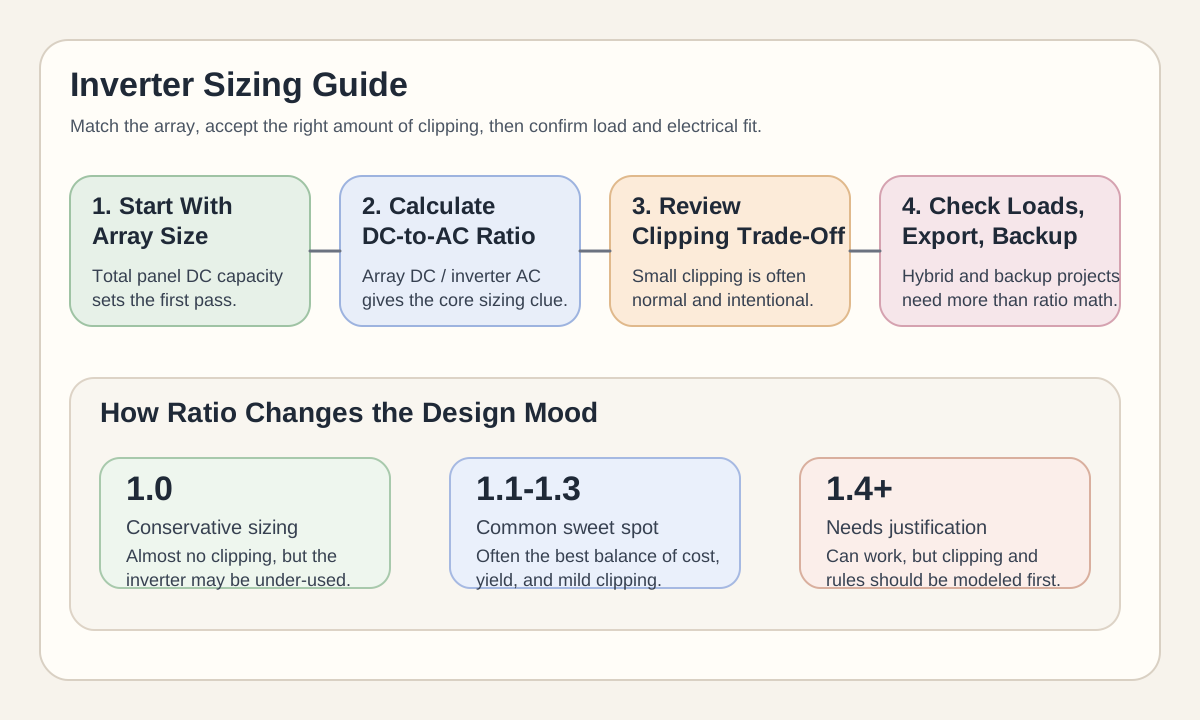
What Inverter Sizing Actually Means
Section titled “What Inverter Sizing Actually Means”At a practical level, inverter sizing has two jobs.
The first is to make sure the inverter can handle the solar array sensibly.
The second is to make sure the inverter can deliver the AC output the project actually needs.
For a simple grid-tied system, the array-to-inverter match usually dominates the decision. For a hybrid or off-grid system, backup loads, surge power, and battery behavior matter much more.
That is why the same 5 kW inverter can be a perfectly rational choice in one project and a bad fit in another.
The Core Formula: DC-to-AC Ratio
Section titled “The Core Formula: DC-to-AC Ratio”The key sizing metric is the ratio between total panel DC capacity and inverter AC rating.
DC-to-AC ratio = array DC capacity (kW) / inverter AC rating (kW)A simple example:
12 kW DC array / 10 kW AC inverter = 1.2That 1.2 ratio tells you the array is modestly oversized relative to the inverter.
This is common and often intentional.
Why the Inverter Is Often Slightly Smaller Than the Array
Section titled “Why the Inverter Is Often Slightly Smaller Than the Array”Panels do not sit at nameplate output all day.
Real systems spend much of the year below STC power because of:
- temperature losses
- sun angle
- haze or cloud
- soiling
- wiring and conversion losses
That is why a slightly smaller inverter can still capture most of the useful annual energy.
HelioScope’s guidance is a good shorthand here: a healthy design often lands around 1.25. EnergySage and similar residential references also point to a common design range around 1.15 to 1.25, with some systems stretching a bit higher when the site conditions justify it.
The Common Sweet Spot
Section titled “The Common Sweet Spot”For ordinary residential grid-tied systems, a DC-to-AC ratio around 1.1 to 1.3 is the range most people should understand first.
That range is popular because it usually balances three things well:
- inverter cost
- annual energy harvest
- acceptable clipping
Common examples include:
5 kWof panels with a roughly4.3-5 kWinverter6.6 kWof panels with a5 kWinverter12 kWof panels with a10 kWinverter
Those are not universal rules, but they are normal enough that seeing them in a quote should not be treated as suspicious by default.
Clipping Is the Trade-Off Everyone Notices
Section titled “Clipping Is the Trade-Off Everyone Notices”Clipping happens when the array could deliver more DC power than the inverter can convert to AC at that moment.
The inverter does not break.
It simply limits output at its rated ceiling.
That can sound wasteful, but a small amount of clipping is often a rational trade. If the inverter costs less and still captures most of the annual production, the project can still come out ahead overall.
Aurora Solar’s well-known simulation of a 100 kW system shows the logic clearly:
DC-to-AC ratio | Annual AC generation | Clipping loss | Reading |
|---|---|---|---|
1.0 | 163.06 MWh | 0% | Conservative sizing |
1.3 | 193.86 MWh | About 0.9% | Strong practical balance |
1.5 | 217.24 MWh | About 4.8% | More yield, but clipping is clearly visible |
The takeaway is not that 1.3 is always right.
The takeaway is that some clipping can be economically smart, while excessive clipping should be modeled and justified rather than assumed away.
When a Higher Ratio Makes Sense
Section titled “When a Higher Ratio Makes Sense”A somewhat higher ratio can make sense when the array rarely hits a perfect midday peak anyway.
Typical examples include:
- east-west roofs
- mixed orientations
- mild climates with lower peak irradiance
- projects where keeping inverter cost down matters more than chasing zero clipping
In those cases, the extra panel capacity can boost shoulder-hour production without creating severe clipping.
When a Higher Ratio Becomes a Red Flag
Section titled “When a Higher Ratio Becomes a Red Flag”This is where sizing stops being a rule of thumb and turns into a design judgment.
Be more cautious when:
- the site has very strong solar resource and little shade
- export limits already constrain output
- the ratio pushes well beyond the usual residential band
- the installer cannot show a production model
- the design ignores the inverter’s
MPPTand voltage limits
A high ratio is only smart if the electrical limits, tariff rules, and annual production model still support it.
Array Matching Is Not the Same as Load Matching
Section titled “Array Matching Is Not the Same as Load Matching”This is where many buyers get confused.
For grid-tied systems, inverter sizing is usually led by the array and export rules.
For hybrid and off-grid systems, the inverter must also support what the site wants to run.
That means you still need to check:
- continuous power
- startup surge
- backup-load panel size
- battery discharge limits
So a 5 kW inverter may be fine for a 6.6 kW array in a normal grid-tied home, but a bad fit if the same project expects that inverter to start pumps, air conditioning, or workshop motors during outages.
A Simple Load-Led Check for Hybrid or Backup Systems
Section titled “A Simple Load-Led Check for Hybrid or Backup Systems”If backup is part of the project, use the load side as a second filter.
Minimum inverter rating = peak simultaneous load x safety marginA practical starting margin is often 1.25.
Example:
Peak simultaneous load = 4.8 kWMinimum target inverter size = 4.8 x 1.25 = 6 kWThat does not replace DC-to-AC sizing.
It sits alongside it.
Do Not Skip the Electrical Fit
Section titled “Do Not Skip the Electrical Fit”A ratio can look fine and still be electrically wrong.
Before signing off an inverter size, you still need to verify the core datasheet limits:
- maximum
DCinput voltage MPPTvoltage range- start-up voltage
- maximum input current
- number of
MPPTtrackers
This matters because the string Vmp needs to live inside the inverter’s MPPT window, and cold-weather Voc still has to stay below the hard DC voltage ceiling.
If those checks fail, the inverter is not correctly sized even if the wattage pairing looked sensible on the quote.
A Good Buyer-Level Sizing Checklist
Section titled “A Good Buyer-Level Sizing Checklist”Use this order and most proposals become easier to judge.
- Start with total panel
DCsize. - Divide by the inverter
ACrating to get theDC-to-ACratio. - Decide whether the ratio looks conservative, normal, or aggressive for the site.
- Check whether clipping has been modeled rather than hand-waved.
- If batteries or backup matter, compare the inverter output against real simultaneous loads and surge demand.
- Verify
MPPT, voltage, and current limits in the datasheet. - Check export rules and future battery plans before locking the model.
That is usually enough to separate a normal design choice from a lazy or mismatched one.
Related Guides in Focus Solar
Section titled “Related Guides in Focus Solar”- Inverters
- How to Read an Inverter Datasheet
- Hybrid Inverter Explained
- How to Choose an Inverter
- Inverter Sizing
Watch or Read More
Section titled “Watch or Read More”Key Takeaways
Section titled “Key Takeaways”- Inverter sizing starts with
DC-to-ACratio, not a rigid one-to-one watt match. - A ratio around
1.1to1.3is a common residential starting band because it often balances cost and annual production well. - Mild clipping is often acceptable if the overall economics improve.
- Backup and hybrid projects need load and surge checks in addition to array matching.
- A sensible ratio still needs to pass the inverter datasheet checks for voltage, current, and
MPPTcompatibility.
Sources Used for This Page
Section titled “Sources Used for This Page”- Aurora Solar, “Choosing the Right Size Inverter for Your Solar Design: A Primer on Inverter Clipping”
- HelioScope Help Center, “Understanding DC/AC Ratio”
- EnergySage, “How Does Sizing a Solar Inverter Work?”
- Afore Energy, “Understanding Solar Inverter DC/AC Ratio”
- RatedPower, “DC/AC ratio: How to choose the right size solar inverter?”