Components
550W vs 600W Panels
Compare 550W and 600W solar panels on output, physical size, current and voltage compatibility, roof fit, and real cost-per-watt trade-offs.
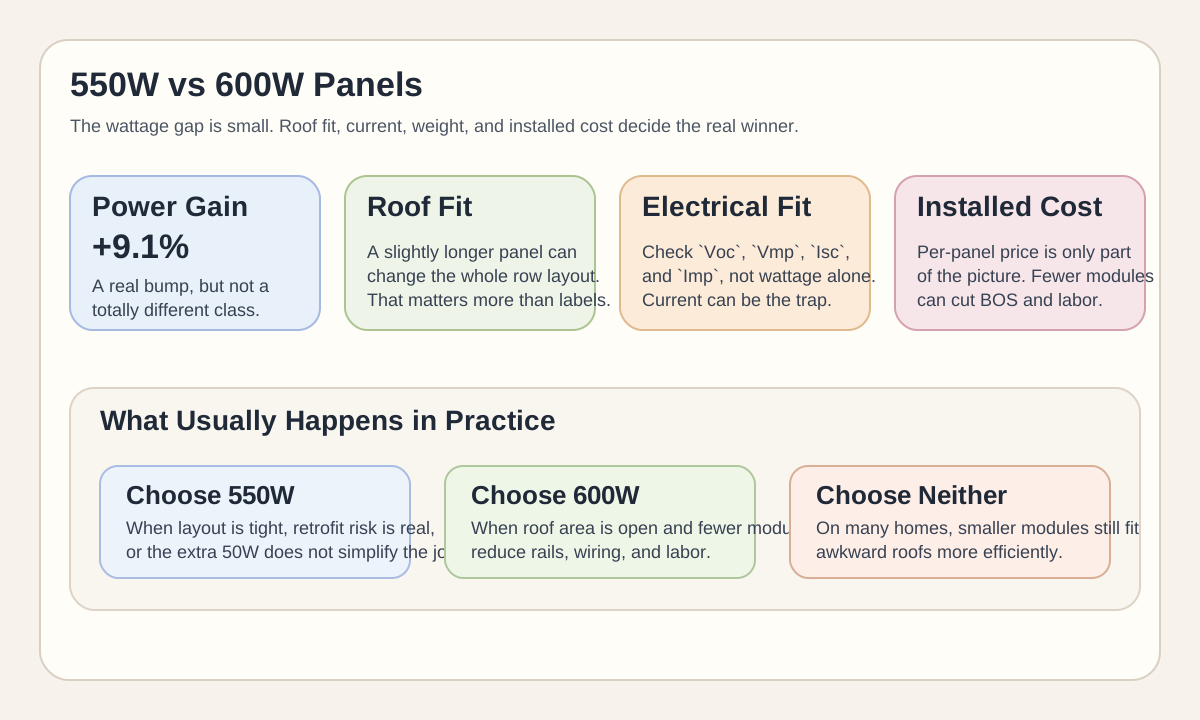
The jump from 550W to 600W sounds bigger than it usually is.
On paper, it is only a 50W difference per panel, which works out to about 9.1% more nameplate power.
That can matter.
But whether it matters enough to change the system decision depends on three other things just as much:
- whether the higher-wattage panel still fits the roof cleanly
- whether the inverter and string design can accept the electrical characteristics
- whether the extra power comes at a meaningful premium in
$/Wor installation complexity
That is why this is not really a wattage question alone.
It is a roof-fit and system-fit question.
The Headline Difference Is Only 9.1%
Section titled “The Headline Difference Is Only 9.1%”The first number is simple:
(600 - 550) / 550 = 9.1%That means one 600W panel gives about 9.1% more nameplate output than one 550W panel.
At system level, the math looks like this:
10panels at550W=5.5 kW10panels at600W=6.0 kW
That is real, but it is not revolutionary.
The more interesting question is what that 0.5 kW gain costs you in panel size, weight, electrical fit, and layout flexibility.
More Power Per Panel Can Reduce Module Count
Section titled “More Power Per Panel Can Reduce Module Count”This is the main argument for higher-wattage modules.
If the roof is open and regular, higher wattage can reduce the number of panels needed for the same target system size.
For example:
- a
6.0 kWtarget needs about11panels at550W - the same target needs
10panels at600W
That can reduce:
- module count
- clamps and rails
- wiring length
- labor time
On bigger roofs, that is where 600W panels start to earn their keep.
But 600W Does Not Automatically Mean a Better Roof Layout
Section titled “But 600W Does Not Automatically Mean a Better Roof Layout”This is where buyers get tripped up.
Maysun’s roof-compatibility guide makes the right practical point:
roof layout often matters more than the nominal wattage jump.
If a slightly longer module causes you to lose an entire row, the higher wattage can backfire. A panel that is better on paper can produce a worse roof layout in real life.
That is why a lower-wattage panel can still be the better system choice if it uses the available roof geometry more efficiently.
Size and Weight, the Hidden Trade-Off
Section titled “Size and Weight, the Hidden Trade-Off”There is no single universal size for all 550W or all 600W panels.
That part matters.
Different manufacturers reach the wattage in different ways, using different cell counts, glass constructions, and module technologies.
Still, the broad pattern is consistent:
550Wmodules are often in the large-format commercial range already600Wmodules are often similar or slightly larger, and usually heavier
Canadian Solar’s 550W HiKu6 CS6W-MS example shows:
- dimensions of
2278 x 1134 x 30 mm - weight of
27.6 kg
Canadian Solar’s 600W TOPBiHiKu6 CS6.2-66TB-600H example shows:
- dimensions of
2382 x 1134 x 40 mm - weight of
33.4 kg
Maysun’s broader market guide for Europe also points to a common 600W size around 2278 x 1134 x 30 mm, which is a useful reminder that not every 600W panel grows by the same amount.
So the honest conclusion is this:
some 600W panels are only a modest step up in physical size, while others are meaningfully bigger and heavier.
You have to check the actual datasheet, not just the wattage class.
Why This Matters More on Residential Roofs
Section titled “Why This Matters More on Residential Roofs”Large-format modules can be a very clean fit on:
- open commercial roofs
- simple industrial roofs
- large ground-mount arrays
They become harder to love on:
- chopped-up residential roofs
- roofs with dormers or chimneys
- narrow roof sections
- sites where handling space is tight
That is why a 550W panel is not automatically the home-friendly option either. Both 550W and 600W are already fairly large by residential standards.
In many homes, the real comparison is not 550W vs 600W.
It is whether either of them actually fits the roof better than a smaller, more flexible module class.
Electrical Compatibility, Where People Make the Expensive Mistake
Section titled “Electrical Compatibility, Where People Make the Expensive Mistake”The physical fit is only half the story.
The electrical side still has to make sense with the inverter and string design.
This is where the comparison gets more subtle than many buyers expect.
Higher wattage does not always show up as much higher voltage.
Sometimes it shows up more clearly as higher current.
That matters because older inverters and string designs may run into current limits before voltage looks dramatic.
A Real Datasheet Example
Section titled “A Real Datasheet Example”Using the Canadian Solar examples above:
550W CS6W-550MS
Vmp41.7 VVoc49.6 VImp13.20 AIsc14.00 A
600W CS6.2-66TB-600H
Vmp40.4 VVoc47.6 VImp14.86 AIsc15.85 A
That is a good reminder that moving from 550W to 600W does not always mean the string voltage rises sharply.
In this example, the current rises more noticeably than the voltage.
So if someone upgrades panel wattage without checking:
- maximum string voltage
MPPToperating window- maximum input current per tracker
- total current on parallel strings
they can still end up with an inverter mismatch.
String Design Still Has to Be Recalculated
Section titled “String Design Still Has to Be Recalculated”A wattage change is not a cosmetic change.
It changes the string math.
That means you still need to recalculate:
- cold-weather
Voc - working
Vmp - string count per
MPPT - current per input
Even if the wattage difference looks small, the electrical consequences can be enough to break an otherwise valid design.
Cost Per Watt, Usually Closer Than Buyers Expect
Section titled “Cost Per Watt, Usually Closer Than Buyers Expect”This is the part that usually surprises people.
In many market guides, 550W and 600W modules sit in very similar $/W territory.
Neexgent’s price-vs-wattage summary makes the broader point well:
what matters more than sticker price is the relationship between wattage, efficiency, installed system cost, and lifetime output.
Tongwei’s discussion lands in a similar place:
higher wattage can reduce installation hardware and labor, but only if the roof, mounting, and long-term performance still make sense.
That means a 600W panel can win even if the per-panel price is higher, because fewer modules may reduce:
- racking quantity
- wiring
- labor hours
- fixed balance-of-system cost
But if the larger module creates layout waste or complicates installation, the economic advantage can disappear quickly.
Efficiency and Technology Matter More Than the Label Alone
Section titled “Efficiency and Technology Matter More Than the Label Alone”One of the traps in this comparison is assuming that wattage tells you everything important.
It does not.
A higher-wattage panel may come with:
- newer cell technology
- better efficiency
- better temperature coefficient
- lower long-term degradation
Or it may simply be a larger panel.
Those are not the same thing.
That is why the better comparison is:
$/W- module efficiency
- temperature coefficient
- degradation warranty
- physical footprint
- inverter compatibility
not just 550 versus 600 as if wattage were the whole story.
A Practical Decision Table
Section titled “A Practical Decision Table”| Situation | Usually better fit | Why |
|---|---|---|
| Large open roof, simple layout | 600W | Fewer modules can reduce hardware and labor |
| Roof where every row length is tight | 550W or smaller | Slight layout differences can decide total system size |
| Retrofit onto an existing inverter | Often 550W or careful re-check | Current and string compatibility still need to be recalculated |
| Buyer focused only on per-panel output | Neither by default | Installed $/W and roof fit matter more |
| Commercial or industrial roof with handling space | 600W often makes more sense | Large-format modules are easier to justify at scale |
| Chopped-up home roof | Often neither is ideal | Smaller modules may use the roof more efficiently |
The Most Useful Way to Make the Choice
Section titled “The Most Useful Way to Make the Choice”If roof space is open and simple, 600W panels are attractive because they reduce module count and push more power through each installed unit.
If the roof is irregular, tight, or retrofit-constrained, 550W panels can be easier to integrate, and smaller panels may be better still.
That is the real answer.
Not:
which wattage is bigger?
But:
which module lets this exact roof and inverter produce the most sensible system?
Related Guides in Focus Solar
Section titled “Related Guides in Focus Solar”- Solar Panels
- How to Read a Panel Datasheet
- Panel Efficiency Explained
- Panel Degradation Rate
- How to Read an Inverter Datasheet
Watch or Read More
Section titled “Watch or Read More”Key Takeaways
Section titled “Key Takeaways”600Wpanels only add about9.1%more nameplate output than550Wpanels.- That extra output can reduce module count on large open roofs, but it does not automatically create a better overall system.
- Physical dimensions and weight vary by manufacturer, so you have to compare real datasheets rather than wattage labels.
- A move from
550Wto600Wcan change current and string compatibility enough to require a full inverter re-check. - Installed
$/W, roof fit, efficiency, and warranty usually matter more than the raw wattage jump by itself.
Sources Used for This Page
Section titled “Sources Used for This Page”- Canadian Solar,
HiKu6 CS6W-MS 535-560Wmodule datasheet - Canadian Solar,
TOPBiHiKu6 CS6.2-66TB-H 600-630Wmodule datasheet - Maysun Solar,
How to Choose Between 410W, 450W, 500W and 600W Solar Panels - Tongwei,
Are higher wattage solar panels better - Neexgent,
Wattage vs. Price: What Really Matters When Choosing Solar Panels?