System Design
Inverter Sizing
Learn how to size a solar inverter using DC-to-AC ratio, clipping trade-offs, load and surge requirements, and MPPT voltage-window checks.
Inverter sizing is where solar design stops being a simple equipment list and turns into an engineering trade-off.
Choose an inverter that is too large and the system may cost more than necessary while operating below its sweet spot much of the time. Choose one that is too small and you can create avoidable clipping, fail to support surge loads, or run into electrical limits on the DC side.
The goal is not to eliminate every watt of clipping or to match panel watts one-for-one. The goal is to choose an inverter that fits the array, the load profile, the roof layout, and the future expansion plan.
This guide explains the sizing logic that matters most in real projects, especially DC/AC ratio, clipping behavior, off-grid load sizing, and MPPT voltage-window checks.
The Core Metric, DC/AC Ratio
Section titled “The Core Metric, DC/AC Ratio”For grid-tied solar, the main sizing ratio is the total DC panel capacity divided by the inverter’s rated AC output.
DC/AC ratio = total panel capacity (kWp) / inverter AC rating (kW)A simple example:
6 kWp array / 5 kW inverter = 1.2 DC/AC ratioThat is a very common configuration.
Why this matters:
- Panels do not produce nameplate power all day
- A slightly smaller inverter often captures most annual energy at lower cost
- Some level of clipping can be economically acceptable
In practice, many real systems land somewhere around 1.13 to 1.30, with the most common design sweet spot often falling near 1.15 to 1.25 depending on climate, orientation, and local design constraints.
Why a 1:1 Match Is Not Always Best
Section titled “Why a 1:1 Match Is Not Always Best”Newer solar buyers often assume a 6 kW array must use a 6 kW inverter.
That sounds intuitive, but it is not usually the most practical design.
A panel array reaches full nameplate output only under specific conditions. For much of the year, production sits below that peak because of temperature, irradiance, angle of incidence, soiling, and other real-world losses.
That is why a slightly undersized inverter can still convert the great majority of annual solar production while improving project economics.
Clipping, the Trade-Off Everyone Notices First
Section titled “Clipping, the Trade-Off Everyone Notices First”Clipping happens when the array could deliver more DC power than the inverter is able to convert to AC at that moment.
The output curve gets flattened at the inverter limit.
At first glance, that sounds like wasted energy, and sometimes it is. But clipping is usually a trade-off, not automatically a mistake.
If a smaller inverter costs less and still captures most of the useful annual production, the project may be better off even if a small amount of midday power is clipped on bright days.
What Different DC/AC Ratios Tend to Mean
Section titled “What Different DC/AC Ratios Tend to Mean”The pattern below reflects the broad trade-off seen in practical modeling.
DC/AC ratio | Typical effect | Main risk |
|---|---|---|
Around 1.0 | Very little or no clipping | Inverter may be under-utilized for much of the year |
Around 1.15 to 1.30 | Often the practical sweet spot | Mild clipping during strong production hours |
Around 1.4 or above | Higher energy harvest in shoulders of the day | Clipping becomes more visible and must be justified carefully |
One well-known Aurora Solar simulation of a 100 kW system showed this clearly:
DC/AC ratio | Annual generation | Clipping loss | Interpretation |
|---|---|---|---|
1.0 | 163.06 MWh | 0% | Clean but conservative sizing |
1.3 | 193.86 MWh | About 0.9% | Strong practical balance |
1.5 | 217.24 MWh | About 4.8% | Extra yield comes with clearly visible clipping |
The key lesson is not that one number is always right.
The lesson is that some clipping can be acceptable if the extra early and late energy from a larger array more than offsets the clipped midday peaks.
Climate and Roof Conditions Change the Best Ratio
Section titled “Climate and Roof Conditions Change the Best Ratio”The best DC/AC ratio is not fixed forever.
A sunnier site with strong irradiance may show noticeable clipping earlier, sometimes once the ratio moves much beyond roughly 1.25.
A weaker-sun site, mixed-orientation roof, or partially shaded array may tolerate a somewhat higher ratio before clipping becomes meaningful.
That is why good inverter sizing should be site-aware.
The ratio that makes sense on a hot, clear, south-facing roof may not be the ratio that makes sense on an east-west or intermittently shaded one.
Off-Grid and Hybrid Systems Need a Second Sizing Lens
Section titled “Off-Grid and Hybrid Systems Need a Second Sizing Lens”For off-grid and hybrid systems, panel capacity is only half the story.
You also have to size the inverter around the loads it must support.
That means checking:
- Continuous power, the total wattage of loads that may run at the same time
- Surge power, the short startup demand from motors, pumps, compressors, and similar equipment
- Safety margin, often a practical multiplier on top of the simultaneous load estimate
Basic load-led formula
Section titled “Basic load-led formula”Minimum inverter rating = peak simultaneous load x safety factorA common planning factor is 1.25.
Example:
Peak load = 7.2 kWMinimum inverter size = 7.2 x 1.25 = 9 kWThat is why off-grid inverter sizing can look very different from simple grid-tied inverter sizing. The inverter may be driven more by load behavior and surge demand than by the solar array itself.
Continuous Power vs Surge Power
Section titled “Continuous Power vs Surge Power”This distinction matters a lot for cabins, farms, pumps, workshops, and backup systems.
Some appliances draw much more power at startup than they do once they are running.
Typical examples:
- Water pumps
- Refrigeration compressors
- Air conditioners
- Power tools
- Workshop motors
If the inverter’s surge capability is too low, the system may trip or fail to start equipment even when the continuous wattage appears acceptable on paper.
That is why the inverter data sheet should be checked for both continuous kW and surge capability, not just headline power.
MPPT Voltage Window, the Electrical Check That Cannot Be Skipped
Section titled “MPPT Voltage Window, the Electrical Check That Cannot Be Skipped”After rough sizing, the design still has to fit the inverter’s electrical input window.
This is where MPPT checks come in.
You need to verify three things:
- The string working voltage,
Vmpp, sits inside the inverter’sMPPToperating range - The cold-weather open-circuit voltage,
Voc, never exceeds the inverter’s maximumDCinput voltage - The number of
MPPTtrackers matches the roof layout if the array has different orientations or tilt groups
If those checks fail, the inverter may be a bad fit even if the DC/AC ratio looked reasonable.
A practical way to think about it
Section titled “A practical way to think about it”Vmpptells you whether the inverter can track the string efficiently during operationVocprotects against over-voltage risk in cold conditions- Multiple
MPPTinputs allow different roof sections to behave independently
This is especially important on split roofs, east-west designs, or projects with unequal string lengths.
Why More MPPT Inputs Can Matter
Section titled “Why More MPPT Inputs Can Matter”An inverter with more than one MPPT input is not just a premium convenience feature.
It can be the difference between a clean design and a compromised one.
If one string faces east and another faces west, forcing both onto a single tracker may reduce performance because the electrical behavior is no longer aligned.
Multiple trackers allow each group to operate closer to its own best power point.
That is why MPPT count is part of inverter sizing, not just part of inverter shopping.
Future Expansion Needs to Be Planned Early
Section titled “Future Expansion Needs to Be Planned Early”One of the easiest sizing mistakes is designing only for today’s loads and today’s panel count.
Future changes can break a design that once looked fine:
- Electric vehicle charging
- Heat pump adoption
- Additional roof space brought online later
- Battery retrofit or larger backup requirement
If the system is likely to expand, the inverter should be checked for:
- Maximum allowed
DCinput power - Spare
MPPTcapacity - Battery compatibility
- Export-control or grid-rule limits
Sometimes the better sizing choice is not the cheapest inverter that works today. It is the inverter that avoids an expensive redesign later.
Common Inverter Sizing Mistakes
Section titled “Common Inverter Sizing Mistakes”- Matching inverter size only to current household usage and ignoring future electrification
- Treating zero clipping as the only acceptable outcome
- Ignoring local irradiance and roof orientation when choosing
DC/ACratio - Forgetting surge demand in off-grid or hybrid systems
- Confusing
VAandWwhen comparing output capacity - Checking panel wattage but skipping
Vmppand cold-weatherVocverification - Expanding the array later without checking whether the original inverter can still handle the input side correctly
Most inverter sizing problems come from optimizing around one variable while ignoring the rest of the system.
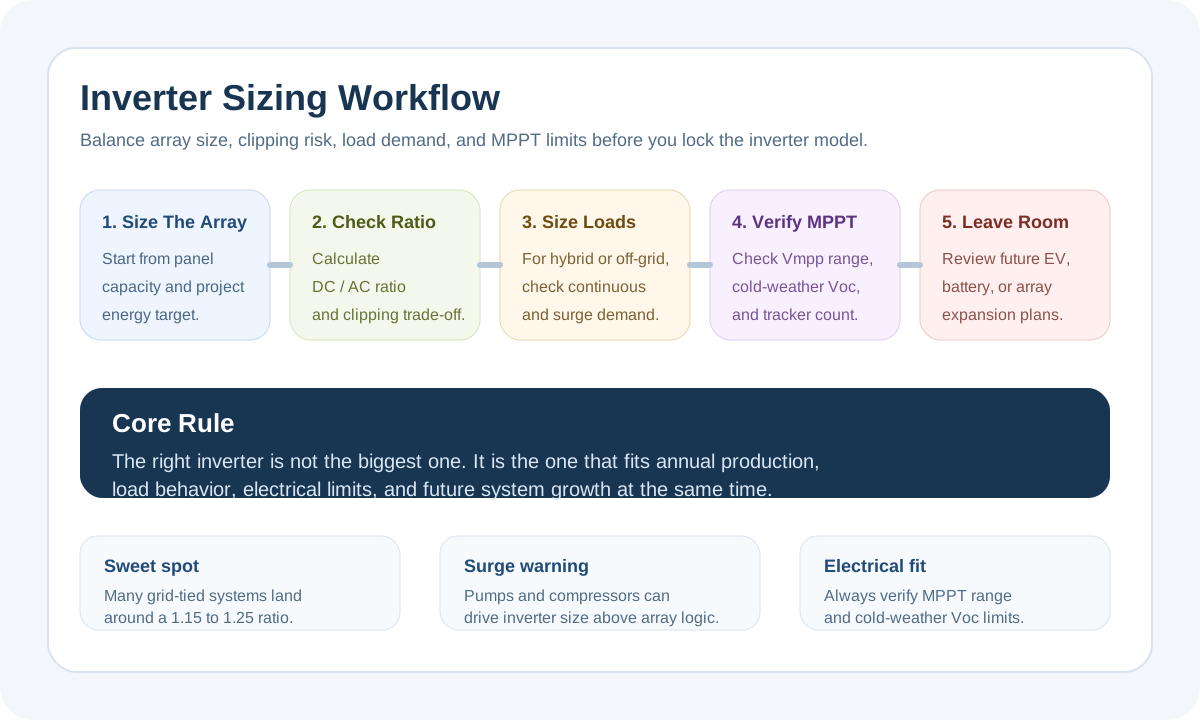
A Good Default Sizing Workflow
Section titled “A Good Default Sizing Workflow”Use this order and the logic usually stays clear.
- Decide whether the project is grid-tied, hybrid, or fully off-grid
- Calculate the panel-array size and initial
DC/ACratio - Review expected clipping against local conditions and project goals
- For hybrid or off-grid systems, size against continuous and surge loads
- Verify
MPPToperating range and cold-weatherVoc - Check future expansion paths before finalizing the inverter model
That sequence keeps the design grounded in both annual energy yield and operational reliability.
Related Guides in Focus Solar
Section titled “Related Guides in Focus Solar”- How to Choose an Inverter
- Solar System Sizing
- Battery Sizing
- System Voltage Selection
- Hybrid Inverter Explained
- Inverter Sizing Guide
Watch or Read More
Section titled “Watch or Read More”Key Takeaways
Section titled “Key Takeaways”- Inverter sizing starts with
DC/ACratio, not a rigid one-to-one watt match. - Mild clipping can be a rational design choice if annual yield and economics improve.
- Off-grid and hybrid systems must be sized against continuous load and surge demand, not only panel capacity.
MPPToperating range and cold-weatherVocchecks are essential after the first sizing pass.- A good inverter choice should still make sense if the system grows later.
Sources Used for This Page
Section titled “Sources Used for This Page”This page was expanded using the research notes and source list provided for this project, especially the following references.
- Aurora Solar, Choosing the Right Size Inverter
- Aurora Help, What is Inverter Clipping
- Aurora Solar, PV System Losses Part 4
- NREL, Quantifying the Impact of Inverter Clipping on Photovoltaic Energy Production
- NREL, Side-by-Side Comparison of Subhourly Clipping Models
- EnergySage, What Size Solar Inverter Do I Need
- Afore Energy, How to Determine the Right Inverter Size
- Wattuneed, MPPT Sizing Technical Guide
- YouTube, How to Size a Solar System