Buying Guide
Solar System Cost Guide
Learn how solar system costs break down across hardware, soft costs, system size, and market conditions so you can judge quotes more intelligently.
Solar pricing looks simple from a distance and messy the moment you compare real quotes.
Two systems with the same capacity can come back with very different prices, and the difference is not always because one installer is overcharging. Sometimes the gap comes from equipment choice. Sometimes it comes from roof complexity, labour, permitting, or battery inclusion. And sometimes it comes from missing detail in the quote itself.
That is why a good solar cost guide should do more than list a single average price. It should help you understand what you are actually paying for.
This page breaks solar costs into the pieces that matter most, hardware, soft costs, system size, market context, and the variables that push quotes apart.
If you are reading this with live proposals open, it works best alongside How to Choose a Solar System and Questions to Ask a Supplier, because price only becomes meaningful once scope and installer quality are visible too.
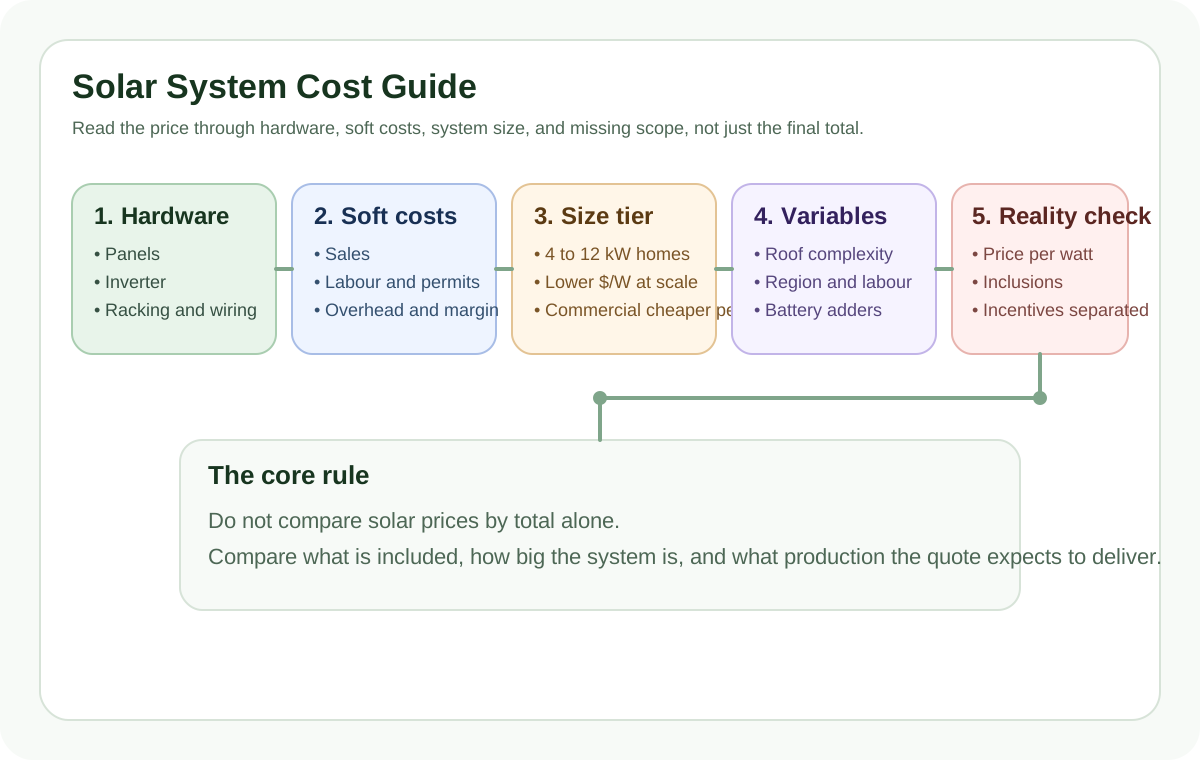
Start With the Big Idea
Section titled “Start With the Big Idea”The cost of a solar system is no longer just a panel story.
Hardware matters, but in many markets soft costs now account for a very large share of the final installed price. As panel prices have fallen, items such as sales, design, permitting, labour, overhead, and installer margin have taken up a larger portion of the bill.
That means buyers need to think in two layers.
- Hardware cost, the physical equipment
- Soft cost, the process of getting that equipment designed, permitted, sold, and installed
This is one reason why cheaper hardware does not automatically translate into dramatically cheaper installed systems.
Hardware vs Soft Costs
Section titled “Hardware vs Soft Costs”A useful way to frame solar pricing is to separate the system into major cost buckets.
| Cost category | Typical examples |
|---|---|
| Hardware | Panels, inverter, racking, electrical balance-of-system components |
| Soft costs | Sales and marketing, design, permitting, labour, overhead, supply chain friction, installer margin |
Recent market breakdowns from quote platforms and industry analysis suggest that soft costs can rival or exceed hardware in total share, especially in residential systems.
This is why two installers can quote the same panel brand and still land far apart on price. The difference may have more to do with sales model, overhead, local labour cost, and project management than with the panel itself.
A Residential Cost Breakdown
Section titled “A Residential Cost Breakdown”One of the clearest ways to understand solar cost is to look at the system as a set of line items rather than a single total.

Most solar cost confusion gets easier once the quote is treated like a set of line items instead of one headline total. Photo by Skylar Kang on Pexels.
Using recent market estimates as a directional example, a typical residential system cost can be distributed roughly across categories like these.
| Line item | Typical role |
|---|---|
| Panels | Direct generation hardware |
| Inverter | Conversion, control, and monitoring core |
| Mounting and structure | Roof attachment and layout support |
| Electrical work | Wiring, protection, and integration to the home |
| Sales and marketing | Customer acquisition cost built into the quote |
| Labour | Installation crew and project execution |
| Overhead and supply chain | Internal operations, logistics, procurement |
| Installer margin | Business profit and risk coverage |
The exact numbers move by market and year, but the buying lesson stays the same.
The system price is not only about modules and inverter.
Typical Cost by System Size
Section titled “Typical Cost by System Size”Larger residential systems often cost less per watt than smaller ones. The total price goes up, but the unit price per watt usually falls as fixed costs are spread over more capacity.
A useful illustrative range for recent residential pricing looks like this.
| System size | Typical price per watt | Approximate pre-incentive total |
|---|---|---|
4 kW | Around the high $2/W range | Roughly the low $10,000s |
6 kW | Slightly lower per watt | Roughly the mid $10,000s |
8 kW | Lower again per watt | Roughly the low $20,000s |
10 kW | Often in the mid $2/W range | Roughly the mid $20,000s |
12 kW | Sometimes slightly lower still | Roughly around the low $30,000s |
If you want concrete size-based examples instead of broad bands, compare 5kW Solar System Cost with 10kW Solar System Cost. The contrast is useful because the total rises sharply while the unit economics often improve.
In markets where a federal tax credit such as the U.S. ITC applies, the post-incentive out-of-pocket number can look materially lower, but only if the buyer actually qualifies and can use the credit.
That is why every cost conversation should separate:
- Pre-incentive price
- Assumed incentives
- Net effective cost after those incentives
If a quote jumps straight to the after-incentive number, ask for the full before-and-after breakdown.
Hardware Costs Still Matter, Just Not Alone
Section titled “Hardware Costs Still Matter, Just Not Alone”Even though hardware is not the whole story, the main physical components still shape the base cost significantly.
Panels
Section titled “Panels”Mainstream panels often fall in a relatively tight range, while premium models can cost much more per watt. That premium may be justified by efficiency, warranty quality, lower degradation, or stronger temperature performance, but buyers should check whether the site actually needs those benefits.
Inverters
Section titled “Inverters”Inverter choice can materially shift system price.
At a broad level:
- Basic string inverter systems are often the lowest-cost path
- Optimizer-based systems cost more
- Microinverter systems often cost more again
That does not make the cheaper option automatically better. It just means inverter architecture is one of the most important cost levers in a proposal.
If you need to decode those trade-offs instead of only pricing them, use How to Choose an Inverter while you compare proposals.
Mounting and Electrical Balance of System
Section titled “Mounting and Electrical Balance of System”Racking, roof attachments, disconnects, wiring, conduit, and switchgear do not generate headlines, but they are part of the installed price and can change meaningfully with roof complexity.
Soft Costs, Where a Lot of Price Variation Hides
Section titled “Soft Costs, Where a Lot of Price Variation Hides”Soft costs are where many buyers underestimate the spread between quotes.
These include items such as:
- Sales and marketing cost
- Proposal design and engineering
- Permitting and interconnection administration
- Installation labour
- Internal company overhead
- Financing administration
- Profit margin
This is one reason a quote can look expensive even when the hardware list seems ordinary. Some business models simply carry more non-hardware cost than others.
Why Quotes Can Differ by 30% or More
Section titled “Why Quotes Can Differ by 30% or More”Large quote gaps are not unusual, and several variables can cause them.
| Variable | Why it changes the quote |
|---|---|
| Panel tier and warranty level | Premium modules cost more per watt |
| Inverter architecture | Microinverters and optimizer systems usually raise cost |
| Roof complexity | Multiple roof faces, steep pitch, and awkward access raise labour cost |
| Regional labour market | Some regions carry much higher installation cost |
| Battery inclusion | Adding storage can radically change total project cost |
| Electrical upgrades | Main panel or service upgrades can add major cost |
This is why price comparisons should always be paired with a scope comparison.
Two quotes are only really comparable when the design assumptions and included work are equally clear.
Battery Adds a Second Cost Layer
Section titled “Battery Adds a Second Cost Layer”Once storage enters the project, cost logic changes fast.
Adding a battery is not just adding a box to the wall. It often changes inverter architecture, control hardware, installation time, and sometimes backup panel design.
For example, a 10 kWh LiFePO4 battery addition can push total system cost up by many thousands of dollars. Exact numbers depend on brand, chemistry, backup requirements, and whether the system is being built battery-ready from the start or retrofitted later.
This is why buyers should treat battery economics separately rather than assuming the battery is just another module-like add-on. How to Choose a Battery and Battery Sizing are the two best follow-on pages when storage starts changing the scope.
Commercial vs Residential Cost
Section titled “Commercial vs Residential Cost”System size also changes cost structure at a larger scale.
Utility and commercial systems generally cost less per watt than residential systems because scale spreads fixed costs more efficiently. Larger projects also use different equipment formats, procurement methods, and installation workflows.
A useful benchmark pattern looks like this.
| System type | Typical cost trend |
|---|---|
| Small residential rooftop | Highest cost per watt among mainstream solar categories |
| Commercial rooftop | Lower cost per watt than residential |
| Commercial ground-mount | Often similar or slightly different depending on civil work |
| Utility-scale | Lowest cost per watt at very large scale |
That is why commercial buyers often think in terms of portfolio economics and project finance, while residential buyers feel the system more directly as a home-improvement purchase.
Regional Price Differences Matter
Section titled “Regional Price Differences Matter”A solar quote in one state, province, or country should not be treated as a universal reference point.
Solar costs shift because of:
- Local labour rates
- Permit complexity
- Roof style norms
- Interconnection rules
- Market competition
- Incentives and tax policy
For example, residential European pricing is often quoted in €/kWp, while U.S. residential pricing is more commonly discussed in $/W. Both can be useful, but they should be read in the context of the local market rather than compared casually across regions.
How to Read a Solar Quote More Intelligently
Section titled “How to Read a Solar Quote More Intelligently”If you want to judge a proposal well, ask for answers to these questions.

A useful quote review is part arithmetic, part scope check, and part assumption audit. Photo by Skylar Kang on Pexels.
- What is the total installed price before incentives
- What is the price per watt
- Which exact panel and inverter models are included
- Are monitoring, permitting, and interconnection included
- Are there roof or electrical upgrade exclusions
- What is the expected annual production in
kWh - If batteries are included, what part of the total belongs to storage
This is also why a cost guide should be used alongside Questions to Ask a Supplier, not instead of it.
A Practical Cost-Reading Framework
Section titled “A Practical Cost-Reading Framework”If you want the simplest way to judge price, use this order.
- Confirm system size and hardware scope
- Look at price per watt for rough orientation
- Separate pre-incentive and post-incentive numbers
- Check what soft costs and extras are hidden inside the total
- Compare expected production, not just installed wattage
That last point matters more than many first-time buyers realize.
A cheaper system with weaker production assumptions is not always cheaper in any useful sense.
Red Flags in Cost Conversations
Section titled “Red Flags in Cost Conversations”- Quotes that only show the post-incentive number
- No price-per-watt disclosure
- Missing equipment model numbers
- No explanation for why one quote is far below the rest
- Vague language about roof work, panel upgrades, or electrical changes
- Strong savings promises with weak production assumptions
The most dangerous solar price is often not the highest one.
It is the one that sounds low because important parts are still missing.
A Good Default Decision Framework
Section titled “A Good Default Decision Framework”If you want the compact rule set, use this order.
- Understand what hardware is included
- Understand how much of the price is soft cost and installation scope
- Compare cost per watt only after scope is normalized
- Separate incentives from the true contract price
- Judge value using both cost and expected long-term output
That framework usually produces a better buying decision than comparing totals alone.
Related Guides in Focus Solar
Section titled “Related Guides in Focus Solar”- How to Choose a Solar System
- Questions to Ask a Supplier
- How to Choose Solar Panels
- How to Choose an Inverter
- How to Choose a Battery
- Solar ROI Analysis
Watch or Read More
Section titled “Watch or Read More”Key Takeaways
Section titled “Key Takeaways”- Solar cost is no longer just a panel-and-inverter story. Soft costs often take up a very large share of the final price.
- Larger systems usually cost less per watt, even though the total contract price rises.
- Inverter architecture, roof complexity, labour market, and battery inclusion can move quotes far more than buyers expect.
- Incentives should always be separated from the true pre-incentive contract cost.
- The most useful way to compare quotes is by scope, price per watt, and expected production together, not by headline total alone.
Sources Used for This Page
Section titled “Sources Used for This Page”This page was expanded using the research notes and source list provided for this project, especially the following references.
- DOE, Solar PV System Cost Benchmarks
- NREL, Solar Installed System Cost Analysis
- EnergySage, Solar Panel Cost 2026
- SolarReviews, Residential Solar Cost Guide
- Anern Store, Solar Installation Cost Breakdown 2025
- Aurora Solar, What Are Solar Soft Costs?
- NY Engineers, Breaking Down the Price of Solar Power Systems
- YouTube, How Much Does Solar Really Cost in 2025?