Components
Depth of Discharge Explained
Learn what depth of discharge means, how it changes usable battery capacity, and why it matters for battery life and sizing calculations.
Depth of discharge, usually shortened to DoD, is one of the simplest battery concepts on paper and one of the most important in practice.
It tells you how much of a battery has already been used.
That sounds basic, but this one number affects three different decisions at once:
- how much energy you can actually use
- how long the battery is likely to last
- how large the battery bank needs to be in the first place
This guide explains what DoD means, how it relates to SoC, how it changes usable capacity, why it affects cycle life, and how to use it in real battery sizing calculations.
What Depth of Discharge Means
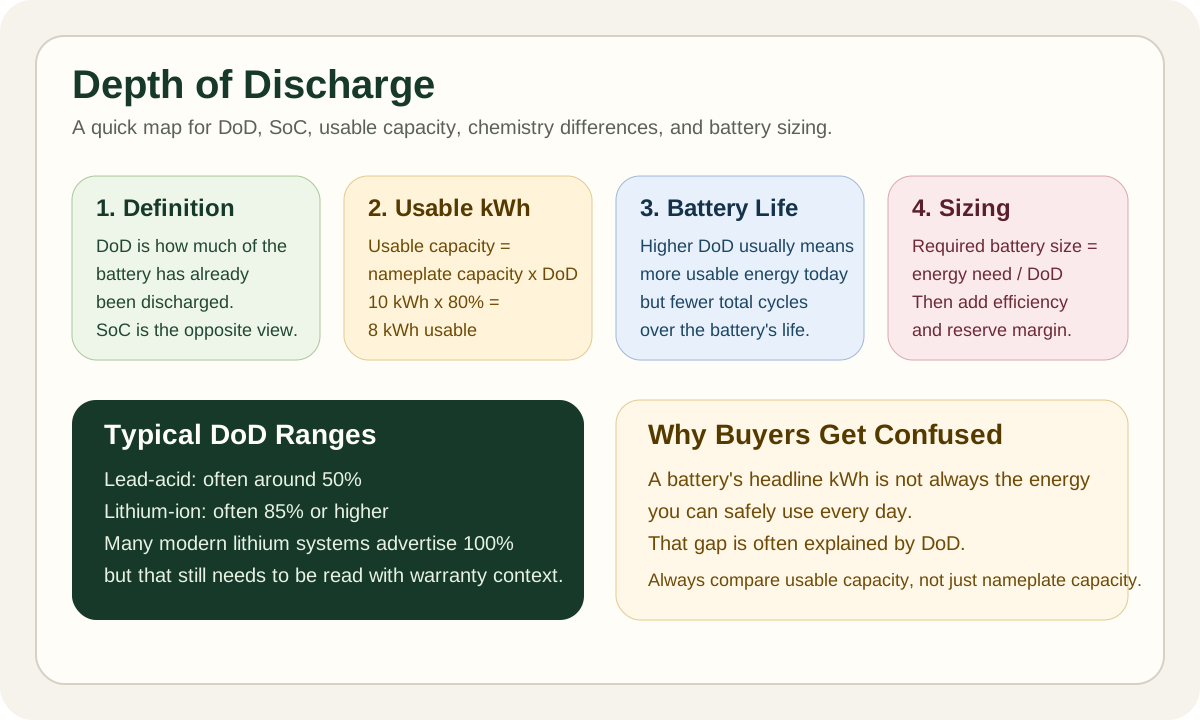
Section titled “What Depth of Discharge Means”The cleanest definition comes from EnergySage and other technical battery references:
DoD is the percentage of a battery’s total capacity that has already been discharged.
So if a battery has used up 80% of its stored energy, it is at:
80% DoDand it has:
20% SoC remainingThat is why DoD and SoC are usually described as opposites.
DoD vs State of Charge
Section titled “DoD vs State of Charge”EnergySage states this very clearly:
DoDtells you how much of the battery has been dischargedSoCtells you how much energy remains stored in the battery
The simplest relationship is:
DoD = 100% - SoCSo:
0% DoDmeans the battery is still full50% DoDmeans half of the stored energy has been used100% DoDmeans the battery is fully discharged
That “mirror image” relationship is one of the most useful battery basics to keep in mind.
Why DoD Matters for Real Usable Capacity
Section titled “Why DoD Matters for Real Usable Capacity”This is where DoD stops being a vocabulary term and becomes a design term.
Battery marketing often highlights nameplate capacity, the headline kWh number. But what you can safely use every day is often lower than that.
The most useful simple formula is:
Usable capacity = nameplate capacity x DoDFor example:
10 kWh battery x 80% DoD = 8 kWh usableAnd:
10 kWh battery x 50% DoD = 5 kWh usableEnergySage gives this exact kind of example, and Memodo does too with a very similar framing.
That is why buyers should not compare batteries using only the headline kWh size. The usable energy can be very different even when the advertised capacity looks similar.
A Very Practical Example
Section titled “A Very Practical Example”EnergySage’s example is easy to remember:
- a
10 kWhbattery with80% DoD - should not be used for more than
8 kWhbefore recharge - which means it should be recharged when about
2 kWhremain
Memodo gives a second useful example:
- battery storage capacity =
10 kWh - usable energy =
9.5 kWh - so
DoD = 95%
That is the exact difference between nameplate capacity and usable capacity in one line.
Typical DoD by Battery Type
Section titled “Typical DoD by Battery Type”One reason DoD matters so much is that different chemistries tolerate very different levels of discharge.
EnergySage gives one of the clearest high-level comparisons:
- lead-acid batteries generally should not discharge beyond about
50% - lithium-ion batteries can generally be drawn down to at least
85% - many modern lithium batteries now advertise
100% DoD
Memodo frames the same pattern slightly differently:
- about
50%for lead-acid - up to about
95%for lithium-ion
The exact number depends on the product, but the pattern is stable:
lithium usually offers much more usable capacity from the same nameplate size.
Why Higher DoD Feels Good Today but Can Cost Battery Life Later
Section titled “Why Higher DoD Feels Good Today but Can Cost Battery Life Later”The reason DoD shows up everywhere in battery discussions is that it is tied directly to cycle life.
The broad rule is very consistent across EnergySage, Battery University, and other battery references:
deeper discharge usually means shorter cycle life.
That does not mean high DoD is automatically bad.
It just means there is usually a tradeoff:
- higher
DoDgives you more usable energy per cycle - lower
DoDusually gives you more total cycles over the battery’s life
This is why storage systems often try to balance usable energy and longevity instead of chasing maximum discharge every single day.
Why Lead-Acid and Lithium Feel So Different in Real Use
Section titled “Why Lead-Acid and Lithium Feel So Different in Real Use”This is one of the most practical lessons for solar storage buyers.
Imagine two batteries with the same nameplate capacity of 5 kWh.
If one is lead-acid at 50% DoD, you can only use:
2.5 kWhbefore recharge.
If the other is lithium-ion at 100% DoD, you can use:
5 kWhThat means a lithium battery can provide double the usable energy from the same nameplate size in that example.
This is a big part of why lithium systems often feel more compact and more flexible, even if the upfront cost is higher.
DoD Is a Sizing Input, Not Just a Battery Spec
Section titled “DoD Is a Sizing Input, Not Just a Battery Spec”When sizing a battery bank, DoD should be treated as a core input.
The simple battery-sizing logic looks like this:
Required nameplate battery capacity = energy demand / DoDSo if your night load is:
6 kWhand your battery should operate at:
80% DoDthen the minimum nameplate capacity before other losses is:
6 / 0.8 = 7.5 kWhThat is the simplest version.
In real sizing work, you then usually add:
- inverter efficiency losses
- round-trip battery losses
- reserve margin
- seasonal or weather margin if backup duration matters
Why “Usable” and “Nameplate” Should Always Be Distinguished
Section titled “Why “Usable” and “Nameplate” Should Always Be Distinguished”Many battery misunderstandings come from mixing these two ideas.
Nameplate capacity is the official rated capacity.
Usable capacity is the portion you can actually rely on without exceeding the battery’s operating limits.
That gap matters a lot for solar storage because:
- runtime is based on usable capacity
- battery count is based on usable capacity
- backup expectations are based on usable capacity
If a buyer only looks at the nameplate figure, they can end up under-sizing the system very quickly.
DoD Also Depends on the Battery’s Intended Use
Section titled “DoD Also Depends on the Battery’s Intended Use”Not every battery is designed for the same duty cycle.
A battery intended for:
- home backup
- self-consumption shifting
- off-grid daily cycling
- occasional emergency use
may be operated very differently even if the chemistry looks similar.
That is why DoD should always be read together with:
- cycle life
- warranty terms
- chemistry
- operating temperature
- intended use case
A Better Way to Compare Batteries With DoD in Mind
Section titled “A Better Way to Compare Batteries With DoD in Mind”When reading a battery datasheet or quote, use this checklist:
- What is the nameplate capacity
- What is the usable capacity
- What
DoDassumption connects the two - What chemistry is it
- What cycle life is quoted at that
DoD
That single habit makes battery comparisons much more honest.
Common Mistakes Buyers Make
Section titled “Common Mistakes Buyers Make”- assuming nameplate capacity is fully usable
- forgetting that
DoDandSoCare opposite directions - comparing lead-acid and lithium batteries only on headline
kWh - ignoring the effect of deeper discharge on battery life
- sizing a battery bank to load alone without dividing by
DoD
A Good Default Comparison Framework
Section titled “A Good Default Comparison Framework”Most battery choices get clearer when you use this order.
- Identify the battery chemistry
- Check the quoted
DoD - Convert nameplate capacity to usable capacity
- Check the cycle-life impact of that discharge depth
- Use
DoDdirectly in the sizing calculation
That keeps the battery discussion grounded in real usable energy, not just marketing numbers.
Related Guides in Focus Solar
Section titled “Related Guides in Focus Solar”- Battery Cycle Life
- Lithium vs Lead-Acid Batteries
- How to Choose a Battery
- Battery Sizing
- Off-Grid Buying Guide
Watch or Read More
Section titled “Watch or Read More”Key Takeaways
Section titled “Key Takeaways”DoDis the percentage of a battery’s total capacity that has already been discharged.DoDandSoCare complements:DoD = 100% - SoC.- Usable battery capacity is not the same as nameplate capacity, and
DoDis one of the main reasons why. - Lead-acid batteries usually operate at much lower
DoDthan lithium batteries, which is why lithium often provides far more usable energy from the same headline size. - In battery sizing, the core move is simple: divide the required energy by the allowed
DoD, then add real-world efficiency and reserve margins.