Components
Mounting Systems
Learn how solar mounting systems differ across rooftop, ground-mount, and carport projects, and what matters most for loads, waterproofing, and site fit.
Mounting systems are easy to underestimate because they do not make electricity.
Panels make electricity.
Inverters convert it.
Batteries store it.
So the racking gets treated like a background detail.
That is a mistake.
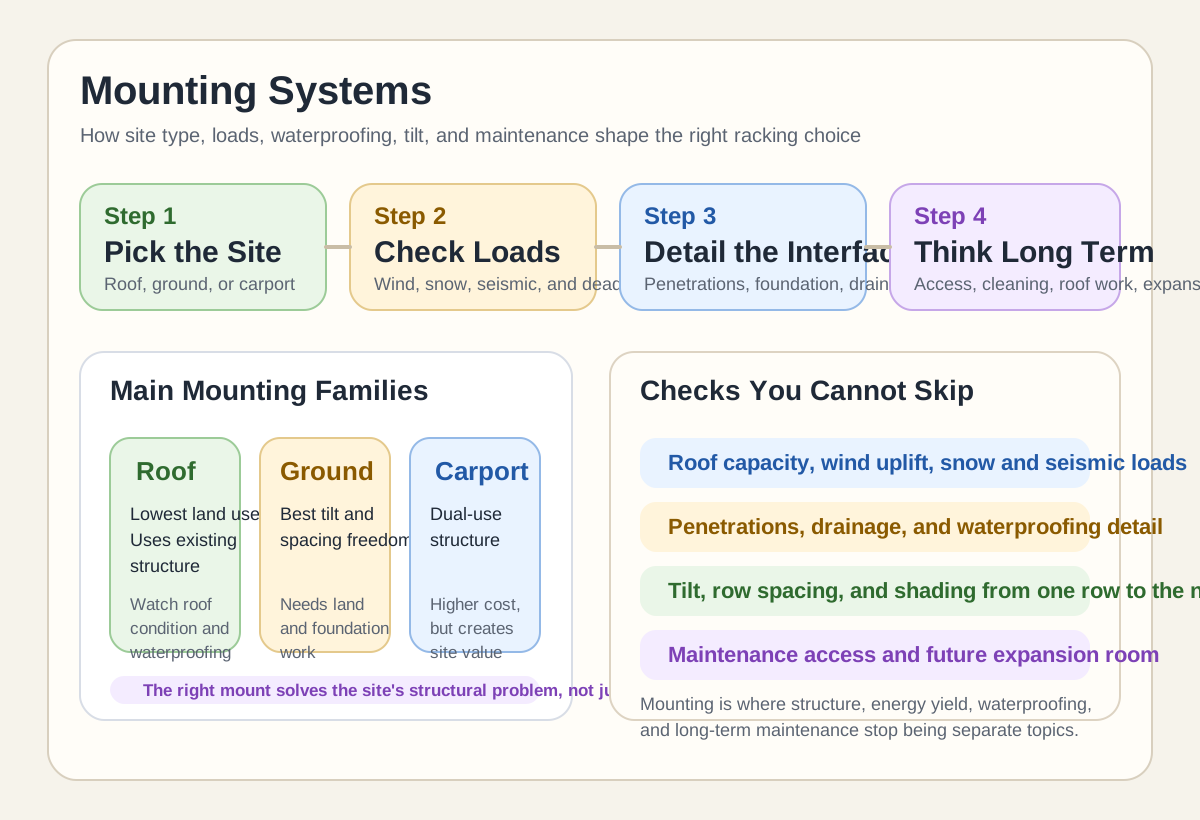
The mounting system is what keeps the array physically on the building or on the site, sets the tilt and orientation the design depends on, and carries the wind, snow, and structural loads the rest of the system has to survive.
That is why mounting is not just a metal frame decision.
It is a structural, waterproofing, maintenance, and code-compliance decision all at once.
This guide explains the main mounting types, where each makes sense, what the real trade-offs are, and what buyers should check before treating one racking option as interchangeable with another.
Why Mounting Systems Matter More Than They First Appear
Section titled “Why Mounting Systems Matter More Than They First Appear”The racking does four jobs at once:
- secures the modules physically
- sets panel tilt and spacing
- transfers wind, snow, and dead load into the structure or foundation
- affects how easy the system is to maintain later
That is already enough reason to take it seriously.
But there is one more layer.
On roof projects in particular, the mounting system often becomes part of the waterproofing conversation too.
So a poor mounting choice does not only create a structural problem.
It can create a leak problem.
That is why support structure should never be treated as a cheap afterthought.
The Three Main Mounting Families
Section titled “The Three Main Mounting Families”For most practical projects, the conversation lands in one of three buckets:
- rooftop mounting
- ground mounting
- carport or canopy mounting
Everything else is usually a variation inside those families.
Rooftop Mounting, the Most Common Starting Point
Section titled “Rooftop Mounting, the Most Common Starting Point”Rooftop mounting is where most residential and a lot of commercial systems begin because it uses structure that already exists.
That is the obvious advantage.
You do not have to buy extra land, and you are not creating a second stand-alone structure just to hold the array.
But the roof trade-off is also obvious:
the roof itself becomes part of the engineering risk.
That means roof-mounted systems have to be judged on more than installed cost.
They also have to be judged on:
- roof condition
- structural capacity
- waterproofing detail
- access for maintenance
- geometry and shading
Sloped Roof Mounting
Section titled “Sloped Roof Mounting”On pitched or sloped roofs, the most common solutions usually revolve around rails, shared-rail arrangements, or lower-material rail-light systems depending on roof type and installer preference.
The basic idea is simple:
the roof attachment transfers load into the structural members, and the rails or attachment hardware support the modules in a controlled layout.
This is why sloped-roof mounting often feels cost-effective.
The roof is already giving you the tilt and much of the support geometry.
That reduces the amount of extra structure you need compared with a full ground-mount frame.
Flat Roof Mounting
Section titled “Flat Roof Mounting”Flat roofs change the question.
Now the mounting system often has to create the tilt instead of inheriting it from the building.
That usually means some combination of:
- ballasted frames
- mechanically attached tilted structures
- low-tilt commercial layouts
Flat-roof systems can be excellent, but they come with their own engineering concerns:
- uplift from wind
- ballast weight
- drainage paths
- membrane protection
- row spacing to avoid self-shading
That is why flat-roof mounting is not just sloped roof, but flat.
It is a different design problem.
The Hidden Rooftop Question, Can the Roof Actually Carry It
Section titled “The Hidden Rooftop Question, Can the Roof Actually Carry It”This is one of the first reality checks that should happen.
A rooftop array adds dead load, wind load, and local attachment stresses.
That means roof capacity is not just about total panel weight.
It is about:
- module weight
- rail and hardware weight
- ballast, if any
- distributed and concentrated loading
- how the roof structure transfers load into beams or purlins
That is why a roof that looks large enough may still not be the right host if the underlying structure or waterproofing condition is poor.
Rooftop Pros and Cons
Section titled “Rooftop Pros and Cons”| Rooftop mounting | Main advantage | Main risk |
|---|---|---|
| Sloped roof | Lower structure cost and uses existing roof angle | Roof penetrations, access difficulty, geometry limits |
| Flat roof | Good commercial use of open roof area | Ballast, uplift, drainage, waterproofing, and extra structural load |
That is why roof systems often win on apparent simplicity but need discipline on structural review.
Ground Mounting, More Freedom, More Land, More Structure
Section titled “Ground Mounting, More Freedom, More Land, More Structure”Ground-mount systems solve a lot of the problems rooftops create.
You get more freedom over:
- orientation
- tilt angle
- row spacing
- maintenance access
- expansion planning
That is why ground mount becomes attractive whenever the roof is:
- too small
- too shaded
- too weak
- too complex
- too valuable to penetrate or disturb
In other words, ground mounting often wins not because it is cheap, but because it gives the designer room to do the job properly.
Why Ground Mount Is Easier to Optimize
Section titled “Why Ground Mount Is Easier to Optimize”A ground array can usually be placed and tilted more deliberately.
That helps with:
- annual yield optimization
- winter-angle tuning
- cleaning access
- cable routing clarity
- future expansion
This is why ground-mount systems often look cleaner from a system-design point of view.
You are no longer negotiating around chimneys, parapets, roof edges, drain lines, and awkward roof faces.
You are building the array where the array wants to be.
The Trade-Off With Ground Mount
Section titled “The Trade-Off With Ground Mount”Of course there is a cost.
Ground mount usually asks for:
- land
- foundations or anchors
- more steel or aluminum structure
- more civil work
- more visible site impact
So ground mount often wins technically while losing on land use or upfront structure cost.
That is the real trade-off.
Not:
ground mount good, rooftop bad.
More like:
ground mount gives more engineering freedom, but it asks you to pay for it in land and structure.
Foundation Styles, Why the Ground Itself Becomes Part of the Design
Section titled “Foundation Styles, Why the Ground Itself Becomes Part of the Design”Once the array moves to the ground, foundation choice matters immediately.
Common directions include:
- concrete footings
- driven posts
- ground screws
The right answer depends on site conditions such as:
- soil quality
- frost depth
- drainage
- corrosion environment
- wind and snow loading
That is why ground mount is not only a frame choice.
It is also a civil and geotechnical choice.
Carport and Canopy Systems, the Hybrid Case
Section titled “Carport and Canopy Systems, the Hybrid Case”Carport systems sit in an interesting middle ground.
They are not as constrained as rooftop systems.
They are not as simple as an open field ground mount either.
They are really multi-function structures.
A solar carport is trying to do at least two jobs:
- support the array
- create a useful sheltered space below
That makes it attractive for parking areas, campuses, commercial lots, and premium sites where land is valuable and shade has real user value.
Why Carports Cost More but Can Still Make Sense
Section titled “Why Carports Cost More but Can Still Make Sense”Carports usually cost more than ordinary rooftop racking and often more than a very straightforward ground mount too.
That is because you are building a raised usable structure, not just a module support frame.
The value case becomes stronger when the project wants:
- dual-use space
- covered parking
- visible solar branding
- integrated drainage
- higher-end site design
So a carport is rarely the cheapest watts-first answer.
It is more often the best answer when the structure itself creates value beyond energy production.
BIPV and Waterproof Canopy Variants
Section titled “BIPV and Waterproof Canopy Variants”Some canopy and carport systems move further into integrated design, including waterproof BIPV-style approaches where drainage and module support are part of one coordinated assembly.
That can look elegant and solve real site goals.
But it also raises the bar on:
- detailing
- drainage
- component compatibility
- installation quality
So these systems can be excellent, but they are not the place to be casual.
Material Choices, Why 6063-T6 Aluminum and Stainless Hardware Show Up So Often
Section titled “Material Choices, Why 6063-T6 Aluminum and Stainless Hardware Show Up So Often”For mounting systems, buyers usually see a mix of:
- aluminum structural members
- stainless steel fasteners and clamps
That pattern is common for a reason.
The structure has to survive outdoors for decades, often on rooftops or sites with heat, moisture, pollution, and corrosion risk.
That is why material choice is not a branding footnote.
It is a durability decision.
The useful question is not just what metal the frame uses.
It is whether the full assembly is designed for long-term corrosion resistance in the actual environment where it will live.
Load Checks, Where Mounting Stops Being a Product Decision and Becomes Engineering
Section titled “Load Checks, Where Mounting Stops Being a Product Decision and Becomes Engineering”This is the point many people try to shortcut.
A mounting system has to survive local loading conditions.
That usually means checking:
- wind load
- snow load
- seismic requirements where relevant
- site exposure
- building code or local structural standard
This is why one mounting system that works well in one region may not be directly transferable to another region with harsher wind, snow, or seismic requirements.
A rack is not safe because it looks strong.
It is safe because it was selected and detailed for the right design loads.
Tilt Angle, Why Mounting Choice Changes Energy Yield
Section titled “Tilt Angle, Why Mounting Choice Changes Energy Yield”Mounting is not just structural.
It changes generation too.
Tilt angle affects:
- seasonal production balance
- drainage and self-cleaning
- row shading on flat roofs or ground arrays
That is why some sites choose steeper tilt for winter performance, while others prefer lower tilt for density, wind profile, or reduced row spacing.
If you want to go deeper on that part, pair this page with Tilt Angle Optimization.
The Most Useful Decision Table
Section titled “The Most Useful Decision Table”| Mounting type | Usually strongest when | Usually weakest when |
|---|---|---|
| Rooftop | Existing roof is sound, space is good, and land is limited | Roof is weak, complex, shaded, or hard to waterproof confidently |
| Ground mount | Site has land and wants optimal orientation, access, and expansion | Land is expensive or civil work is hard to justify |
| Carport / canopy | Site wants dual-use structure and shade value | Budget is tight and cheapest installed watts are the top priority |
That is the real comparison.
Each option solves a different site problem.
Common Mounting Mistakes
Section titled “Common Mounting Mistakes”These are the mistakes that keep repeating across real projects.
Treating Racking as Commodity Hardware
Section titled “Treating Racking as Commodity Hardware”This is how projects end up with systems that fit on paper but ignore load paths, roof condition, or waterproofing complexity.
Ignoring Roof Condition
Section titled “Ignoring Roof Condition”A roof can be large enough and still be the wrong place for solar if it is near the end of its life or difficult to seal properly after penetrations.
Underestimating Wind Uplift
Section titled “Underestimating Wind Uplift”This is especially dangerous on flat roofs, exposed sites, and raised canopy structures.
Optimizing Only for Lowest Cost
Section titled “Optimizing Only for Lowest Cost”A cheaper rack that creates harder maintenance access, lower durability, or greater waterproofing risk is not always cheaper in the long run.
Forgetting Maintenance Access
Section titled “Forgetting Maintenance Access”A beautiful dense layout is not always a maintainable one.
Access matters for cleaning, replacement, inspection, and roof work later.
What to Check on a Real Quote
Section titled “What to Check on a Real Quote”If you are reviewing a real proposal, these questions usually surface the important differences quickly.
- Is the mounting type clearly identified as rooftop, ground mount, or carport?
- Does the quote mention how the structure handles local wind and snow loads?
- On roofs, how are penetrations or waterproofing details handled?
- Is the attachment method compatible with the roof type or site foundation?
- Does the proposed tilt and spacing make sense for energy yield and maintenance access?
- Is the material and corrosion protection described clearly enough to trust long-term outdoor use?
If those answers are vague, the design may still be immature.
Related Guides in Focus Solar
Section titled “Related Guides in Focus Solar”- Solar Panels
- Cables & Connectors
- Tilt Angle Optimization
- Shading Loss Analysis
- Questions to Ask a Supplier
Watch or Read More
Section titled “Watch or Read More”Key Takeaways
Section titled “Key Takeaways”- Mounting systems do more than hold panels up, they also shape tilt, load transfer, waterproofing detail, and maintenance access.
- Rooftop systems often win on convenience and cost, but they depend heavily on roof condition and structural suitability.
- Ground mounts usually offer more design freedom and easier maintenance, but they require land and more civil work.
- Carports make sense when the structure below the array creates real value, not just when the site wants solar anywhere possible.
- The right mounting choice is the one that fits the site, structure, loads, and long-term maintenance plan together.