Components
How to Read a Panel Datasheet
Learn which solar panel datasheet fields matter most, from Pmax and Voc to temperature coefficients, degradation, and mechanical fit.
A solar panel datasheet looks dense because it is doing several jobs at once.
It is a product summary, a performance sheet, a mechanical drawing, a warranty note, and a design document for the installer.
That is why new buyers often get overwhelmed by it.
The good news is that you do not need to memorize every field.
For most real decisions, only a short list of specs does most of the work:
PmaxVocIscVmpImp- temperature coefficients
- dimensions and weight
- degradation and warranty
This guide explains what each of those means, why it matters, and which numbers are actually worth comparing before you buy.
What the Datasheet Is Really For
Section titled “What the Datasheet Is Really For”Aurora Solar makes the point well in its panel spec-sheet guide:
the datasheet is what tells designers, installers, and engineers how the module will behave electrically, mechanically, and thermally.
That matters because the panel is not being chosen in isolation.
It has to fit:
- the inverter
- the string design
- the roof layout
- the mounting system
- the long-term production model
So the real purpose of the datasheet is not marketing.
It is compatibility.
The First Field Most People Notice, Pmax
Section titled “The First Field Most People Notice, Pmax”Pmax is the panel’s maximum power under STC, or Standard Test Conditions.
Those conditions are usually:
1000 W/m²irradiance25°Ccell temperature- air mass
1.5
If a panel is labeled 550W, that is what the manufacturer says it can deliver under those lab conditions.
That is useful, but only as a starting point.
Real roofs almost never operate under perfect STC.
So Pmax is the headline comparison number, not the full performance story.
Vmp and Imp, the Working Power Point
Section titled “Vmp and Imp, the Working Power Point”Pmax is really built from two working numbers:
Vmp, voltage at maximum powerImp, current at maximum power
Those are the numbers that tell you how the panel actually operates when it is producing at its best point.
This is why Vmp and Imp are often more useful for system design than the headline wattage alone.
They help determine:
- how many modules make sense in a string
- whether the inverter’s
MPPTwindow will fit the design - how current behaves when strings are paralleled
Voc, the Number That Protects You From Overvoltage Mistakes
Section titled “Voc, the Number That Protects You From Overvoltage Mistakes”Voc is open-circuit voltage.
That is the maximum voltage a panel can produce when it is not connected to a load.
This number matters most when you are checking string voltage against inverter limits.
Aurora and other spec-sheet guides make the same design point here:
string voltage has to stay below the inverter’s maximum allowed DC voltage, especially in cold weather, when panel voltage rises.
That is why Voc is a safety and compatibility number, not just a trivia spec.
A simple example:
Panel Voc = 46.2 V9 modules in series = 415.8 VCold-weather correction factor 1.25 = 519.75 VIf the inverter’s max DC input is 500 V, that string is too aggressive.
If the inverter limit is 600 V, the design may still be acceptable.
That is the sort of check a datasheet is really for.
Isc, the Current Ceiling
Section titled “Isc, the Current Ceiling”Isc is short-circuit current.
It tells you the maximum current the panel can produce under short-circuit conditions.
This matters when checking:
- conductor sizing
- fuse and protection assumptions
- inverter current limits
- parallel string behavior
In practice, Imp often matters more for normal operation, but Isc still matters because protection and current-limit calculations are usually built around the worst-case current side.
That is why panel wattage alone is never enough.
Two panels with similar wattage can behave very differently on the current side.
The Temperature Coefficient, Where Real-World Output Starts to Move Away From STC
Section titled “The Temperature Coefficient, Where Real-World Output Starts to Move Away From STC”This is one of the most important parts of the whole datasheet.
A panel does not hold its nameplate output as temperature rises.
Aurora, SolarQuotes, and most serious panel guides all stress the same point:
solar modules get less efficient as they heat up.
The key number to watch is usually the temperature coefficient of Pmax.
Typical values are often somewhere around -0.30%/°C to -0.40%/°C.
That means every degree above the reference temperature reduces output a little.
Example:
Temp coefficient of Pmax = -0.35%/°CCell temperature rise above 25°C = 35°CPower loss = 35 x 0.35% = 12.25%So a 550W panel on a very hot roof may deliver much less than 550W at that moment.
Voc and Isc Temperature Coefficients Matter Too
Section titled “Voc and Isc Temperature Coefficients Matter Too”Pmax gets most of the attention, but the other temperature coefficients also matter.
Voctemperature coefficient helps with cold-weather voltage calculationsIsctemperature coefficient shows how current shifts with temperature
The Voc coefficient is especially important because a cold morning can push string voltage upward enough to matter in inverter sizing.
That is why a good spec-sheet reading is not just:
how much power does this panel make?
It is also:
how does this panel behave when conditions stop being perfect?
NOCT or NMOT, the More Realistic Operating Temperature Clue
Section titled “NOCT or NMOT, the More Realistic Operating Temperature Clue”STC is a lab condition.
NOCT or NMOT is closer to field behavior.
Aurora’s explainer is helpful here because it reminds readers that the operating cell temperature in the field is usually far above 25°C.
NOCT-style values give you a more realistic sense of how hot the module may run in actual operation.
That makes them useful when you are trying to estimate real production rather than brochure output.
If two panels have similar wattage but one runs cooler, that panel can outperform expectations more consistently in hot climates.
Module Efficiency, Useful but Easy to Misread
Section titled “Module Efficiency, Useful but Easy to Misread”Efficiency tells you how much sunlight the module converts into electricity per unit area.
This is most useful when roof space is limited.
A high-efficiency module can help you fit more total system capacity onto the same roof.
But efficiency should not be read in isolation.
A more efficient panel is not automatically the better buy if:
- it costs much more per watt
- the roof has plenty of spare area
- the size and electrical fit are otherwise similar
So efficiency is usually a space-use metric first, not a universal quality score.
Power Tolerance, the Fine Print on the Nameplate
Section titled “Power Tolerance, the Fine Print on the Nameplate”Some datasheets also show a power tolerance, such as:
0 to +5 Wor
±3%This tells you how close the actual module output is expected to be relative to the rated number.
That matters because a positive-only tolerance is generally better than a broad plus-or-minus range.
It does not usually decide the whole buying decision by itself, but it is one of the cleaner signs that the manufacturer is not hiding sloppy manufacturing spread behind a big headline wattage.
Dimensions and Weight, Where Roof Reality Shows Up
Section titled “Dimensions and Weight, Where Roof Reality Shows Up”This is one of the most underestimated parts of the datasheet.
The panel still has to fit the roof and the mounting system physically.
You should always check:
- module length and width
- frame thickness
- weight
- clamp zones
- mechanical load ratings
This matters because a panel can look excellent electrically and still be the wrong choice if it:
- does not fit the roof sections efficiently
- exceeds comfortable handling limits
- requires different rail spacing
- creates layout waste around setbacks, vents, or roof hips
So a panel datasheet is not only about performance.
It is also a roof-fit document.
Mechanical Load and Certifications
Section titled “Mechanical Load and Certifications”Aurora also points readers toward wind, snow, and certification information for good reason.
Mechanical load ratings tell you how well the panel is designed to handle structural stress.
Certifications such as IEC, UL, or TUV help confirm the module has passed recognized testing and compliance frameworks.
These fields usually do not decide between two similar panels on their own, but they matter a lot when:
- the site is in a high-wind zone
- snow load is significant
- bankability and certification quality matter to the buyer
Degradation Rate and Warranty, the Long-Term Value Fields
Section titled “Degradation Rate and Warranty, the Long-Term Value Fields”The front page of the datasheet often highlights the long-term performance warranty.
That is not filler.
It tells you how fast the manufacturer expects the module to lose output over time.
Common patterns today include:
- a larger first-year drop
- then a slower annual decline afterward
NREL’s outdoor degradation work is useful here because it grounds the discussion in field behavior rather than warranty language alone. In one 2012 preprint, NREL reported that most of the modules it investigated showed less than 0.5%/year decrease in maximum power, with short-circuit current decline playing an important role.
For practical buying comparisons, the questions are:
- what is the first-year degradation allowance?
- what is the annual degradation rate afterward?
- what output is guaranteed at year
25or year30?
That tells you more about long-term value than headline wattage alone.
The Small Table That Does Most of the Work
Section titled “The Small Table That Does Most of the Work”| Field | What it means | Why it matters |
|---|---|---|
Pmax | Max power under STC | Fast headline comparison |
Vmp | Voltage at max power | String and MPPT design |
Imp | Current at max power | Operating current and parallel behavior |
Voc | Open-circuit voltage | Cold-weather overvoltage check |
Isc | Short-circuit current | Current limits and protection assumptions |
Temp coefficient of Pmax | Heat-related power loss | Real hot-weather performance |
NOCT or NMOT | More realistic module operating temperature | Better field-performance expectations |
| Dimensions and weight | Physical panel footprint | Roof fit, handling, and mounting |
| Degradation and warranty | Long-term output loss | Lifetime value and yield modeling |
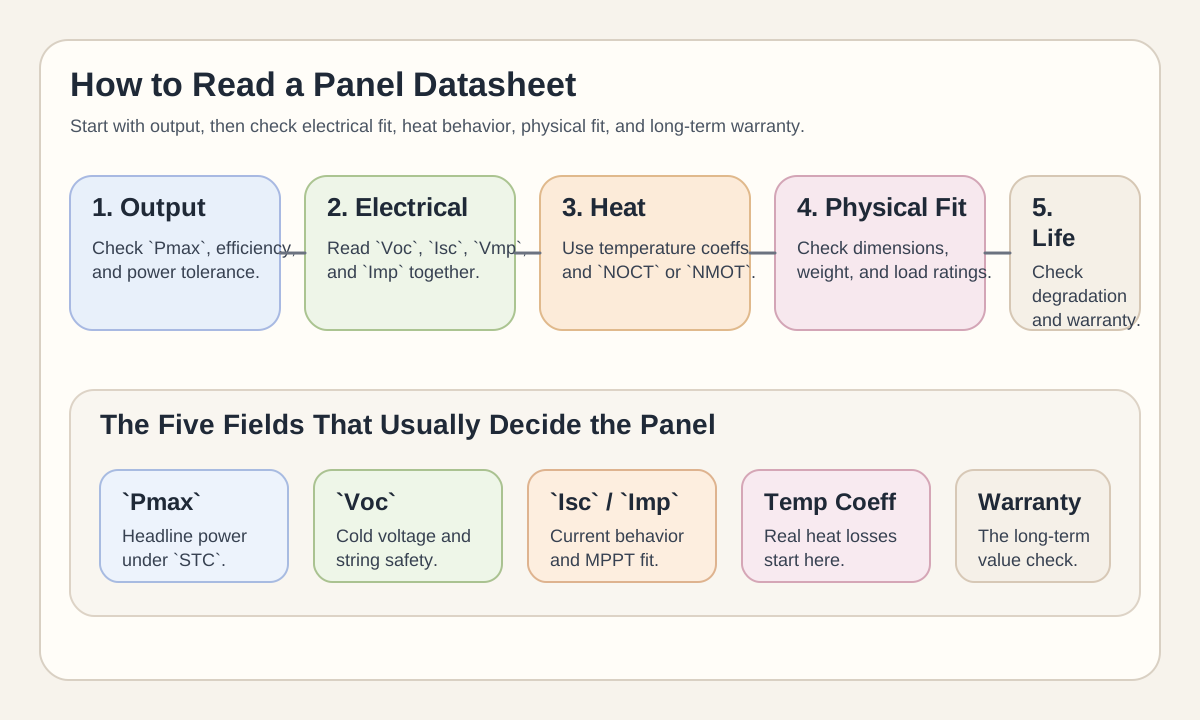
A Practical Reading Order for Buyers
Section titled “A Practical Reading Order for Buyers”If you want the shortest useful routine, do it like this.
- Check
Pmax, efficiency, and power tolerance. - Check
Voc,Vmp,Isc, andImp. - Check temperature coefficients and
NOCTorNMOT. - Check dimensions, weight, and mechanical load.
- Check degradation and warranty.
- Then ask whether the panel still makes sense for this inverter and this roof.
That reading order keeps you focused on the specs that actually influence system design.
Related Guides in Focus Solar
Section titled “Related Guides in Focus Solar”- Solar Panels
- 550W vs 600W Panels
- Panel Efficiency Explained
- Panel Degradation Rate
- How to Read an Inverter Datasheet
Watch or Read More
Section titled “Watch or Read More”Key Takeaways
Section titled “Key Takeaways”Pmaxis only the starting point, not the full performance story.Voc,Vmp,Isc, andImpare the fields that make the module compatible or incompatible with the rest of the system.- Temperature coefficients and
NOCTorNMOTare what turn a lab number into a real-world expectation. - Dimensions and weight matter because the panel still has to fit the roof and mounting system physically.
- Degradation and warranty tell you how much of today’s output the manufacturer expects you to keep over the long run.
Sources Used for This Page
Section titled “Sources Used for This Page”- Aurora Solar, “Understand solar panel specification sheets and how to read them”
- SolarQuotes, “How To Read A Solar Panel Specification”
- Pretapower, “How to Read a Solar Panel Datasheet: Key Specs That Matter Most”
- NREL, “Outdoor PV Module Degradation of Current-Voltage Parameters”