Components
Lithium vs Lead-Acid Batteries
Compare lithium and lead-acid batteries for solar storage by upfront cost, usable capacity, cycle life, efficiency, maintenance, and long-term ownership cost.
Lithium and lead-acid batteries can both store solar energy, but they behave very differently once you move past the sticker price.
That is why the most useful comparison is not just:
which battery is cheaper to buy?
It is:
which battery gives you more usable energy, lasts longer, wastes less electricity, and costs less over the years you actually plan to use it?
In most modern solar storage systems, lithium wins that long-term comparison. Lead-acid still has a place, but usually in smaller, lower-budget, or less frequently cycled setups.
This guide compares the two battery paths by DoD, effective capacity, cycle life, efficiency, maintenance, and total cost of ownership.
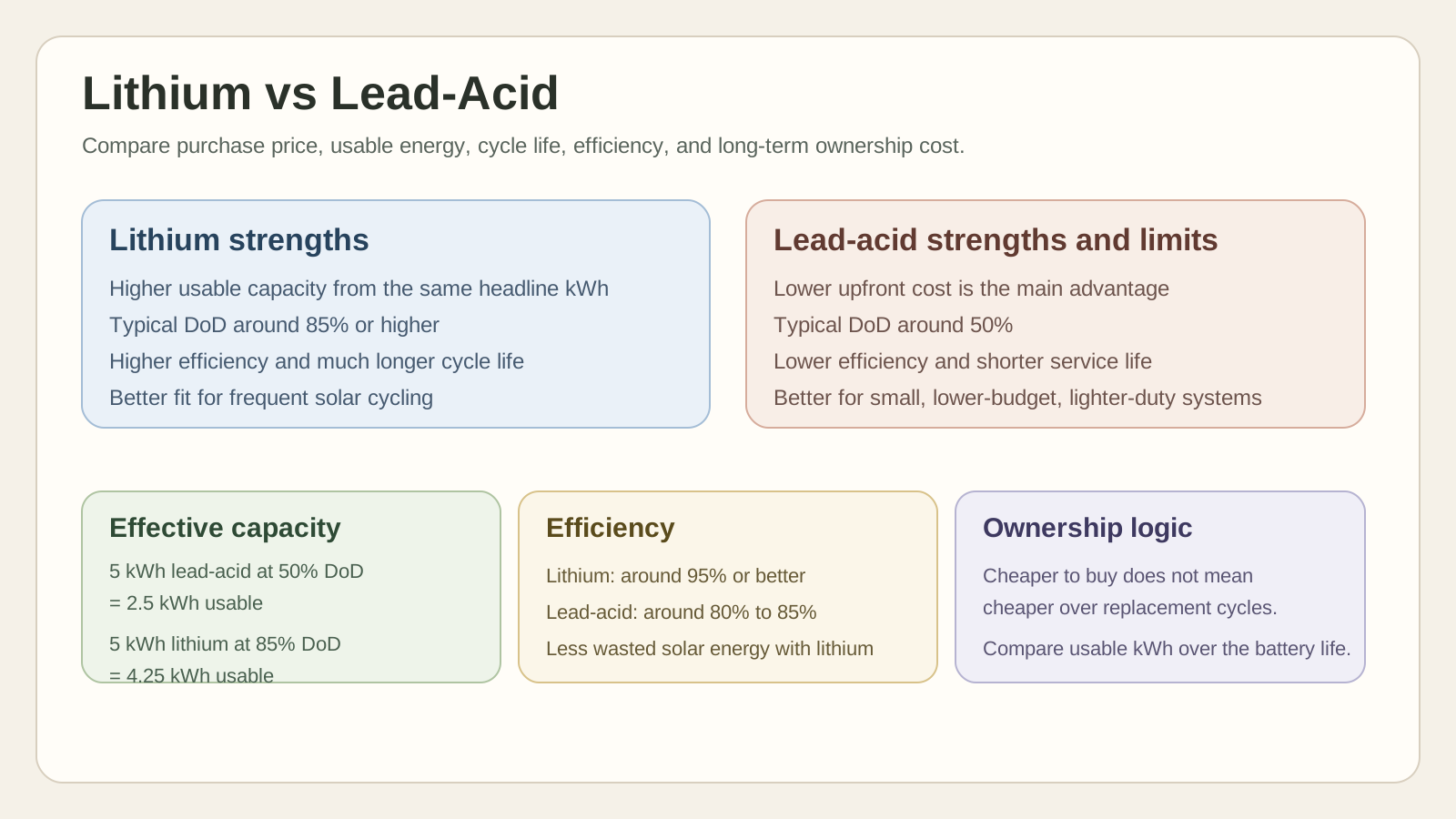
The Short Version
Section titled “The Short Version”EnergySage’s side-by-side comparison is a good baseline:
- lithium batteries cost more upfront
- lead-acid batteries cost less upfront
- lithium usually allows much deeper discharge
- lithium is usually more efficient
- lithium usually lasts much longer
That is why lithium is generally the better fit for most residential solar storage systems, while lead-acid remains more attractive in budget-sensitive or lightly used off-grid situations.
Upfront Cost: Lead-Acid Looks Cheaper First
Section titled “Upfront Cost: Lead-Acid Looks Cheaper First”This is the category where lead-acid makes its strongest case.
EnergySage notes that lead-acid battery systems can cost much less than similarly sized lithium systems. Its comparison page gives broad ranges such as:
- lithium-ion: roughly
$5,000-$15,000 - lead-acid: roughly
$500-$1,000+
The exact numbers vary widely by size and installation scope, but the direction is clear:
lead-acid usually wins on day-one purchase price.
That lower entry cost is one reason lead-acid is still used in:
- small off-grid cabins
- light-duty backup setups
- DIY systems where budget pressure is the first constraint
Usable Capacity: Lithium Usually Delivers Much More Real Energy
Section titled “Usable Capacity: Lithium Usually Delivers Much More Real Energy”This is where the comparison changes quickly.
The battery you buy is not the same thing as the battery you can routinely use.
EnergySage’s DoD guidance gives the most practical rule:
- lithium-ion batteries can often use
85%or more of their capacity - lead-acid batteries generally should not be discharged beyond roughly
50%
That means two batteries with the same nameplate capacity may not give you the same usable energy at all.
For example, if both batteries are rated at:
5 kWhthen a rough usable-capacity comparison looks like this:
Lead-acid at 50% DoD = 2.5 kWh usableLithium at 85% DoD = 4.25 kWh usableIf the lithium battery is designed around even deeper discharge, the gap can be larger still.
This is why lithium often has a much higher effective capacity in real solar storage use.
Why DoD Changes the Whole Comparison
Section titled “Why DoD Changes the Whole Comparison”Depth of discharge is one of the most important reasons lithium feels easier to live with.
EnergySage says it directly:
- using
85%or more of lithium capacity in a cycle is normal - discharging lead-acid much past
50%harms battery lifetime
That means lead-acid buyers often need more headline storage to get the same practical runtime.
So even before cycle life enters the conversation, lead-acid may require more physical capacity to do the same job.
Cycle Life: Lithium Usually Wins by a Wide Margin
Section titled “Cycle Life: Lithium Usually Wins by a Wide Margin”Cycle life is where the long-term economics start to swing hard.
Industry references and academic work both show the same broad pattern:
- lead-acid batteries often deliver hundreds to low-thousands of cycles
- lithium batteries often deliver thousands of cycles
LFPin particular tends to perform very well in repetitive storage use
ScienceDirect’s off-grid battery comparison highlights that lead-acid shows poorer charge acceptance and faster degradation under the kinds of partial-charge and variable-charging conditions common in renewable systems, while lithium chemistries, especially LFP, perform better under those off-grid stressors.
That matters because solar batteries are often used in exactly those imperfect real-world conditions.
In plain terms:
lithium usually survives repeated cycling far better than lead-acid.
Efficiency: Lithium Wastes Less Stored Energy
Section titled “Efficiency: Lithium Wastes Less Stored Energy”Efficiency affects how much of the electricity you put into the battery you can later get back.
EnergySage gives a clean comparison here too:
- most lithium batteries are
95%efficient or more - lead-acid batteries are more often around
80-85%
That difference matters more than it looks.
Higher efficiency means:
- less energy lost in storage
- better solar self-consumption performance
- lower effective cost per delivered
kWh
So even when two batteries look similar in size, lithium usually turns more stored solar energy into usable electricity.
Maintenance: Lead-Acid Usually Asks More of the Owner
Section titled “Maintenance: Lead-Acid Usually Asks More of the Owner”Another reason lithium has become the default in modern residential storage is that it is usually much easier to own.
Lead-acid systems more often involve:
- stricter operating limits
- more sensitivity to deep discharge
- more routine attention to charging behavior and state of health
Lithium systems are usually much closer to a low-maintenance ownership experience.
That difference may not show up as a line item in the quote, but it does show up in day-to-day use.
Total Cost of Ownership Is Where Lithium Often Pulls Ahead
Section titled “Total Cost of Ownership Is Where Lithium Often Pulls Ahead”PowerTech Systems gives one of the clearest examples of why lead-acid can lose the economic comparison over time.
Its case study compares:
- an AGM lead-acid setup with
100 kWhinstalled capacity but only50 kWhusable - a lithium-ion setup with
50 kWhinstalled capacity and50 kWhusable
The lithium system needs only one installation, while the lead-acid path requires multiple replacements to deliver the same service life.
PowerTech’s summary is especially useful:
- lead-acid total cost:
78,000 EUR - lithium total cost:
23,000 EUR - lithium cost per usable
kWhis about2.8xcheaper in that example
That does not mean every lithium battery is automatically cheaper in every project.
It does mean the right comparison is not:
upfront battery price alone
but rather:
usable energy over the battery’s real working life.
Why Lithium Usually Fits Solar Storage Better
Section titled “Why Lithium Usually Fits Solar Storage Better”Solar storage is a demanding application because batteries are often:
- cycled frequently
- partially charged and discharged
- expected to deliver predictable backup performance
- paired with users who do not want constant maintenance
That is exactly why lithium, and especially LFP, has become so common in:
- home battery systems
- daily-cycling self-consumption systems
- premium backup systems
- modern off-grid designs
The chemistry simply fits the duty cycle better.
When Lead-Acid Still Makes Sense
Section titled “When Lead-Acid Still Makes Sense”Lead-acid is not obsolete. It is just less forgiving.
It can still make sense when:
- upfront budget matters more than lifetime optimization
- the system is small
- cycling is infrequent
- the user accepts shorter life and stricter operating limits
- replacement cost and maintenance are already expected parts of the project
That is why lead-acid still appears in small cabins, light backup systems, and lower-budget DIY builds.
When Lithium Is Usually Worth the Higher Price
Section titled “When Lithium Is Usually Worth the Higher Price”Lithium is usually the better choice when:
- you want the highest usable capacity from a compact battery
- the battery will cycle often
- you care about long service life
- efficiency matters
- maintenance simplicity matters
- you want better long-term economics, not just lower upfront cost
For most mainstream home solar storage projects, this is the more common decision path.
A Better Buyer Framework Than “Which One Is Better?”
Section titled “A Better Buyer Framework Than “Which One Is Better?””Instead of asking only which battery is better, ask:
- How much usable energy do I need?
- How often will the battery cycle?
- How important is low maintenance?
- Do I care more about the purchase price or the long-term cost?
- Am I designing for occasional backup or everyday solar shifting?
Those questions usually lead to a clearer answer than chemistry labels alone.
Common Comparison Mistakes
Section titled “Common Comparison Mistakes”- comparing nameplate capacity instead of usable capacity
- ignoring
DoD - ignoring replacement frequency
- treating all lithium batteries as one identical category
- focusing only on sticker price instead of total ownership cost
- forgetting that battery efficiency changes the value of every stored
kWh
If You Want One Practical Rule of Thumb
Section titled “If You Want One Practical Rule of Thumb”If the project is a modern home solar storage system and you can afford the higher upfront price, lithium is usually the stronger long-term choice.
If the project is a small, budget-limited, or lightly used setup where lower initial cost matters most, lead-acid can still be reasonable.
That is the comparison in its simplest honest form.
Related Guides in Focus Solar
Section titled “Related Guides in Focus Solar”- Batteries Hub
- Depth of Discharge Explained
- Battery Cycle Life
- How to Choose a Battery
- Battery Sizing
Read More From External Sources
Section titled “Read More From External Sources”Key Takeaways
Section titled “Key Takeaways”- Lead-acid is usually cheaper upfront, but lithium usually provides more usable energy, longer life, and better efficiency.
DoDis one of the biggest reasons the comparison changes so much in real solar storage use.- Lithium often delivers much more effective capacity from the same headline
kWh. - Lead-acid can still make sense in small, low-budget, or lightly used systems.
- For most modern solar storage systems, lithium usually offers the better long-term ownership value.
Sources Used for This Page
Section titled “Sources Used for This Page”- EnergySage, Lithium-ion vs. Lead Acid Batteries
- EnergySage, What is depth of discharge?
- ScienceDirect, A comparison of lead-acid and lithium-based battery behavior and capacity fade in off-grid renewable charging applications
- PowerTech Systems, Lithium-ion vs Lead-Acid cost analysis
- Evlithium, Lithium vs. Lead Acid Batteries: A 10-Year Cost Analysis
- SolaX Power, Depth of Discharge Explained