System Design
Battery Sizing
Learn how to size a solar battery bank using daily load, autonomy days, depth of discharge, efficiency losses, and temperature derating.
Battery sizing is where storage design stops being abstract and starts becoming math.
If the battery bank is too small, the system runs out of usable energy during bad weather or long evenings. If it is too large, the project gets more expensive than it needs to be. The goal is not the biggest battery. The goal is the right battery for the load pattern, backup target, and climate.
This guide walks through the sizing logic step by step so you can move from daily energy use to a realistic battery-bank target in kWh or Ah.
The Core Formula
Section titled “The Core Formula”The most common battery-sizing framework uses four core variables.
- Daily energy use
- Desired autonomy days
- Maximum usable depth of discharge,
DoD - System efficiency factor
In its common form, the formula looks like this.
Battery bank (kWh) =Daily load (kWh) x autonomy days / (DoD x efficiency factor)This formula is useful because it turns a vague question, how much battery do I need, into a structured one.
How much energy do I need to carry, for how long, and how much of the battery can I actually use after real-world losses.
What Each Variable Means
Section titled “What Each Variable Means”| Variable | What it means | Why it matters |
|---|---|---|
| Daily load | Total energy used in a typical day | This is the foundation of the whole calculation |
| Autonomy days | How many days the system should operate without meaningful charging | Drives reliability during poor weather or outages |
DoD | Maximum share of the battery you plan to use | Converts nominal capacity into usable capacity |
| Efficiency factor | Loss correction for inverter, wiring, charging, and system behavior | Prevents under-sizing based on ideal math |
If any one of these inputs is unrealistic, the battery result will be unrealistic too.
Step 1, Calculate Daily Load
Section titled “Step 1, Calculate Daily Load”Daily load is usually calculated by listing each appliance, its power draw, and the hours it runs in a day.
Device energy per day = watts x hours usedThen add everything together.
For example:
| Device | Power | Hours per day | Daily energy |
|---|---|---|---|
| Fridge | 120 W | 10 h effective runtime | 1.2 kWh |
| Lights | 100 W | 5 h | 0.5 kWh |
| Laptop and electronics | 150 W | 6 h | 0.9 kWh |
| Water pump | 500 W | 1 h | 0.5 kWh |
| Miscellaneous loads | 300 W | 3 h | 0.9 kWh |
Total daily load, about 4.0 kWh
This is why careful load estimation matters so much. Small errors compound quickly once they are multiplied by autonomy days and corrected for DoD.
Step 2, Choose Autonomy Days
Section titled “Step 2, Choose Autonomy Days”Autonomy days tell you how long the battery bank should support the system without meaningful recharge from solar.
Typical design ranges often look like this.
| Autonomy target | Common use case |
|---|---|
Less than 1 day | Grid-connected backup or short overnight bridging |
1 day | Basic backup or fair-weather solar storage |
2 to 3 days | More resilient off-grid design |
More than 3 days | Harsh climates, mission-critical loads, or highly conservative off-grid design |
More autonomy improves resilience, but it raises battery cost quickly. That is why many systems land in the 1 to 3 day range depending on whether the goal is grid backup, self-consumption shifting, or true off-grid reliability.
Step 3, Apply the Right DoD
Section titled “Step 3, Apply the Right DoD”Depth of discharge is one of the biggest reasons two battery chemistries need very different bank sizes for the same job.
| Battery type | Typical recommended DoD |
|---|---|
| Flooded lead-acid | Around 50% |
| AGM or gel | Around 50% |
LiFePO4 | Often 80% to 100% depending on design target |
NMC lithium-ion | Often 80% to 90% |
The lower the usable DoD, the larger the nominal battery bank you need to deliver the same usable energy.
This is why lithium systems can often achieve the same functional backup with much less nominal capacity than lead-acid designs.
Step 4, Add an Efficiency Factor
Section titled “Step 4, Add an Efficiency Factor”Real systems lose energy in several places.
- Battery charging and discharging losses
- Inverter losses
- Wiring losses
- Control-system inefficiencies
Instead of pretending the system is perfect, battery sizing usually applies an efficiency correction.
Practical sizing guides often use stronger loss factors for lead-acid systems and lighter ones for modern lithium systems.
For example:
- Lead-acid system correction may be around
1.2 LiFePO4correction may be closer to1.05
You can think of this as a realism factor. It keeps a mathematically neat answer from becoming an operationally weak one.
Worked Example, Lead-Acid vs LiFePO4
Section titled “Worked Example, Lead-Acid vs LiFePO4”Suppose a home uses 10 kWh per day and wants 2 days of autonomy.
Lead-acid example
Section titled “Lead-acid example”Assume:
- Daily load =
10 kWh - Autonomy =
2days DoD=50%- Efficiency factor =
1.2
10 x 2 / 0.5 x 1.2 = 48 kWhRequired lead-acid battery bank, about 48 kWh
LiFePO4 example
Section titled “LiFePO4 example”Assume:
- Daily load =
10 kWh - Autonomy =
2days DoD=80%- Efficiency factor =
1.05
10 x 2 / 0.8 x 1.05 = 26.25 kWhRequired LiFePO4 battery bank, about 26.25 kWh
This difference is why lithium often changes the physical size and practicality of a battery room so dramatically.
Temperature Derating, One of the Most Missed Corrections
Section titled “Temperature Derating, One of the Most Missed Corrections”Temperature affects both usable capacity and battery lifespan.
That matters because a battery bank sized on a mild-weather spreadsheet may perform very differently in a cold shed, a hot garage, or a poorly ventilated equipment room.
Cold conditions
Section titled “Cold conditions”Low temperatures can reduce available battery capacity, especially below freezing. In colder climates, it is common to increase battery reserve above the nominal result to account for reduced usable energy.
Practical guidance often suggests adding roughly 15% to 25% capacity margin in colder installations, especially for off-grid systems that must carry through winter.
Hot conditions
Section titled “Hot conditions”Heat creates a different risk. Very high battery temperature can accelerate aging and reduce long-term life. Some battery management systems also begin limiting current when temperatures climb too high.
That is why temperature is not only a comfort spec. It is a sizing and lifespan variable.
From Ah to kWh
Section titled “From Ah to kWh”Battery systems are sometimes quoted in kWh and sometimes in Ah. To convert Ah into kWh, you need the system voltage.
Capacity (kWh) = Ah x system voltage / 1000For example:
500 Ah x 48 V / 1000 = 24 kWhThat means a 48 V battery bank rated at 500 Ah stores about 24 kWh of nominal energy.
This is why Ah by itself is incomplete. Without the system voltage, it does not tell you the whole storage story.
Series and Parallel Configuration
Section titled “Series and Parallel Configuration”Once the required energy is known, the battery bank still needs to be configured electrically.
Series connection
Section titled “Series connection”Series connection raises voltage.
Number of batteries in series =required system voltage / single battery voltageExample:
48 V / 12 V = 4 batteries in seriesParallel connection
Section titled “Parallel connection”Parallel connection raises capacity in Ah.
Parallel strings =required Ah / single battery AhThis is why battery-bank design is never only about the energy number. The physical configuration also has to fit the system voltage and current plan.
Safety Margin and Engineering Reserve
Section titled “Safety Margin and Engineering Reserve”In real projects, the raw formula result is often not the final answer.
Designers commonly add reserve margin for things like:
- Wiring and inverter losses
- Load spikes and usage variability
- Aging over time
- Seasonal weather swings
- Future expansion
A practical reserve factor often lands somewhere around 1.2 to 1.5 depending on how conservative the system needs to be.
For off-grid users, that reserve is often more important than in grid-connected backup systems because there is no outside fallback when conditions get ugly.
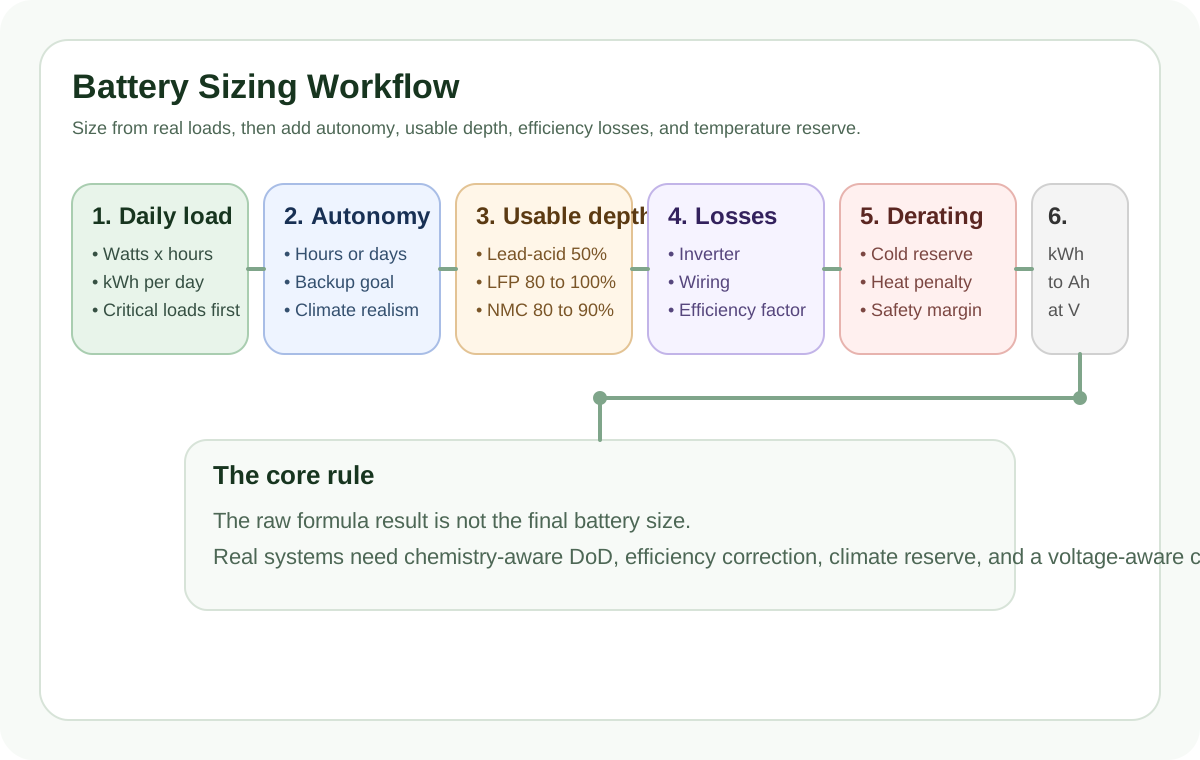
A Practical Sizing Workflow
Section titled “A Practical Sizing Workflow”Use this order and the math usually stays clear.
- Build an honest daily load table
- Decide whether the goal is short backup, daily cycling, or off-grid autonomy
- Choose autonomy days
- Apply the right
DoDfor the battery chemistry - Add efficiency correction
- Add temperature and safety margin where needed
- Convert to
Ahand check the required system voltage
That sequence keeps the calculation grounded in how the system will actually be used.
Common Sizing Mistakes
Section titled “Common Sizing Mistakes”- Using average household consumption when only critical loads need backup
- Forgetting that lead-acid usable capacity is much lower than nominal capacity
- Ignoring cold-weather derating
- Ignoring inverter losses and wiring losses
- Treating
Ahas meaningful without voltage - Choosing autonomy days that are too optimistic for the climate
Most undersized battery systems do not fail because the formula was complicated.
They fail because one or two inputs were wishful instead of realistic.
A Good Default Decision Framework
Section titled “A Good Default Decision Framework”If you want the compact rule set, use this order.
- Start with believable daily load data
- Pick autonomy days based on actual reliability needs
- Use the right
DoDfor the battery chemistry - Add efficiency and temperature corrections before you trust the answer
- Convert the result into a voltage-aware battery-bank configuration
That usually gets you much closer to a system that works in real life, not just in a clean spreadsheet.
Related Guides in Focus Solar
Section titled “Related Guides in Focus Solar”- How to Choose a Battery
- Battery Cycle Life
- Lithium vs Lead-Acid Batteries
- Off-Grid Buying Guide
- Load Estimation
- Inverter Sizing
Watch or Read More
Section titled “Watch or Read More”Key Takeaways
Section titled “Key Takeaways”- Battery sizing starts with daily load, then layers in autonomy days,
DoD, and system losses. - The same backup target can require very different nominal capacity depending on chemistry.
- Temperature derating is one of the easiest ways to under-size a real system if you ignore it.
Ahonly becomes meaningful once you combine it with system voltage.- A small reserve margin often protects the system better than chasing an unrealistically tight calculation.
Sources Used for This Page
Section titled “Sources Used for This Page”This page was expanded using the research notes and source list provided for this project, especially the following references.
- DOE, Solar-Plus-Storage 101
- NREL, Economic Sizing of Batteries for Smart Home
- EnergySage, How Many Solar Batteries Do I Need?
- Enexer, How to Size a Battery Bank for Your Solar PV System
- ScienceDirect, Depth of Discharge Overview
- Anern, How Temperature Impacts Lithium Solar Battery Lifespan
- Unbound Solar, Battery Bank Sizing
- YouTube, Sizing Battery Capacity for Your Solar Power System