System Design
Shading & Loss Analysis
Learn how partial shading affects PV output, why losses are nonlinear, how bypass diodes work, and when optimizers or microinverters make sense.
Shading analysis is one of the most important parts of solar design because shading losses are not linear.
That is the point many first-time system owners miss. A panel that is only partly shaded does not necessarily lose only that same percentage of power. In a string-based system, a relatively small shaded area can drag down current across a much larger electrical path, and in worse cases it can create localized heating that damages cells over time.
This guide explains why shading behaves this way, how to estimate the likely production impact, what bypass diodes actually do, and how to decide between doing nothing, changing the layout, or moving toward optimizers or microinverters.
Why Shading Losses Are Nonlinear
Section titled “Why Shading Losses Are Nonlinear”Shading does not behave like a simple area calculation.
In a series circuit, current is limited by the weakest part of the string. That is why one weak section can reduce output from a much larger chain of cells or modules. In practical terms, a small shaded cell can cause a much larger power drop than its physical size suggests.
One widely cited example in solar education shows how shading only 1 out of 36 cells on a panel can slash panel output by around 75% under the wrong conditions. That is the classic reminder that solar shading is governed by electrical bottlenecks, not just by visible shadow coverage.
Why Shading Can Damage More Than Energy Yield
Section titled “Why Shading Can Damage More Than Energy Yield”The problem is not only lost production.
When a shaded cell is forced into reverse bias by the rest of the string, it can heat up and form a hot spot. That localized temperature rise can become severe enough to stress the module over time.
Possible long-term effects include:
- Cell cracking
- Encapsulant browning
- Delamination
- Faster module aging
This is why shading analysis is partly an energy topic and partly a reliability topic.
A Practical Way to Think About Loss Severity
Section titled “A Practical Way to Think About Loss Severity”Annual shading loss depends on when the shadow happens, how long it lasts, and which part of the electrical architecture it hits.
The broad pattern in field guidance often looks like this:
| Shading severity | Affected panel area | Typical panel loss | Possible annual system loss |
|---|---|---|---|
| Light | Less than 20% | About 15% to 25% | Around 5% to 15% |
| Moderate | 20% to 40% | About 25% to 40% | Around 15% to 25% |
| Heavy | More than 40% | About 40% to 95% | 25%+ |
One of the more sobering rules of thumb from industry writeups is that shading over only about 10% of a system area can still create a much larger system-level energy penalty than most buyers expect if the affected modules are electrically important.
That is why roof shading should be modeled, not guessed.
Why Time of Day Matters
Section titled “Why Time of Day Matters”Not every shadow is equally serious.
For example:
- A short winter-evening shadow may have only limited annual impact because irradiance is already low
- A repeated midday summer shadow can hurt far more because it strikes during the system’s most productive hours
- Morning-only or evening-only shading may still matter if time-of-use economics or battery charging windows are important
This is why good shading analysis always asks not just where the shadow lands, but when.
Bypass Diodes, What They Help With and What They Do Not
Section titled “Bypass Diodes, What They Help With and What They Do Not”Modern panels usually include bypass diodes, often dividing the module into 3 sub-strings.
When one sub-string becomes shaded badly enough, the diode can turn on and allow current to route around that portion of the panel instead of forcing the whole module to choke completely.
This is helpful because it can limit the loss to roughly one section of the panel rather than all of it.
What bypass diodes do well
Section titled “What bypass diodes do well”- Reduce the worst-case effect of limited cell shading inside a module
- Help limit hot-spot risk
- Improve tolerance to modest partial shading
What bypass diodes do not solve
Section titled “What bypass diodes do not solve”- They do not make shading harmless
- They do not remove mismatch between differently shaded modules in the same string
- They do not solve complex
MPPTissues when multiple local power peaks appear
That last point matters in real systems. Partial shading can create multiple local maxima on the power curve, which makes tracking more difficult for the inverter than a clean, uniformly illuminated string.
String Inverter vs Optimizer vs Microinverter Under Shade
Section titled “String Inverter vs Optimizer vs Microinverter Under Shade”Once shading is real and recurring, the next question is how much electronics should be added to manage it.
The broad trade-off often looks like this:
| Architecture | Shade tolerance | Light-shade performance | Heavy-shade performance | Cost | Monitoring |
|---|---|---|---|---|---|
| String inverter only | Weakest | Around 78.2% in one comparison set | Poor | Lowest | System-level |
| Optimizers plus string inverter | Strong | Around 92.1% | Better | Mid-range | Panel-level |
| Microinverters | Strongest | Around 93.5% | Best | Highest | Panel-level |
Why microinverters often win in harder shade:
- Each panel operates independently
- One shaded module does not pull down a whole string the same way
- Module-level monitoring makes diagnosis easier later
Why optimizers still matter:
- They can recover a large share of mismatch losses
- They usually cost less than a full microinverter architecture
- They preserve some string-inverter economics while improving flexibility
If the roof is clean and mostly unshaded, plain string architecture may still be the most sensible choice. But once recurring shade becomes part of the site, optimizer and microinverter discussions become much more important.
Common Sources of Shading
Section titled “Common Sources of Shading”Shading analysis starts with source identification.
Fixed obstructions
Section titled “Fixed obstructions”These include:
- Chimneys
- Vent pipes
- Antennas
- Neighboring buildings
- Parapets
These are usually the easiest to model because their position is stable throughout the year.
Seasonal shading
Section titled “Seasonal shading”Trees are the classic example.
Leaf cover changes, branch shadows lengthen in winter, and low sun angles can turn a manageable summer roof into a much harder winter site.
Dynamic shading
Section titled “Dynamic shading”Cloud edges, temporary equipment, cranes, and short-lived site conditions are harder to predict precisely. These often get handled as generalized loss assumptions rather than detailed object models.
Row-to-row self-shading
Section titled “Row-to-row self-shading”Ground-mount and flat-roof systems can shade themselves if row spacing is too tight. This is not an external obstacle problem. It is a layout design problem.
Soiling and partial cover
Section titled “Soiling and partial cover”Dust, bird droppings, and debris are not always classified as classic shading, but they can create similar mismatch behavior and localized loss.
A Good Field Checklist for Roof Shade
Section titled “A Good Field Checklist for Roof Shade”When reviewing a site, check:
- Trees on the east, south, and west sides
- Chimneys or vents that cast narrow but recurring shadows
- Nearby structures that affect winter sun angles
- Roof sections with mixed tilt or orientation
- Places where one row can shade another
- Likely future shading, such as fast-growing trees
These checks are often more useful early than arguing over tiny efficiency differences between panel brands.
Tools for Shading Analysis
Section titled “Tools for Shading Analysis”The right tool depends on how complex the site is.
| Tool | Best use | Strength |
|---|---|---|
PVWatts | Quick first-pass modeling | Fast and simple, useful when shade is modest or treated as a loss factor |
SAM | Detailed engineering analysis | Better for object-level shading and hourly loss modeling |
| Aurora Solar | Professional roof design | Strong for installer workflows, roof modeling, and automated site analysis |
| Solar Pathfinder or SunEye | On-site assessment | Useful for field capture and seasonal solar-access measurements |
The more irregular the roof and the more valuable the project, the more justified it becomes to move from rough loss assumptions to real shading software or site-measurement tools.
Practical Ways to Reduce Shading Losses
Section titled “Practical Ways to Reduce Shading Losses”Not every shading problem requires expensive electronics. Sometimes the best answer is still geometric.
Change module placement
Section titled “Change module placement”Move the most affected modules away from repeat shadow paths if the roof allows it.
Group strings more intelligently
Section titled “Group strings more intelligently”Place similarly shaded modules together rather than mixing clean and shaded modules randomly.
Increase row spacing
Section titled “Increase row spacing”For ground-mount and flat-roof projects, self-shading often responds better to spacing changes than to hardware changes.
Use optimizers or microinverters when shade is structural
Section titled “Use optimizers or microinverters when shade is structural”If the site will always have shade at certain times, module-level electronics may be the most reliable way to recover performance.
Trim or remove vegetation when realistic
Section titled “Trim or remove vegetation when realistic”This is sometimes the simplest financial answer if the tree impact is strong and site rules allow it.
Common Shading Analysis Mistakes
Section titled “Common Shading Analysis Mistakes”- Assuming shadow percentage equals power-loss percentage
- Looking only at summer noon conditions and ignoring winter sun angle
- Counting on bypass diodes to solve a poor roof layout
- Ignoring self-shading on flat roofs or ground-mount arrays
- Treating all shading as equal regardless of time of day
- Choosing a string design on a complex roof without analyzing whether optimizers or microinverters would pay back
Most shading mistakes start with over-simplification.
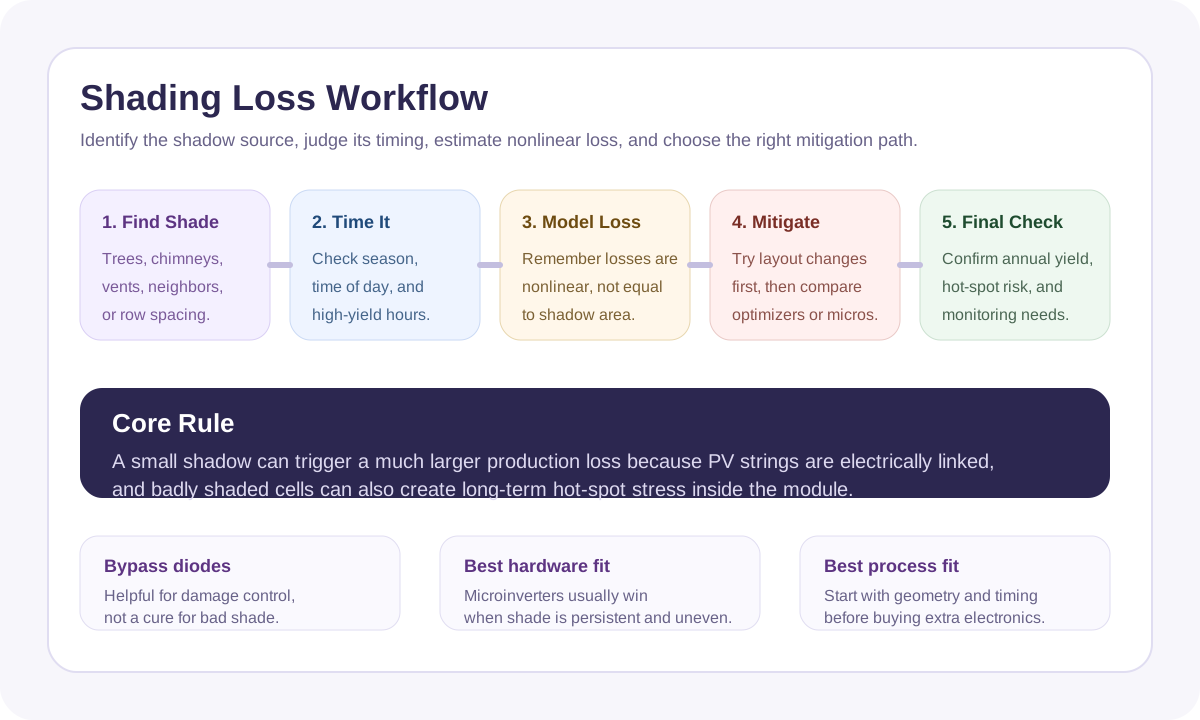
A Practical Analysis Workflow
Section titled “A Practical Analysis Workflow”Use this order and the decision process usually stays clean.
- Identify every fixed, seasonal, and self-shading source on the site
- Estimate when each shadow occurs and whether it overlaps with high-production hours
- Decide whether the impact is light, moderate, or heavy
- Review whether geometry changes can solve the problem before adding electronics
- If shade remains, compare string-only, optimizer, and microinverter architectures
- Model annual losses with an appropriate tool before finalizing system size
That sequence keeps the project from paying for unnecessary complexity while still taking real shading seriously.
Related Guides in Focus Solar
Section titled “Related Guides in Focus Solar”- Tilt Angle Optimization
- Solar System Sizing
- How to Choose an Inverter
- Inverter Sizing
- String vs Microinverter
- Hybrid Inverter Explained
Watch or Read More
Section titled “Watch or Read More”Key Takeaways
Section titled “Key Takeaways”- Shading losses are nonlinear because series-connected circuits are limited by their weakest part.
- Small shaded areas can cause much larger power losses than their visible size suggests.
- Bypass diodes help reduce worst-case losses but do not make shading harmless.
- Recurring shade can justify optimizers or microinverters, especially on complex roofs.
- The best mitigation path often starts with better layout and better modeling, not immediately with more hardware.
Sources Used for This Page
Section titled “Sources Used for This Page”This page was expanded using the research notes and source list provided for this project, especially the following references.
- Aurora Solar, Shading Losses in PV Systems and Techniques to Mitigate Them
- EasySolar, How Shading Impacts Solar Panel Efficiency
- 8MSolar, The Impact of Shading and Obstructions on Solar Panel Performance
- Clean Energy Reviews, Solar Panel Shading Problems and Bypass Diodes
- SolarTech, Power Optimizer vs Microinverter Comparison
- RatedPower, Limiting Shading Losses to Maximize Output
- Aalborg University, Impact of Partial Shading on PV Output Power
- YouTube, Solar Panel Partial Shading Hotspots and Bypass Diodes