Components
Battery Cycle Life
Learn what battery cycle life means, how depth of discharge changes it, and why cost per cycle often matters more than upfront battery price.
Cycle life is one of the most useful battery specs, and also one of the easiest to misuse.
At a glance, it sounds simple. A battery can do a certain number of charge-and-discharge cycles before it is considered worn out.
In practice, though, that number changes with battery chemistry, depth of discharge, temperature, charge rate, and even the capacity threshold the manufacturer uses to define “end of life.”
That is why a single cycle-life number never tells the whole story by itself.
This guide explains what cycle life actually means, why DoD changes it so much, how chemistry changes the result, and how to translate cycle life into a more useful long-term metric such as cost per cycle.
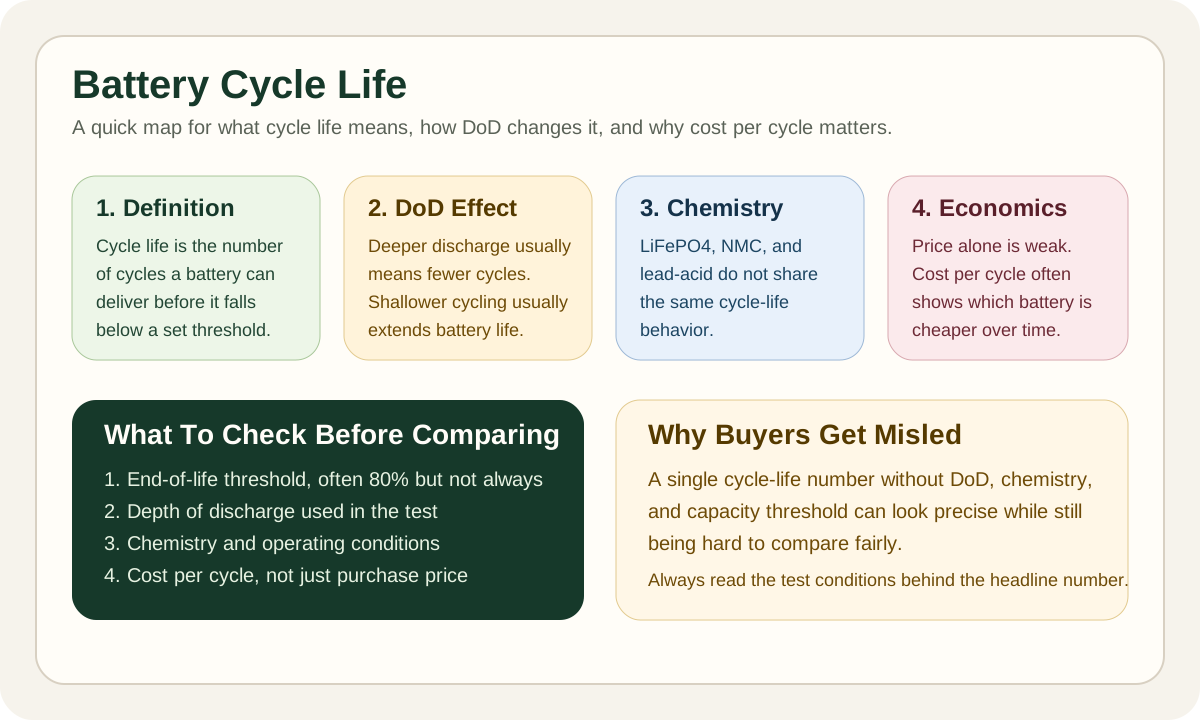
What Battery Cycle Life Actually Means
Section titled “What Battery Cycle Life Actually Means”ScienceDirect’s engineering overview gives a strong baseline definition:
cycle life is the number of charge and discharge cycles a battery can complete before its capacity falls below a specified threshold.
In solar and storage conversations, that threshold is often:
80% of the initial rated capacityBut not every source uses exactly the same end-of-life point.
That detail matters.
ScienceDirect’s battery materials overview notes that industry discussions often treat a battery as at end of life when its capacity has fallen to 80% of its initial value. But Battery University’s widely cited DoD table for lithium-ion batteries uses a stricter threshold of 70% remaining capacity.
So the first rule is simple:
never compare cycle-life claims unless you know what “end of life” means in that specific source.
One Cycle Does Not Always Mean “100% Used Up”
Section titled “One Cycle Does Not Always Mean “100% Used Up””A full cycle usually means one complete discharge followed by one recharge.
But in real storage use, batteries are often only partially cycled.
That is why cycle life and depth of discharge are tightly linked. A battery that is repeatedly discharged only partway usually lasts for many more cycles than one that is repeatedly driven deep.
This is the core logic behind almost every serious battery-lifetime discussion.
Why Depth of Discharge Changes Cycle Life So Much
Section titled “Why Depth of Discharge Changes Cycle Life So Much”ScienceDirect’s engineering references state this very clearly:
- cycle life depends strongly on
DoD - higher
DoDtypically means lower cycle life
Battery University shows the same pattern with unusually clear numbers. Its lithium-ion table estimates cycle counts at different DoD levels before the battery falls to 70% of remaining capacity:
| Depth of discharge | Approx. NMC cycles | Approx. LiFePO4 cycles |
|---|---|---|
100% DoD | ~300 | ~600 |
80% DoD | ~400 | ~900 |
60% DoD | ~600 | ~1,500 |
40% DoD | ~1,000 | ~3,000 |
20% DoD | ~2,000 | ~9,000 |
10% DoD | ~6,000 | ~15,000 |
The pattern is the real lesson:
shallower cycling usually means a much longer usable life.
That is why storage systems often avoid very deep cycling unless the design specifically expects it.
Why Chemistry Matters
Section titled “Why Chemistry Matters”Cycle life is not a single “lithium battery” number.
Different chemistries behave very differently, and Battery University’s table above makes that visible immediately.
At the same DoD, LiFePO4 typically lasts meaningfully longer than NMC.
That helps explain a very common pattern in the storage market:
LiFePO4is popular in stationary home and commercial storageNMCis often favored in applications where energy density matters more- lead-acid remains much shorter-lived in cyclic storage use
This is why “lithium” is not a precise enough category when long-term storage economics are being discussed.
The 80% Threshold Is Common, but It Is Not Universal
Section titled “The 80% Threshold Is Common, but It Is Not Universal”Many buyers assume every cycle-life chart uses the same end point.
That is not true.
ScienceDirect and many manufacturer datasheets treat 80% remaining capacity as the practical end-of-life reference.
Battery University’s DoD comparison table, however, uses 70% remaining capacity for its lithium-ion example.
So when you read a battery datasheet, always ask:
- is the cycle-life number measured to
80%remaining capacity? - to
70%? - or to some other threshold?
Without that, the headline number can be misleading.
Other Things That Change Cycle Life
Section titled “Other Things That Change Cycle Life”Even if chemistry and DoD are the same, cycle life still moves with other conditions.
ScienceDirect and Battery University both point to factors such as:
- charge and discharge rate
- average state of charge
- temperature
- charging voltage
- current stress
Battery University is especially blunt on two stressors for lithium batteries:
- high temperature
- staying at high voltage or very high state of charge
So if you are trying to explain why battery lifetime in the field differs from the brochure, this is usually where the answer starts.
Why Manufacturer Cycle-Life Numbers Need Context
Section titled “Why Manufacturer Cycle-Life Numbers Need Context”ScienceDirect’s photovoltaics reference warns that published cycle-life figures should be read carefully because:
- test conditions may use high currents
- quoted
DoDcan be tied to a specific discharge rate - real photovoltaic charging behavior can be less ideal than laboratory cycling
It even notes that cycle-life figures are often derated in practical PV use because full recharge after every discharge is easier in a lab than in the field.
That means spec-sheet numbers are useful, but they are not the same thing as guaranteed real-world life in a solar storage system.
Cost per Cycle Is Often More Useful Than Price Alone
Section titled “Cost per Cycle Is Often More Useful Than Price Alone”This is the point where cycle life becomes a buying metric instead of just a chemistry concept.
Greentech Renewables frames the economics very simply:
Cost per cycle = battery bank cost / number of cyclesThat one formula is incredibly useful because it shifts the discussion away from:
“Which battery is cheaper today?”
toward:
“Which battery delivers energy more cheaply over time?”
A Practical Cost-per-Cycle Example
Section titled “A Practical Cost-per-Cycle Example”Greentech Renewables gives a worked comparison between three battery-bank types in one example load profile:
- Flooded lead-acid: about
$5,278.80 / 1,150 cycles = $4.59 per cycle - AGM: about
$10,800 / 2,050 cycles = $5.27 per cycle LiFePO4: about$13,450 / 10,000 cycles = $1.35 per cycle
That example is useful because it shows something many buyers miss:
the battery with the highest upfront price can still be the cheapest battery over its useful cycle life.
It is not a universal ranking for every installation, but it is a very strong illustration of why cycle life matters financially.
Cost per Cycle Is Good, but Delivered Energy Is Better
Section titled “Cost per Cycle Is Good, but Delivered Energy Is Better”Cost per cycle is a strong upgrade over sticker price, but it is still not the final metric.
Two batteries can have the same cycle count and still deliver different total lifetime energy because of:
- different usable
DoD - different round-trip efficiency
- different actual kWh capacity
That is why the next level up from cost per cycle is often:
- cost per delivered
kWh - or, in more advanced financial work,
LCOS
Still, cost per cycle is often the best practical bridge between simple buying advice and full energy-storage economics.
A Better Way to Read Cycle-Life Claims
Section titled “A Better Way to Read Cycle-Life Claims”When you see a cycle-life number on a battery page or datasheet, run through this checklist:
- What chemistry is it
- What
DoDis the number based on - What end-of-life threshold is being used
- At what temperature and current was it tested
- Is the number being quoted for a lab test or a realistic solar-use case
That one habit prevents a lot of false comparisons.
Why This Matters for Solar Storage Buyers
Section titled “Why This Matters for Solar Storage Buyers”For solar storage, cycle life matters because the battery is rarely judged only on whether it works today.
It is judged on whether it still creates value years from now.
That is why cycle life should usually be discussed together with:
- battery chemistry
DoD- usable capacity
- temperature environment
- cost per cycle
A cheap battery with weak cycle life can become the expensive battery very quickly once replacement timing enters the picture.
Common Mistakes Buyers Make
Section titled “Common Mistakes Buyers Make”- comparing cycle-life numbers without checking the
DoD - assuming every source uses the same
80%end-of-life threshold - treating all lithium batteries as one category
- ignoring temperature and high-state-of-charge stress
- judging long-term value only by upfront battery price
A Good Default Comparison Framework
Section titled “A Good Default Comparison Framework”Use this order and battery lifetime comparisons become much more useful.
- Identify the chemistry
- Check the
DoD - Check the end-of-life threshold
- Look for temperature and charge-rate assumptions
- Convert the result into cost per cycle
- If needed, step up to cost per delivered
kWh
That keeps you from treating two completely different lifetime claims as if they were the same.
Related Guides in Focus Solar
Section titled “Related Guides in Focus Solar”- Depth of Discharge Explained
- Lithium vs Lead-Acid Batteries
- How to Choose a Battery
- Battery Sizing
- Off-Grid Solar System Cost
Watch or Read More
Section titled “Watch or Read More”Key Takeaways
Section titled “Key Takeaways”- Cycle life is the number of cycles a battery can complete before its capacity falls below a defined threshold, often
80%, but not always. DoDis one of the strongest drivers of cycle life: deeper cycling usually means fewer total cycles.LiFePO4typically offers much longer cycle life thanNMCat the sameDoD, which helps explain its popularity in stationary storage.- A battery with a higher upfront cost can still be the better long-term buy if its cost per cycle is much lower.
- The safest way to compare batteries is not just chemistry or price. It is chemistry plus
DoDplus threshold plus cost per cycle.