Components
How to Read an Inverter Datasheet
Learn which inverter datasheet parameters matter most, from max DC voltage and MPPT range to efficiency curves, grid compliance, and sizing red flags.
An inverter datasheet looks technical because it is technical.
But once you know what to look for, most of the confusion collapses into a short list of questions.
Can the inverter safely accept the array voltage?
Will the array actually sit inside the MPPT window in real operation?
Does the AC output match the system you are building?
And is the impressive-looking efficiency number a real operating clue, or just a peak laboratory number that makes the brochure look good?
That is the whole game.
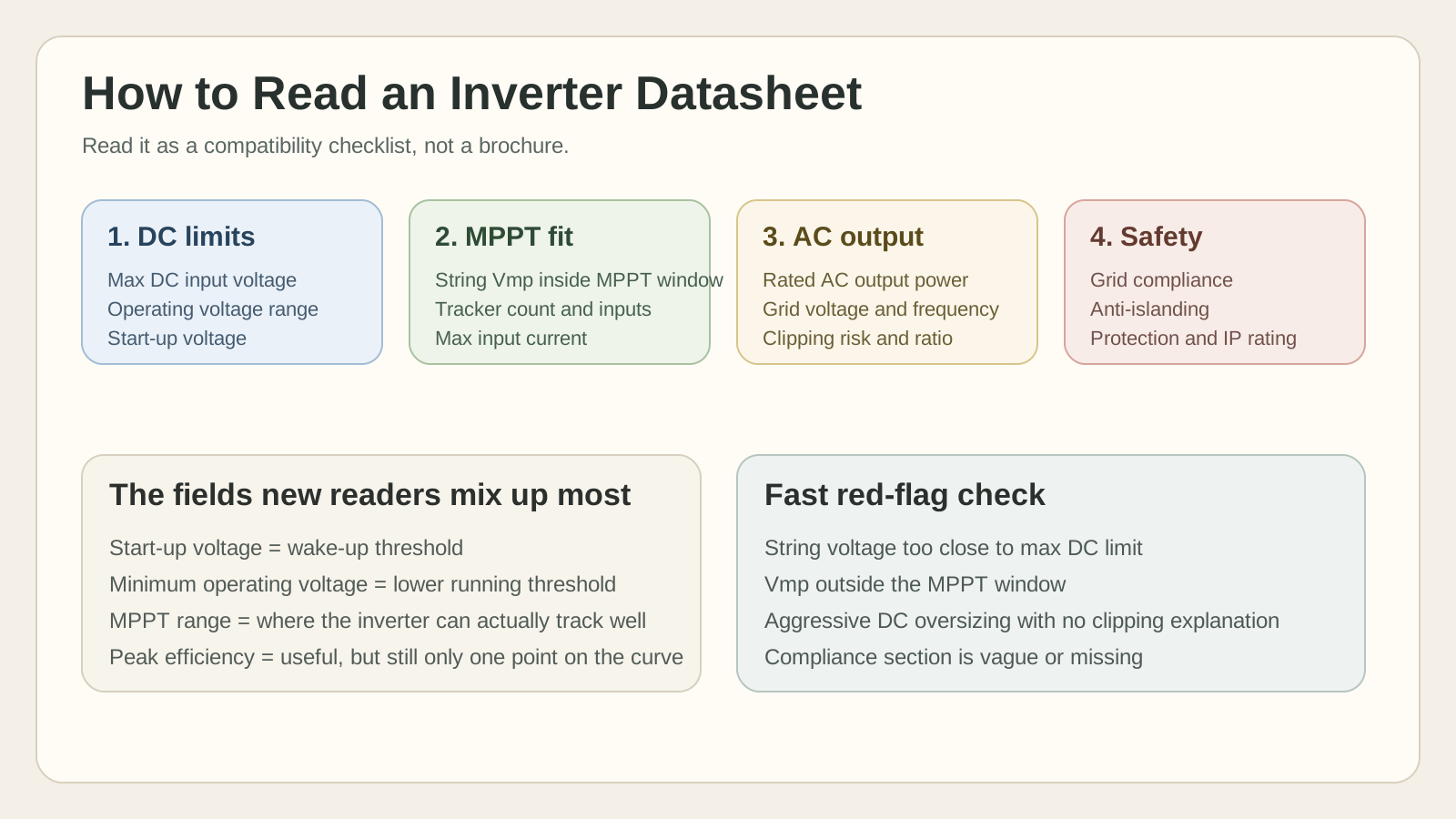
This guide walks through the inverter fields that matter most, explains the ones people confuse all the time, and ends with the red flags that usually catch bad sizing or low-quality proposals.
Why the Datasheet Matters More Than the Marketing Page
Section titled “Why the Datasheet Matters More Than the Marketing Page”Marketing pages tell you what the manufacturer wants you to notice.
The datasheet tells you what the inverter will actually tolerate.
Penn State’s AE 868 inverter lesson is especially useful here because it makes the key point very plainly:
the PV string has to stay inside the inverter’s electrical limits, not just vaguely match the brand or the nominal power size.
That means the datasheet is where you verify:
- whether the inverter can safely accept the highest array voltage
- whether the string will actually operate inside the usable voltage range
- whether the inverter can track the string properly through its
MPPTwindow - whether the unit is compliant for grid connection and anti-islanding
If those checks fail, the system can underperform, clip more than expected, refuse to start properly, or in the worst case exceed an electrical limit.
Start on the DC Input Side
Section titled “Start on the DC Input Side”Most inverter mistakes start here.
The array talks to the inverter on the DC side first, so the first job is to confirm that the string voltage and current make electrical sense before you look at any efficiency claim.
Maximum DC Input Voltage
Section titled “Maximum DC Input Voltage”This is one of the hard-stop numbers.
Penn State’s guidance is simple:
the maximum voltage of the PV string must never exceed the inverter’s maximum DC input voltage.
This matters most on cold days, because module Voc rises as temperature drops.
So when you see:
Maximum DC input voltage = 600 Vyou do not compare that against a casual daytime operating voltage.
You compare it against the highest possible cold-weather string Voc.
If your cold corrected string voltage can cross that line, that is a red flag immediately.
Operating Voltage Range
Section titled “Operating Voltage Range”This tells you the broader voltage band in which the inverter can work.
Penn State separates this from the more specific MPPT window, which is helpful because many readers blur them together.
The operating range answers a basic question:
can the inverter stay on at all across the voltage range your array is likely to produce?
If the string spends too much time outside that band, the inverter may not behave properly even if the nameplate sizes look reasonable.
Start-Up Voltage vs Minimum Operating Voltage
Section titled “Start-Up Voltage vs Minimum Operating Voltage”This is one of the easiest points to confuse.
Penn State explains the difference clearly:
start-up voltageis the threshold needed to wake the inverter up- minimum operating voltage is the lower bound it can stay running at after it has already started
Those are not the same thing.
A system may need a higher morning voltage to begin operating, but once it is already online, it can keep running at a lower voltage.
That is why a proposal that only mentions MPPT range but ignores start-up voltage is not really giving you the full electrical picture.
MPPT Voltage Range
Section titled “MPPT Voltage Range”For real system matching, this is one of the most important fields on the whole sheet.
The MPPT range is the voltage window where the inverter can actively track the array and harvest power efficiently.
Penn State’s point here is the one worth remembering:
the string Vmp should sit inside the inverter’s MPPT tracking range.
Not near it in theory.
Not inside it for ten minutes a day.
Inside it in the conditions the array will actually see for most of its working life.
If the string usually sits outside the MPPT window, the inverter cannot optimize the array correctly.
That is why MPPT range matters more than a casual glance at nominal system voltage.
Max Input Current and MPPT Inputs
Section titled “Max Input Current and MPPT Inputs”Voltage gets most of the attention, but current limits matter too.
You still need to confirm:
- maximum input current per tracker
- number of
MPPTtrackers - number of string inputs per tracker
This matters most when the design includes:
- parallel strings
- mixed roof planes
- different orientations
- different tilt angles
A datasheet with multiple MPPT trackers is often much easier to work with on a split roof, because each tracker can handle its own string conditions more independently.
A Practical String-Check Example
Section titled “A Practical String-Check Example”Here is the sort of quick check that makes a datasheet suddenly feel less abstract.
Imagine the inverter shows:
Max DC input voltage = 600 VMPPT range = 160 V to 480 VStart-up voltage = 180 VAnd imagine your module string is:
Voc = 41 Vper moduleVmp = 34 Vper module12modules in series
Then your rough checks look like this:
String Voc = 12 x 41 = 492 VString Vmp = 12 x 34 = 408 VThat means:
492 Vis below the600 Vhard ceiling408 Vsits inside the160-480 VMPPTrange408 Vis also comfortably above the180 Vstart-up threshold
That is the kind of reading you should be able to do from a datasheet before anyone tells you the design is good.
Then Move to the AC Output Side
Section titled “Then Move to the AC Output Side”Once the DC input side is safe and sensible, the next question is what the inverter can actually deliver to the home or grid on the AC side.
Rated AC Output Power
Section titled “Rated AC Output Power”This is the inverter’s core output rating.
It tells you how much AC power the inverter is designed to deliver continuously under rated conditions.
This number matters because it is the anchor for:
- inverter sizing
- clipping expectations
- load matching
- export limits in some jurisdictions
If the inverter is much smaller than the array, clipping becomes more likely.
If it is much larger than the array, you may pay more for capacity that the system rarely uses.
DC-to-AC Ratio and Clipping
Section titled “DC-to-AC Ratio and Clipping”This is where the datasheet stops being a component document and becomes a design document.
A common residential design approach is to keep the array-to-inverter ratio somewhere around 1.1 to 1.3, though the best answer depends on climate, orientation, tariff rules, and export constraints.
The reason is simple:
- too small an inverter can create excessive clipping
- too large an inverter can weaken the economics
EnergySage-style sizing guidance is useful here because it keeps the idea practical rather than theoretical.
Some clipping is normal.
Uncontrolled clipping because the array is clearly oversized for the inverter is a red flag.
Efficiency: Do Not Stop at Peak Efficiency
Section titled “Efficiency: Do Not Stop at Peak Efficiency”This is one of the biggest brochure traps.
Penn State notes that inverter efficiency often reaches 95%+ under rated conditions.
That sounds great, but the more important point is that inverter efficiency changes with input voltage and operating point.
Valentin Software’s inverter parameter help is useful for this exact reason. It highlights that efficiency is not a single frozen number, and that input voltage can shift the result.
So if you are reading a datasheet, do not stop at:
Peak efficiency = 98.2%That number is interesting, but it is not the whole story.
The better question is:
how efficient is the inverter in the range where this system will spend most of its real life?
Why the Efficiency Curve Matters More
Section titled “Why the Efficiency Curve Matters More”If the datasheet includes an efficiency curve, that is often more valuable than the headline peak figure.
The curve helps you see whether the inverter is:
- efficient only near one narrow operating point
- or consistently efficient across a wider working range
That matters because a residential system does not spend every minute at perfect midday output.
It spends a lot of time at partial load.
A flashy peak number with weak part-load behavior can be less useful than a slightly lower peak number with a steadier real operating curve.
Grid Compliance and Anti-Islanding
Section titled “Grid Compliance and Anti-Islanding”If the inverter is intended for grid-tied use, compliance is not a footnote.
It is a safety requirement.
Penn State’s inverter reference specifically calls out standards such as IEEE 1547 and the need for anti-islanding protection.
That matters because the inverter must be able to disconnect safely when the grid is down or unstable, rather than feeding power into a de-energized line.
So when reading a datasheet, do not skip the compliance section.
Check for:
- grid code compatibility
- anti-islanding protection
- voltage and frequency compliance
- certifications required in your market
This is one of the places where a cheap-looking spec sheet can hide a very expensive problem later.
Protection and Environmental Ratings
Section titled “Protection and Environmental Ratings”Not every page highlights these well, but they matter in real installations.
You should also scan for:
- ingress protection such as
IP65or similar - operating temperature range
- overvoltage and overcurrent protection
- cooling method
- noise level if the inverter will sit near occupied space
These fields do not usually decide system compatibility by themselves, but they absolutely affect install quality and ownership experience.
The Red Flags to Watch For
Section titled “The Red Flags to Watch For”This is the practical checklist section.
If you see any of these, slow down.
Red flag 1, the string only barely fits the voltage limits
Section titled “Red flag 1, the string only barely fits the voltage limits”If the design sits too close to the maximum DC voltage ceiling, cold-weather voltage rise may push it into unsafe territory.
Red flag 2, the proposal shows array size but not string voltage logic
Section titled “Red flag 2, the proposal shows array size but not string voltage logic”If the installer tells you the inverter size and panel count but does not explain:
- string
Voc - string
Vmp MPPTfit
then the design explanation is incomplete.
Red flag 3, peak efficiency is highlighted but no curve or European efficiency is shown
Section titled “Red flag 3, peak efficiency is highlighted but no curve or European efficiency is shown”That can make the inverter look stronger on paper than it is across ordinary operating conditions.
Red flag 4, the inverter has too few MPPT trackers for the roof layout
Section titled “Red flag 4, the inverter has too few MPPT trackers for the roof layout”Multiple orientations and roof planes often need more tracker flexibility than a very basic unit can offer.
Red flag 5, the DC-to-AC ratio is unusually aggressive with no clipping explanation
Section titled “Red flag 5, the DC-to-AC ratio is unusually aggressive with no clipping explanation”Some oversizing is normal.
Very aggressive oversizing without a climate or tariff rationale deserves a second look.
Red flag 6, compliance is vague
Section titled “Red flag 6, compliance is vague”If the datasheet or proposal does not clearly state the relevant grid certifications and anti-islanding capability, that is not a small omission.
A Good Reading Order for Any Inverter Datasheet
Section titled “A Good Reading Order for Any Inverter Datasheet”If you want one repeatable process, use this:
- Check maximum
DCinput voltage. - Check start-up voltage and operating voltage range.
- Check the
MPPTwindow. - Check max input current and tracker count.
- Check rated
ACoutput power. - Check efficiency and the curve if available.
- Check compliance, anti-islanding, and environmental ratings.
- Then step back and ask whether the array and inverter are actually well matched.
That order prevents the most common beginner mistake, which is getting distracted by power size and peak efficiency before the electrical compatibility work is even done.
Related Guides in Focus Solar
Section titled “Related Guides in Focus Solar”- Inverters Hub
- Inverter Sizing Guide
- Hybrid Inverter Explained
- String vs Microinverter
- Inverter Sizing
Read More From External Sources
Section titled “Read More From External Sources”Key Takeaways
Section titled “Key Takeaways”- The most important inverter datasheet fields are usually
max DC voltage,start-up voltage, operating range,MPPTrange, input current, ratedACoutput, efficiency, and grid compliance. - A string can look fine by panel count and still be wrong electrically if its voltage does not fit the inverter properly.
MPPTrange is one of the most important real-world compatibility checks in string design.- Peak efficiency is useful, but the efficiency curve often tells you more about how the inverter will behave in daily operation.
- Good inverter reading is really a compatibility exercise, not a brochure-reading exercise.