Buying Guide
Off-Grid Buying Guide
Learn how to evaluate loads, autonomy days, battery chemistry, coupling architecture, and backup strategy before buying an off-grid solar system.
Off-grid solar is a very different buying decision from grid-tied solar.
With a grid-connected system, the utility can quietly cover mistakes. With an off-grid system, design errors show up immediately, usually on cloudy days, in winter, or when a large load starts and the system cannot keep up.
That is why the first rule of off-grid buying is simple.
You are not buying panels.
You are buying reliability.
This guide focuses on the practical buying side of that decision, load estimation, battery reserve, system architecture, and the kinds of shortcuts that create regret later.
The Core Off-Grid Difference
Section titled “The Core Off-Grid Difference”The biggest difference between off-grid and grid-tied solar is not the panel.
It is the absence of a safety net.
An off-grid system must generate, store, and deliver all required energy inside the system boundary. There is no utility backup when weather turns bad, batteries run low, or surge loads spike unexpectedly.
That changes the design mindset completely.
- Load estimation becomes mandatory, not optional
- Battery sizing becomes foundational
- Autonomy days matter
- Charge controller and inverter sizing matter more
- A backup generator often becomes part of a serious reliability plan
This is why off-grid systems usually cost more and punish weak assumptions much faster than grid-tied systems.
The Five-Step Buying Framework
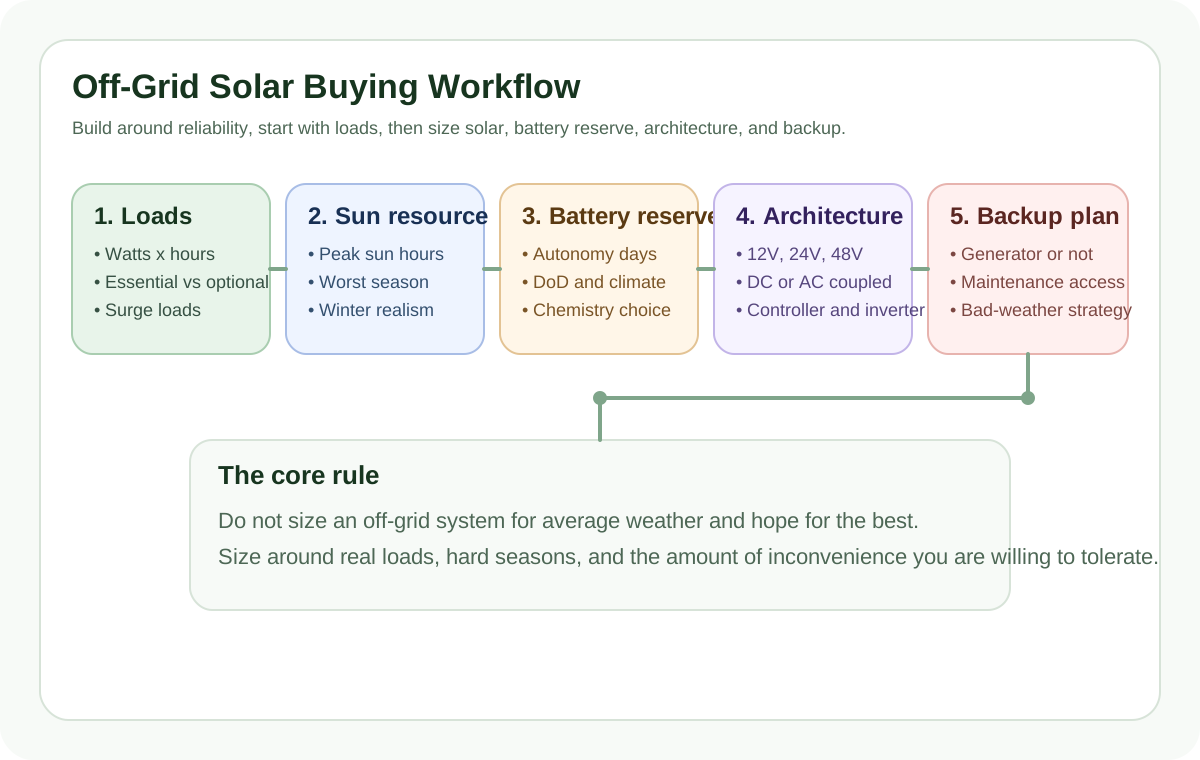
Section titled “The Five-Step Buying Framework”If you want the short version first, the decision path looks like this.
- Estimate your real daily loads
- Check your local solar resource and worst-case season
- Size the array and battery around autonomy, not optimism
- Choose the right architecture and system voltage
- Decide how much backup redundancy you need
That order matters. If you skip the load step, the rest of the design becomes guesswork.
Step 1, Estimate Loads Honestly
Section titled “Step 1, Estimate Loads Honestly”Every off-grid system starts with the same question.
How much electricity do you actually need each day.
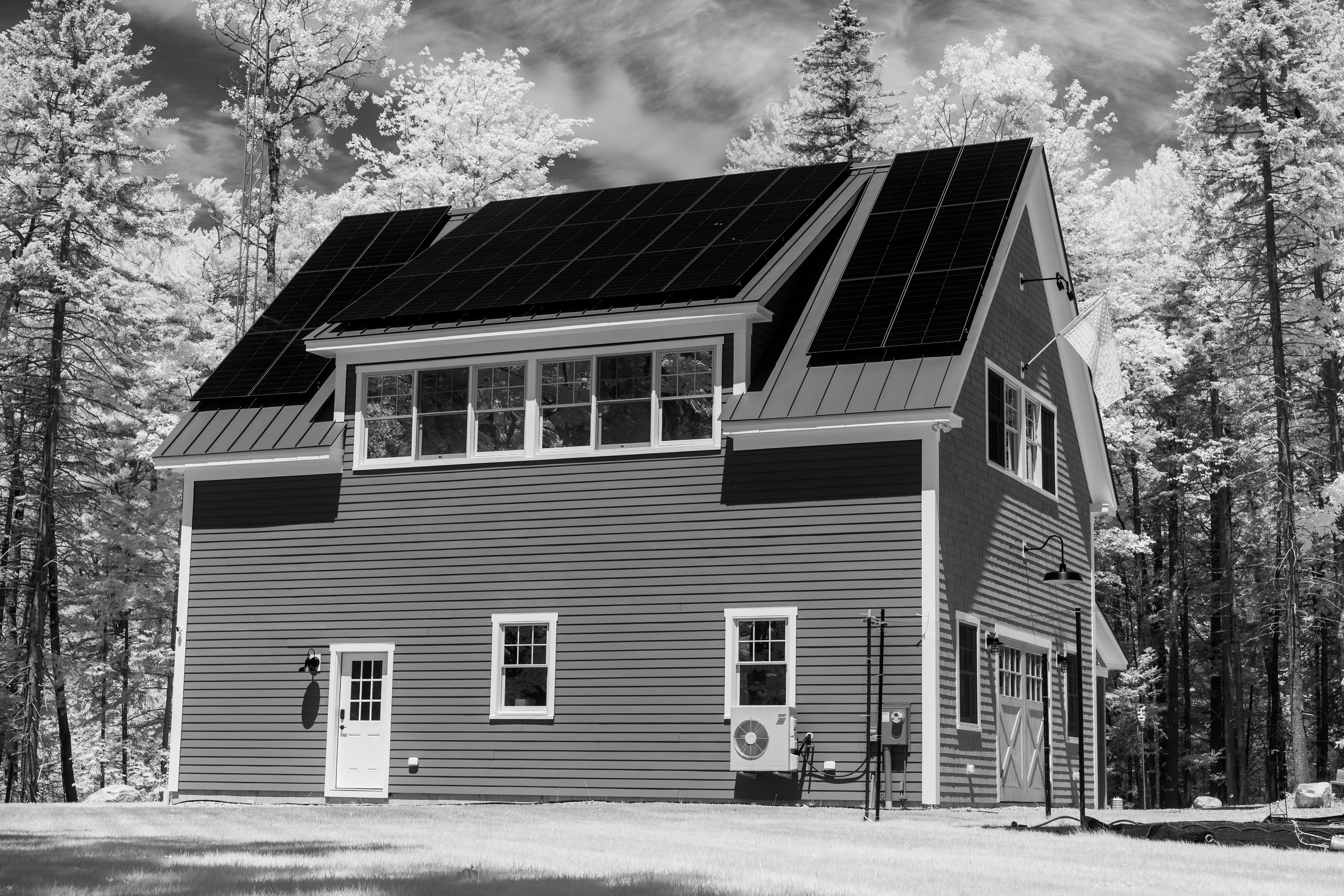
Off-grid buying usually starts with a remote or self-reliant site where the roof and surroundings shape the whole design. Photo by Skyler Ewing on Pexels.
The standard process is simple in principle.
For each device, take:
power in watts x hours used per day = daily energy in watt-hours
Then sum the totals across all loads.
That number becomes the foundation for battery sizing, inverter sizing, and array sizing.
A Practical Load Checklist
Section titled “A Practical Load Checklist”- Refrigerator or freezer
- Lighting
- Internet and communications gear
- Water pump
- Laptop, TV, and electronics
- Cooking loads
- Heating or cooling loads
- Workshop or tool loads if relevant
The trap here is not forgetting one big load.
It is underestimating how long loads run, and not accounting for startup surges from motors, pumps, or compressors.
That is why off-grid planning usually works better when you separate loads into three buckets.
| Load class | Meaning |
|---|---|
| Essential | Must stay on no matter what |
| Important | Strongly preferred, but not life-or-system critical |
| Deferrable | Can be moved or skipped during poor weather |
That one habit alone often prevents expensive oversizing and under-sizing mistakes.
Step 2, Use Real Sun Resource Data
Section titled “Step 2, Use Real Sun Resource Data”Once daily energy demand is clear, the next step is solar resource.
The key metric is peak sun hours. This is what lets you translate daily energy demand into required array production.
In practice, buyers often use tools such as PVWatts from NREL to get location-based solar resource estimates. That is a much stronger starting point than using a generic sunshine assumption from another region.
But here is the off-grid catch.
Do not size for the best month.
Do not even size for the average month if winter reliability matters.
Off-grid systems need to survive the hard season, not only perform well in summer.
Step 3, Size the Array With Losses Included
Section titled “Step 3, Size the Array With Losses Included”At a rough level, array sizing follows this logic.
Required PV array power =Daily energy use (Wh) / peak sun hoursThen adjust upward for real-world losses such as inverter losses, wiring losses, battery charging inefficiency, dust, and weather margin.
That is why many practical sizing guides suggest adding roughly 10% to 20% above the bare minimum calculation.
A Simple Example
Section titled “A Simple Example”If your site uses 6,000 Wh per day and receives 5 peak sun hours, the basic calculation starts here.
6,000 / 5 = 1,200 WBut that is still not a finished design.
Once you account for system losses and reserve margin, the actual array may need to be larger than the bare calculation suggests.
This is especially true in off-grid systems where occasional underproduction is not just a lower savings month, it is a reliability problem.
Step 4, Size the Battery Around Autonomy Days
Section titled “Step 4, Size the Battery Around Autonomy Days”Battery storage is the heart of off-grid reliability.
Most serious off-grid systems are sized not just for one night of storage, but for one to three autonomy days, meaning how long the system should keep operating with poor solar input.
A common battery-sizing logic looks like this.
Battery capacity =Daily energy use x autonomy days / usable depth of dischargeThen you still need to adjust for system efficiency and temperature effects.
This is where buyers often discover the true cost of off-grid independence. Batteries are not a side feature. They are one of the main cost drivers in the whole project.
Why Climate Changes Battery Sizing
Section titled “Why Climate Changes Battery Sizing”Cold weather reduces effective battery performance, so colder sites often need more reserve than the nominal spreadsheet suggests. Some practical guides recommend adding around 25% extra capacity in cold-climate scenarios to handle temperature derating more safely.
Hot climates create a different problem. Heat can accelerate battery aging, so ventilation and battery-room thermal conditions become part of the buying decision.
If you want to go deeper on the calculation side, read Battery Sizing and How to Choose a Battery.
Battery Chemistry, the Most Important Hardware Choice
Section titled “Battery Chemistry, the Most Important Hardware Choice”For most modern off-grid systems, the battery chemistry discussion usually comes down to lithium versus lead-acid, and more specifically LiFePO4 versus older alternatives.
| Battery type | Typical strength | Typical weakness | Best fit |
|---|---|---|---|
LiFePO4 | Long cycle life, high usable DoD, strong safety profile | Higher upfront cost than low-end lead-acid | Most modern serious off-grid systems |
NMC lithium | High energy density | Usually less ideal than LiFePO4 for fixed off-grid storage | Some compact or specialized storage cases |
| Lead-acid, AGM or gel | Lower upfront cost | Much shorter life and lower usable DoD | Budget systems or legacy setups |
For stationary off-grid storage, LiFePO4 is often the most comfortable default because long life and high usable depth matter more than maximum compactness.
Lead-acid can still look attractive on upfront price, but it often loses appeal once you model cycle life, usable capacity, and replacement frequency.
System Voltage, One of the Quietly Important Decisions
Section titled “System Voltage, One of the Quietly Important Decisions”Off-grid components must agree on system voltage.
That means the panel configuration, charge controller, battery bank, and inverter all need to make sense together in 12V, 24V, or 48V terms.
As loads get larger, higher system voltage often becomes more practical because it reduces current and can simplify conductor sizing and efficiency.
As a rule of thumb:
12Vsystems are usually for smaller and lighter-duty setups24Vsystems are common in medium off-grid builds48Vsystems are often the more practical choice for larger residential off-grid systems
This is one of those areas where random component mixing causes expensive trouble. Compatibility should be checked early, not after the cart is already full.
Charge Controllers and Inverters Matter More Than Buyers Expect
Section titled “Charge Controllers and Inverters Matter More Than Buyers Expect”Panels and batteries get the attention, but off-grid reliability also depends on the conversion and control layer.
Check these carefully.
- Charge controller type and current capacity
- Battery chemistry support and charging logic
- Inverter continuous output
- Inverter surge capacity for motors and compressors
- Monitoring and alarm visibility
- Safety protection and disconnect hardware
A system that looks large enough on paper can still perform badly if the inverter cannot handle surge loads or the charge controller cannot manage the array and battery correctly.
DC-Coupled vs AC-Coupled Off-Grid Systems
Section titled “DC-Coupled vs AC-Coupled Off-Grid Systems”Off-grid systems are often described in terms of how solar, battery, and loads are coupled.
| Architecture | How it works | Typical fit |
|---|---|---|
DC-coupled | Solar charges batteries through a charge controller before power is inverted for AC loads | Smaller systems or designs centered on battery charging efficiency |
AC-coupled | Solar is inverted first, then managed through AC architecture with battery charging handled differently | Larger systems and more flexible AC load scenarios |
DC-coupled systems are often simpler and more efficient in smaller off-grid designs. AC-coupled systems can make sense in larger or more modular setups, especially where daytime load use is high or architecture flexibility matters more.
This is not a beginner spec to obsess over too early, but it is worth asking the installer to explain clearly because it affects efficiency, expandability, and complexity.
Generator Backup, Often the Difference Between Comfortable and Fragile
Section titled “Generator Backup, Often the Difference Between Comfortable and Fragile”Many off-grid buyers want a pure solar-and-battery solution with no generator at all.
That can work for very disciplined low-load systems in strong solar climates.
But for many real off-grid homes, a backup generator is still part of a robust design strategy. It protects the system during bad weather, seasonal shortages, unusual load spikes, or maintenance windows.
That does not mean the system failed.
It means the design takes resilience seriously.
What Off-Grid Systems Usually Cost
Section titled “What Off-Grid Systems Usually Cost”Off-grid systems vary widely in cost because the real drivers are not just panel count.
The biggest variables are usually these.
- Daily energy demand
- Battery chemistry and capacity
- Desired autonomy days
- Inverter size and surge needs
- Whether a generator is included
- Site logistics and installation difficulty
Published estimates for full off-grid systems often span from roughly the low tens of thousands of dollars to much more for larger residential setups. The range is wide because load expectations vary wildly, and batteries dominate the economics quickly.
That is also why price-per-watt alone becomes much less useful here than it is in simple grid-tied projects.
Red Flags to Watch For
Section titled “Red Flags to Watch For”- Designs based on monthly bills without a real appliance-level load audit
- No mention of winter or worst-case solar conditions
- Battery capacity sized with no autonomy explanation
- No discussion of surge loads
- Mixed component voltages or unclear compatibility
- No backup plan for bad-weather stretches
Most off-grid failures start with optimism.
Not with bad weather.
A Good Default Decision Framework
Section titled “A Good Default Decision Framework”If you want the compact rule set, use this order.
- Reduce and classify loads before sizing anything
- Size for the difficult season, not the best season
- Build battery reserve around realistic autonomy days
- Prefer simple, compatible architecture over flashy component mixing
- Decide upfront whether generator backup is part of the reliability plan
That sequence usually produces a stronger off-grid system than starting from a panel bundle and hoping the rest works itself out.
Related Guides in Focus Solar
Section titled “Related Guides in Focus Solar”- On-Grid vs Off-Grid Systems
- How to Choose a Battery
- How to Choose an Inverter
- Battery Sizing
- Load Estimation
- Charge Controllers
Watch or Read More
Section titled “Watch or Read More”Key Takeaways
Section titled “Key Takeaways”- Off-grid buying is fundamentally a reliability design problem, not just a panel shopping problem.
- Honest load estimation and autonomy planning matter more than almost any hardware brand debate.
LiFePO4is often the strongest default battery chemistry for modern off-grid storage.- System voltage, controller compatibility, and inverter surge capacity matter more than many first-time buyers expect.
- A generator is often part of a resilient off-grid design, not a sign that solar was planned badly.
Sources Used for This Page
Section titled “Sources Used for This Page”This page was expanded using the research notes and source list provided for this project, especially the following references.
- DOE, Grid-Connected or Stand-Alone Renewable Energy Systems
- DOE, Own Your Power! Off-Grid Solar Guide
- NREL, Designing Off-Grid Solar Systems
- NREL, Installation and O&M of Off-Grid Solar
- EnergySage, Off-Grid Solar Costs and Best Products
- EcoFlow, Off-Grid Solar for Beginners
- SolarTech, Complete Off-Grid Solar System Guide
- YouTube, How to Size Your Off Grid Solar System