Getting Started
How Solar Panels Work
Learn how sunlight becomes electricity, how photovoltaic cells are built, and what affects real-world solar panel performance.
Solar panels look simple from the outside, but a lot is happening inside each cell. When sunlight hits a solar cell, it can knock electrons loose inside the semiconductor material. The cell is designed so those electrons move in one direction, which creates direct current (DC) electricity. That electricity is then collected, combined with other cells, and sent to the rest of the solar system.
If you are new to solar, this page gives you the full picture. We will start at the cell level, then move up to modules, strings, inverters, and complete systems.
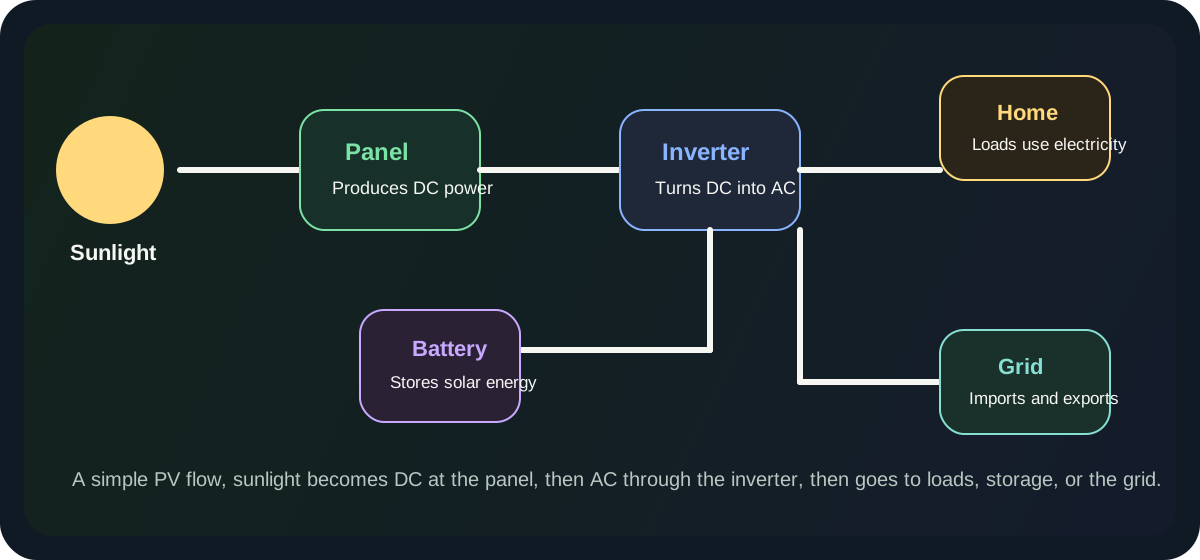
The Big Idea Behind Solar Panels
Section titled “The Big Idea Behind Solar Panels”Solar panels generate electricity through the photovoltaic effect. In simple terms, light energy from the sun is converted into electrical energy.
Here is the short version of what happens.
- Sunlight reaches the solar cell.
- Some photons carry enough energy to free electrons inside the silicon.
- An internal electric field pushes those electrons in a preferred direction.
- The electrons flow through an external circuit, creating usable electric current.
This is why solar panels produce electricity whenever they receive enough light. No moving parts are required at the panel itself.
What a Solar Cell Is Made Of
Section titled “What a Solar Cell Is Made Of”Most solar panels use silicon solar cells. A finished panel includes more than just silicon, but the cell is where the electricity is created.
A typical silicon solar cell includes these layers and components.
| Layer or part | What it does |
|---|---|
| Tempered glass | Protects the cells from weather, impact, and dirt |
| Anti-reflective coating | Reduces reflection so more sunlight enters the cell |
| Front metal contacts | Collect electrons from the cell and carry current away |
| N-type silicon layer | Silicon doped to have extra electrons available |
| PN junction | The boundary where the electric field is formed |
| P-type silicon layer | Silicon doped to have electron vacancies called holes |
| Rear metal contact | Completes the circuit on the back of the cell |
The two silicon layers are intentionally treated with small amounts of other elements.
- N-type silicon is commonly doped with phosphorus, which provides extra electrons.
- P-type silicon is commonly doped with boron, which creates holes where electrons can move.
When these two layers meet, they form a PN junction. That junction is the heart of the solar cell because it creates the internal electric field that separates charge.
How the Photovoltaic Effect Works
Section titled “How the Photovoltaic Effect Works”The physics can sound intimidating at first, but the flow is actually pretty intuitive once you picture it step by step.
1. Light enters the cell
Section titled “1. Light enters the cell”Sunlight passes through the glass and anti-reflective coating. The top N-type layer is intentionally thin so light can reach the active region near the PN junction.
2. Photons free electrons
Section titled “2. Photons free electrons”If a photon has enough energy, it can free an electron from its atomic bond in the silicon crystal. That leaves behind a hole.
3. The electric field separates charge
Section titled “3. The electric field separates charge”At the PN junction, the built-in electric field pushes electrons toward the N-side and holes toward the P-side. This separation matters because it prevents the charges from immediately recombining.
4. Current flows through the external circuit
Section titled “4. Current flows through the external circuit”Once the front and rear contacts are connected through a wire, electrons can travel through the external circuit. That moving charge is electrical current. If the circuit is connected to a load, such as a light, pump, or inverter, the current can do useful work.
5. The cell keeps producing power while light is available
Section titled “5. The cell keeps producing power while light is available”As long as light continues to generate charge carriers, the process repeats. The output is DC electricity.
One helpful mental model is to think of a solar cell as a device that uses light to create a voltage difference, then uses that voltage difference to drive current through a circuit.
Why One Cell Is Not Enough
Section titled “Why One Cell Is Not Enough”A single silicon solar cell produces only about 0.5 volts under typical operating conditions. That is useful for understanding the physics, but not enough to run a real home or business system by itself.
This is why cells are combined into larger assemblies.
- Cells wired in series add voltage while current stays roughly the same.
- Cells wired in parallel add current while voltage stays roughly the same.
For example, if 60 cells are connected in series and each cell contributes about 0.5 volts, the module might operate around 30 volts. If that module can deliver 8 amps, the power is roughly 240 watts.
This is also why panel datasheets list values like voltage at maximum power, current at maximum power, open-circuit voltage, and short-circuit current. Those numbers describe how the combined cells behave as a module. If you want to go deeper on performance metrics, see Panel Efficiency Explained.
From Cells to Modules to Strings
Section titled “From Cells to Modules to Strings”The terminology can be confusing early on, so it helps to separate the levels.
- A cell is the individual photovoltaic device.
- A module or panel is a weatherproof unit containing many cells.
- A string is a set of panels connected in series.
- An array is the complete group of strings in the system.
Common panel configurations include the following.
| Configuration | Typical use |
|---|---|
| 36-cell modules | Older or small off-grid battery charging applications |
| 60-cell or 72-cell modules | Common in residential and commercial systems |
| Larger modern formats | Common in commercial and utility-scale projects |
The exact number of cells matters because it affects system voltage, inverter compatibility, and battery charging behavior.
Where the Electricity Goes Next
Section titled “Where the Electricity Goes Next”Solar panels do not usually power household appliances directly. The power first passes through other equipment that makes it safe and usable.
Grid-tied systems
Section titled “Grid-tied systems”In a grid-connected system, solar panels send DC electricity to an inverter. The inverter converts it to alternating current, or AC, which can power loads in the building. If solar production is higher than current demand, excess energy may be exported to the grid where local policy allows it.
You can compare system types in more detail on On-Grid vs Off-Grid Systems.
Off-grid systems
Section titled “Off-grid systems”In an off-grid system, solar panels charge a battery through a charge controller, then an inverter supplies AC power to loads when needed. The charge controller is important because it prevents battery overcharging and manages the power coming from the panels. See Charge Controllers for a deeper explanation.
Hybrid systems
Section titled “Hybrid systems”A hybrid system combines solar, batteries, and the utility grid. This allows the system to store surplus energy, support backup loads during outages, and still interact with the grid when needed. These systems typically use a hybrid inverter. See Hybrid Inverter Explained for details.
Utility-scale solar farms
Section titled “Utility-scale solar farms”At the largest scale, many panel rows are connected to central or string inverters, then stepped up through transformers before feeding the electrical grid.
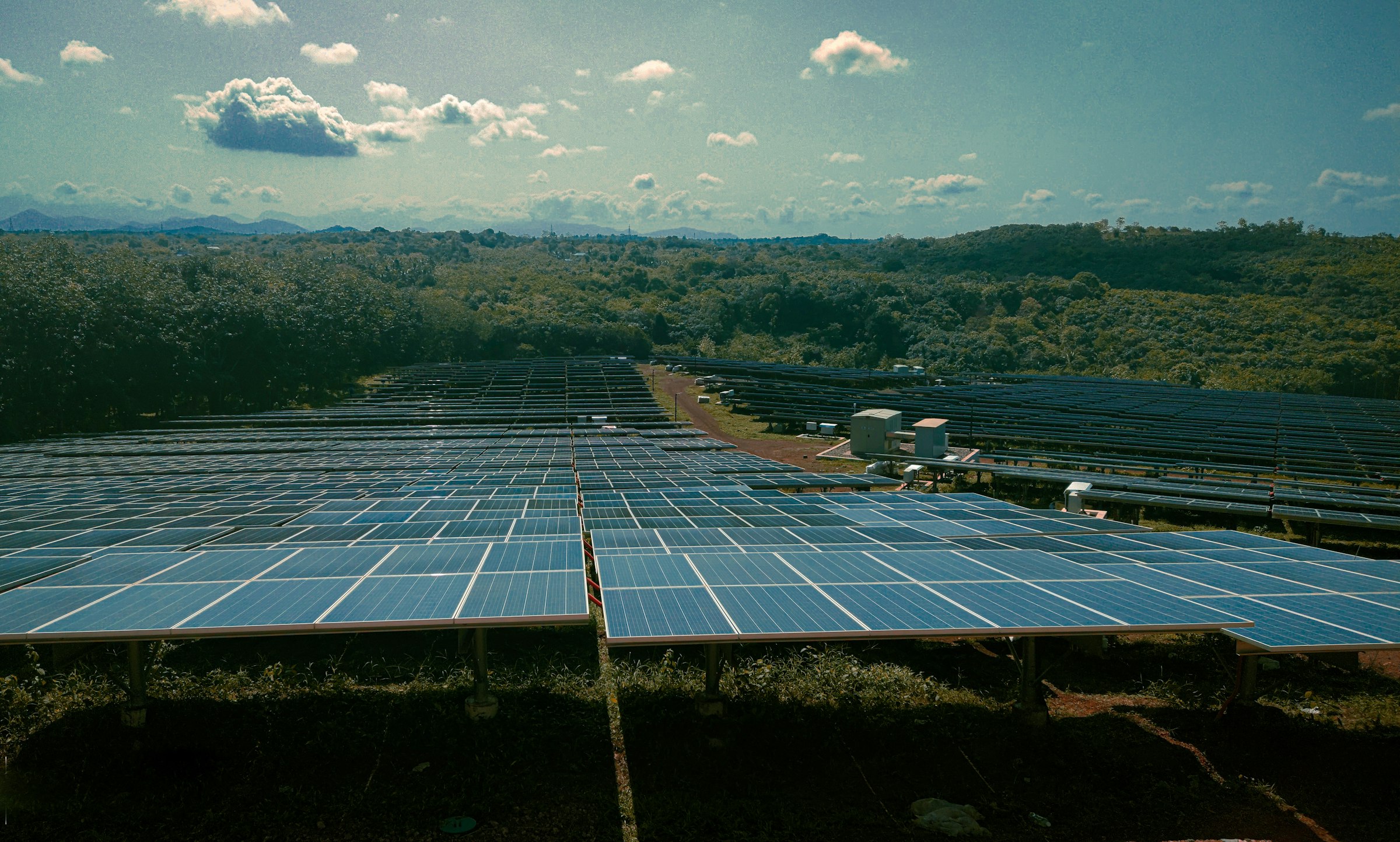
Utility-scale solar shows the same PV idea repeated at field scale. Photo by Harisankar on Unsplash.
Common Solar Panel Technologies
Section titled “Common Solar Panel Technologies”Not all solar panels are built the same way. Different cell technologies make trade-offs between efficiency, cost, appearance, and flexibility.
| Type | Typical efficiency range | Typical characteristics |
|---|---|---|
| Monocrystalline silicon | About 15 to 19 percent in older mainstream products, often higher in newer premium modules | Dark appearance, higher efficiency, common choice where roof space is limited |
| Polycrystalline silicon | About 13 to 17 percent in older mainstream products | Lower cost historically, slightly lower efficiency, less common in newer premium markets |
| Amorphous silicon thin film | About 5 to 8 percent | Lower efficiency, lightweight options, useful in small electronics or niche applications |
| Flexible thin film | Varies, usually lower than rigid crystalline panels | Useful on curved or weight-sensitive surfaces such as RVs and marine applications |
Monocrystalline and polycrystalline panels both use silicon, but monocrystalline cells have a more uniform crystal structure, which generally improves efficiency. Thin-film technologies can be valuable when low weight, flexibility, or specific form factors matter more than maximum efficiency.
Why Solar Panels Do Not Convert All Sunlight Into Electricity
Section titled “Why Solar Panels Do Not Convert All Sunlight Into Electricity”This is one of the most important things to understand. A solar panel does not turn every bit of sunlight into electrical power. Some energy is always lost.
Major loss mechanisms include the following.
| Loss source | Why it happens |
|---|---|
| Spectral mismatch | Silicon can only use photons above its bandgap energy, so some wavelengths are not converted |
| Excess photon energy | Photons with much more energy than needed lose the excess as heat |
| Reflection | Some sunlight bounces off the panel surface instead of entering the cell |
| Recombination | Some electrons and holes recombine before contributing to current |
| Temperature rise | Higher cell temperature usually lowers voltage and overall performance |
| Dirt and shading | Dust, debris, and partial shading reduce incoming light and can reduce string output |
| Wiring losses | Electrical resistance in cables converts some energy to heat |
| Inverter losses | Converting DC to AC is efficient, but never perfect |
In real systems, panel efficiency is only part of the story. Layout, shading, operating temperature, inverter selection, cable sizing, and maintenance all affect final energy yield. For more design-focused guidance, see Shading & Loss Analysis, Tilt Angle Optimization, and Cable Sizing.
Why Temperature and Shade Matter So Much
Section titled “Why Temperature and Shade Matter So Much”People often assume solar panels love heat because they work in sunny climates. In reality, solar cells need light more than they need heat. Strong sunlight increases available energy, but high cell temperature usually reduces voltage and therefore lowers output.
Shade is another major performance issue. In a series string, even partial shading on one panel can drag down the performance of the whole string unless the system is designed with mitigation methods such as module-level power electronics or thoughtful string layout.
That is why site survey work matters so much. Good solar design is not only about choosing a panel. It is also about roof orientation, tilt angle, seasonal sun path, and avoiding obstacles such as chimneys, trees, or nearby buildings.
Watch or Read More
Section titled “Watch or Read More”Why Solar Still Matters
Section titled “Why Solar Still Matters”Even with these limitations, solar remains one of the most practical ways to generate electricity without fuel combustion at the point of use. The sun delivers an enormous amount of energy to the Earth, and photovoltaic technology gives us a direct way to capture part of it.
Solar is not perfect. Output changes by location, weather, season, and time of day. Nighttime production is zero, which is why grid connection or energy storage matters so much. But when solar is combined with well-designed electronics, sensible system sizing, and, where needed, batteries, it becomes a dependable part of a modern energy system.
Key Takeaways
Section titled “Key Takeaways”- Solar panels work through the photovoltaic effect, which converts light into DC electricity.
- The critical structure inside the cell is the PN junction, which creates the electric field that separates charge.
- Individual cells produce only a small voltage, so many cells are connected together into modules and strings.
- Inverters, charge controllers, batteries, and wiring determine how solar power is used in real systems.
- Real-world performance depends on more than panel rating alone. Temperature, shading, reflection, wiring, and conversion losses all matter.
Further Reading
Section titled “Further Reading”If you want to keep going after this page, these are the best next steps.
- What Is Solar Energy
- On-Grid vs Off-Grid Systems
- Panel Efficiency Explained
- Charge Controllers
- Hybrid Inverter Explained
- Shading & Loss Analysis
Sources Used for This Page
Section titled “Sources Used for This Page”This page was expanded using the research notes and source list provided for this project, especially the following references.