System Design
Solar System Sizing
Learn how to size a solar array using daily load, peak sun hours, derate factors, roof area, and the different goals of grid-tied versus off-grid design.
Solar system sizing looks simple at first.
Take your daily electricity use, divide by sunshine, and you get a panel size. That basic idea is correct, but the real design question is more nuanced because sunlight is not uniform, module nameplate power is not what the home actually receives at the socket, and the right design target changes depending on whether the project is grid-tied, hybrid, or off-grid.
That is why good sizing is really a chain of linked decisions.
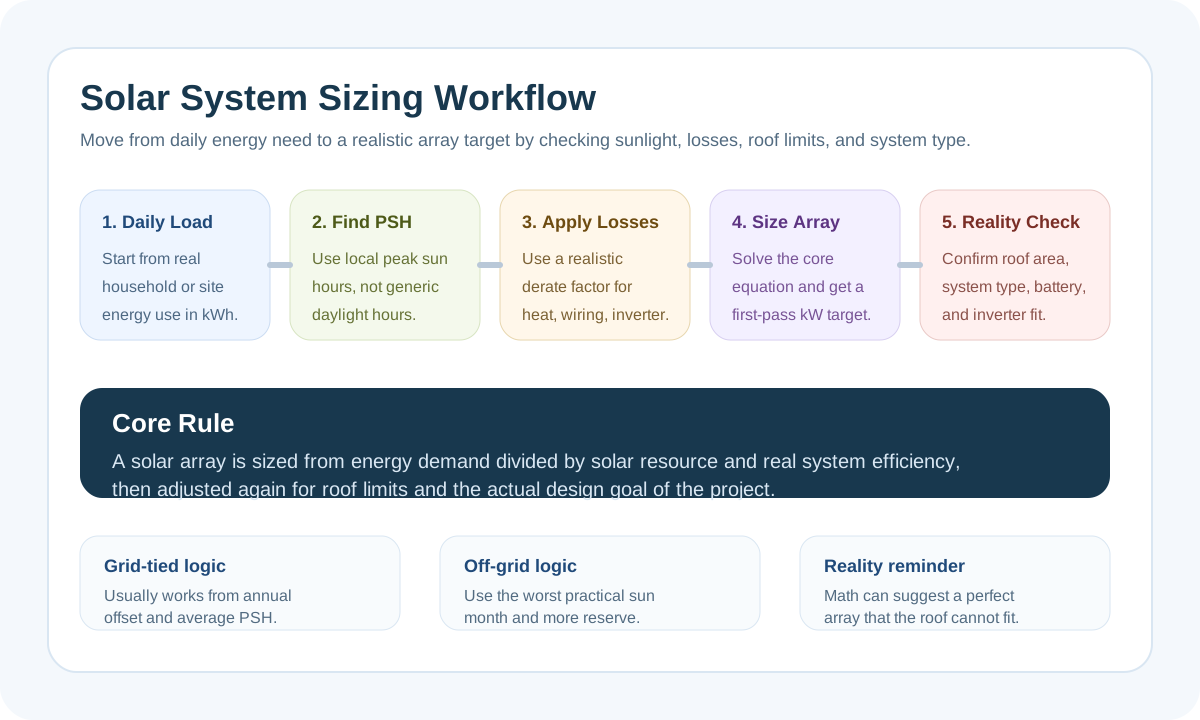
You start with believable daily load data, convert that into a target energy output, adjust for local peak sun hours, then apply real-world system losses before you trust the final array size.
This guide walks through that logic step by step so you can move from kWh/day to a realistic solar array target in kW.
The Core Formula
Section titled “The Core Formula”At its simplest, array sizing works backward from the energy the site needs each day.
Array capacity (kW) =daily load (kWh) / (peak sun hours x system efficiency)Where:
- Daily load is the site’s energy demand in
kWh/day - Peak sun hours,
PSH, describe the location’s solar resource - System efficiency is the derate factor that converts ideal panel output into realistic delivered energy
This formula is powerful because it turns system sizing into a transparent chain of assumptions instead of guesswork.
Worked Example
Section titled “Worked Example”Suppose a household uses 20 kWh/day, the site averages 5 peak sun hours per day, and the design assumes an overall system efficiency of 0.80.
Array = 20 / (5 x 0.80)Array = 5 kWThat means the project needs roughly a 5 kW array on paper to deliver the required daily energy under those assumptions.
The important phrase there is on paper.
The quality of the result depends entirely on whether the load number, PSH value, and derate factor are realistic for the actual site.
Step 1, Start With Daily Load
Section titled “Step 1, Start With Daily Load”Array sizing begins with energy demand, not with roof area and not with panel count.
That demand usually comes from:
- An appliance-by-appliance load estimate
- Utility bills converted into daily
kWh - Short-term meter data averaged over time
If the daily load is wrong, the array size will be wrong no matter how good the rest of the math is.
If you have not done this step yet, read Load Estimation first.
Step 2, Use the Right Peak Sun Hours
Section titled “Step 2, Use the Right Peak Sun Hours”Peak sun hours are one of the most important geographic inputs in solar design.
They do not mean the number of daylight hours. They mean the equivalent number of hours per day when solar irradiance averages 1000 W/m2.
That is why two places with similar daylight length can still have very different PSH values.
Typical broad ranges
Section titled “Typical broad ranges”| Region | Typical PSH |
|---|---|
| Germany, Munich | Around 3.0 to 3.5 h/day |
| United Kingdom | Around 2.5 to 3.5 h/day |
| Vancouver | Around 3.8 to 4.1 h/day |
| Adelaide | Around 5.0 to 5.5 h/day |
| Houston | Around 5.0 h/day |
| U.S. Southwest | Around 6.0 to 7.0 h/day |
| Middle East and North Africa | Around 6.5 to 7.5 h/day |
These are useful for orientation, but a real project should use an address-based source such as PVWatts whenever possible.
Why PSH Choice Changes by System Type
Section titled “Why PSH Choice Changes by System Type”The correct PSH assumption depends on what the system is trying to achieve.
Grid-tied systems
Section titled “Grid-tied systems”These often use annual-average solar resource because the grid can absorb shortfalls and surpluses across the year.
Off-grid systems
Section titled “Off-grid systems”These should usually be sized against the worst practical solar month, often a winter low-sun condition, because there is no grid fallback. That is why off-grid sizing should usually be cross-checked against Battery Sizing instead of being treated as an array-only calculation.
Hybrid systems
Section titled “Hybrid systems”These often sit in the middle. The grid still exists as backup, but battery behavior and backup expectations may justify a more conservative PSH choice than pure grid-tied design.
That is why PSH is not just a weather input. It is a design-goal input too.
Step 3, Apply a Realistic Derate Factor
Section titled “Step 3, Apply a Realistic Derate Factor”Panel nameplate power is not what the home receives in real operation.
Solar energy gets reduced by a chain of losses between the module label and the final usable output.
This is why solar sizing uses a derate factor or overall system efficiency.
A practical default often lands in the 0.75 to 0.80 range, though some engineering references show lower overall factors around 0.731 once many real losses are stacked together.
Common loss sources
Section titled “Common loss sources”| Loss source | Typical range |
|---|---|
| Temperature losses | About 5% to 7% |
| Cable and connector losses | About 2% to 3% |
| Inverter losses | About 2% to 4% |
MPPT tracking losses | About 1% to 2% |
| Shading losses | About 0% to 10% depending on the site |
| Soiling | About 1% to 7% depending on climate |
| First-year aging and later degradation | Roughly 0.5% to 1% per year after installation |
That is why two homes with the same load and the same sunlight can still need different array sizes if one roof is hotter, dirtier, or more shaded than the other.
A Good First-Pass Sizing Workflow
Section titled “A Good First-Pass Sizing Workflow”If you want the compact version, use this order.
- Estimate believable daily energy use in
kWh/day - Find local
PSHusing a location-aware tool - Choose a realistic derate factor
- Solve for array capacity in
kW - Convert that result into panel count and roof area
- Re-check the answer against inverter size, battery goals, and roof constraints
That sequence keeps system sizing connected to both energy need and physical feasibility.
From Array Size to Panel Count
Section titled “From Array Size to Panel Count”Once you know the array target in kW, you can estimate the number of modules required.
Panel count = array size (W) / panel wattage (W)For example:
5 kW array = 5000 W5000 / 400 = 12.5 panelsThat means you would likely need about 13 panels rated at 400 W, subject to actual string layout, roof dimensions, and available module sizes.
Typical rough counts using 400 W panels
Section titled “Typical rough counts using 400 W panels”| System size | Typical panel count | Approximate roof area |
|---|---|---|
3 kW | 7 to 9 panels | Around 11.9 to 15.3 m2 |
5 kW | 12 to 15 panels | Around 20.4 to 25.5 m2 |
6.6 kW | 15 to 18 panels | Around 25.5 to 30.6 m2 |
8 kW | 19 to 24 panels | Around 32.3 to 40.8 m2 |
10 kW | 22 to 30 panels | Around 37.4 to 51.0 m2 |
These are quick planning numbers, not final layout results.
Roof Space Can Change the Design More Than the Math
Section titled “Roof Space Can Change the Design More Than the Math”A theoretically correct array size still has to fit the site.
That means checking:
- Usable roof area
- Orientation
- Tilt
- Obstructions such as chimneys and vents
- Shading from trees or nearby buildings
This is why some homes that “need” a larger array mathematically may still end up with a smaller practical installation and a partial offset strategy instead of full annual coverage.
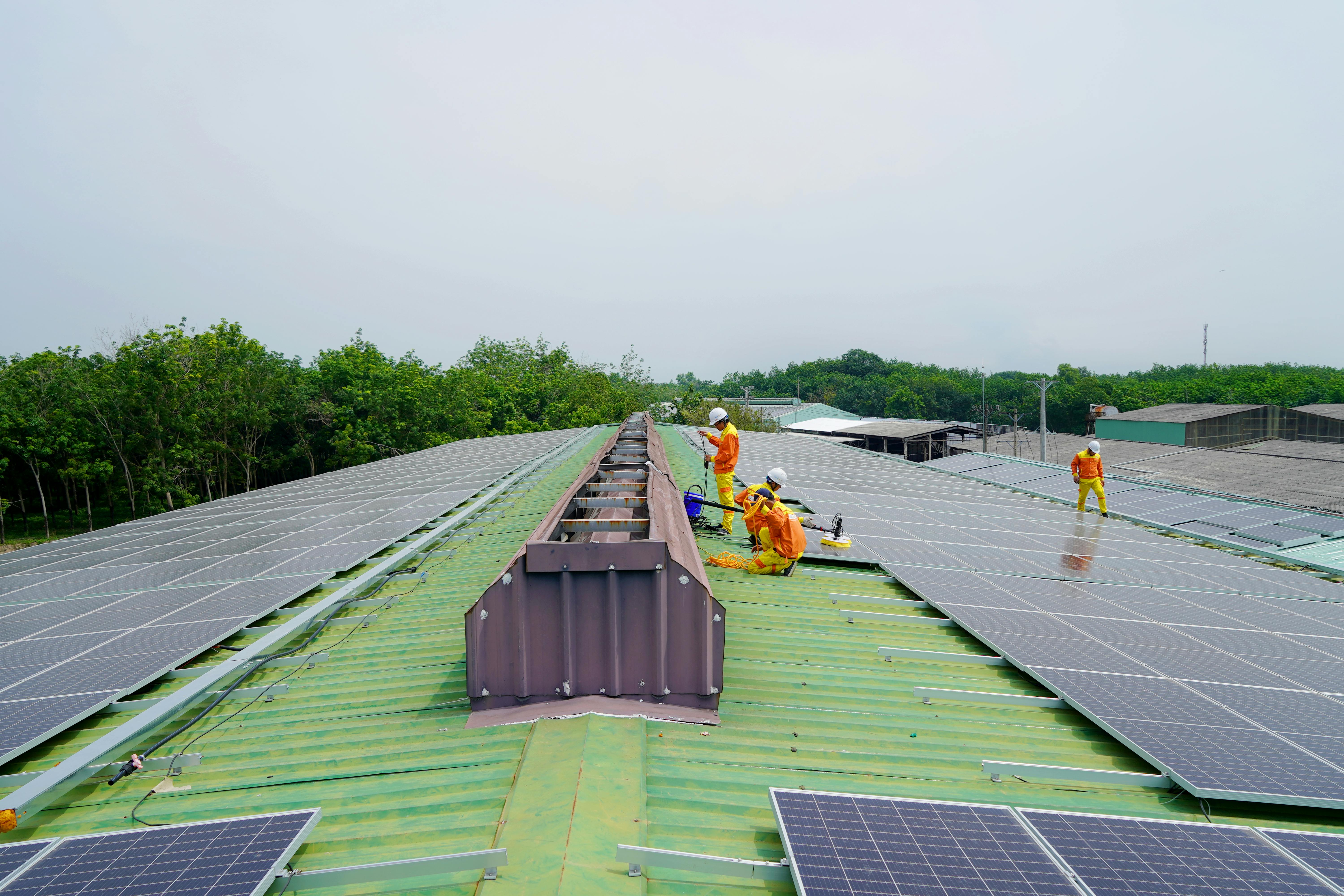
Real sizing always meets real roof geometry, access limits, and layout constraints sooner or later. Photo by Trinh Tran on Pexels.
Grid-Tied vs Off-Grid vs Hybrid Sizing Goals
Section titled “Grid-Tied vs Off-Grid vs Hybrid Sizing Goals”The same house can justify very different array sizes depending on the project objective.
Grid-tied
Section titled “Grid-tied”A grid-tied system often aims to offset around 80% to 100% of annual consumption, depending on export policy, budget, and roof area.
The grid covers shortfalls, so the array does not need to solve every low-sun event by itself.
Off-grid
Section titled “Off-grid”An off-grid system must survive the worst practical solar conditions and work together with the battery bank.
That usually means:
- Using low-season
PSH - Adding reserve margin
- Designing around battery autonomy days
- Sometimes including generator backup
Hybrid
Section titled “Hybrid”A hybrid system often aims to cover daytime load directly, support some night load with batteries, and let the grid act as the final fallback.
That can make the target array size more strategic than absolute.
Why Off-Grid Sizing Is More Conservative
Section titled “Why Off-Grid Sizing Is More Conservative”Off-grid design is usually less forgiving because it cannot rely on the utility as a hidden backup layer.
That is why off-grid sizing often includes:
- Worst-month sun assumptions
- Larger battery reserve
- Higher caution on derate factor
- More attention to winter load behavior
It is common for an off-grid array to look oversized compared with a grid-tied system serving the same average daily energy because the design target is reliability, not just annual offset.
After the array target is set, most projects still need Inverter Sizing to confirm that the power electronics can actually support the loads the array was designed around.
Common Solar System Sizing Mistakes
Section titled “Common Solar System Sizing Mistakes”- Using daylight hours instead of true peak sun hours
- Assuming nameplate panel power translates directly into delivered energy
- Reusing a generic derate factor on a shaded or high-temperature site
- Ignoring roof-space limits until after the math is done
- Using annual-average
PSHfor an off-grid design that must survive winter - Forgetting that battery-backed systems may need extra array to recharge storage reliably
Most solar sizing errors do not come from a hard formula.
They come from oversimplified assumptions feeding the formula.
A Practical Design Example
Section titled “A Practical Design Example”Suppose a household uses 15 kWh/day.
Now compare two design paths:
Grid-tied example
Section titled “Grid-tied example”- Daily load =
15 kWh PSH=5 h/day- Derate factor =
0.80
Array = 15 / (5 x 0.80) = 3.75 kWA first-pass answer would be about 3.8 kW.
More conservative off-grid example
Section titled “More conservative off-grid example”- Daily load =
15 kWh - Winter
PSH=3.5 h/day - Derate factor =
0.75
Array = 15 / (3.5 x 0.75) = 5.71 kWNow the first-pass answer is about 5.7 kW.
Same household, very different system size, because the design goal changed.
Where This Page Connects to the Rest of the Design
Section titled “Where This Page Connects to the Rest of the Design”Solar system sizing gives you the array target, but it is only one part of the final system.
After this step, most projects still need:
That is why array size should be treated as the center of a design loop, not the end of the process.
Related Guides in Focus Solar
Section titled “Related Guides in Focus Solar”- Load Estimation
- Battery Sizing
- Inverter Sizing
- Shading & Loss Analysis
- Tilt Angle Optimization
- Solar System Size Calculator
Watch or Read More
Section titled “Watch or Read More”Key Takeaways
Section titled “Key Takeaways”- Solar array sizing starts with daily energy demand, not panel count.
- The core formula depends on three things, load,
PSH, and realistic system efficiency. - A default derate factor around
0.75to0.80is often useful, but difficult sites may need more caution. - Grid-tied, hybrid, and off-grid systems should not use the same solar-resource assumptions blindly.
- A mathematically correct array still has to fit the roof, the inverter, and the battery strategy.
Sources Used for This Page
Section titled “Sources Used for This Page”This page was expanded using the research notes and source list provided for this project, especially the following references.
- NREL PVWatts Calculator
- NREL, Performance Parameters for Grid-Connected PV Systems
- NREL, Availability and Performance Loss Factors for U.S. PV Fleet
- Alternative Energy Tutorials, How to Size Your Solar Array
- Anker SOLIX, Solar Panel Calculation
- EnergySage, What Size Solar Inverter Do I Need
- Solacity, How to Size a Solar System That Really Works
- Renewable Energy Hub, How Many Solar Panels Do I Need
- YouTube, Solar 101 How to Size Your Solar System