Components
Charge Controllers
Understand what charge controllers do in battery-based solar systems, how PWM and MPPT differ, and how to size a controller correctly.
Charge controllers are easy to ignore when people first learn solar.
Panels feel more exciting.
Batteries feel more expensive.
Inverters feel more powerful.
But in an off-grid or battery-based system, the charge controller is one of the parts quietly protecting the battery bank from bad charging behavior all day long.
That is why this component matters so much.
It regulates the energy coming from the array so the battery is charged properly rather than abused, overheated, or pushed outside the safe limits of the system.
This guide explains what a charge controller really does, when PWM still makes sense, why MPPT became the normal answer for most modern systems, and how to size a controller without getting trapped by only one number on the label.
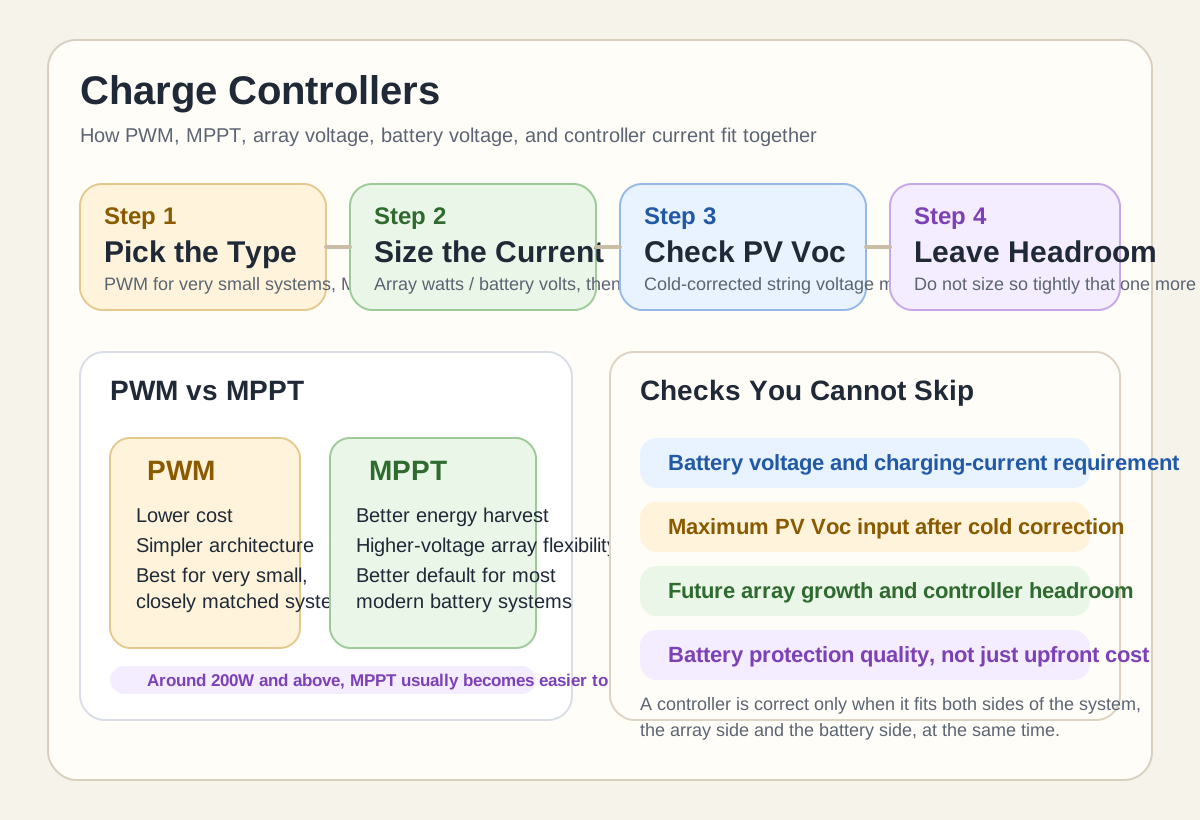
What a Charge Controller Actually Does
Section titled “What a Charge Controller Actually Does”In a battery-based solar system, the array does not simply feed the battery directly and hope for the best.
The controller sits between the panels and the battery bank and manages how charging happens.
Its basic jobs are:
- prevent overcharging
- manage charging stages properly
- limit unsafe voltage and current behavior
- protect battery health over time
In many systems it also contributes battery-monitoring and load-control functions, but the core job is simple:
it keeps charging under control.
That is why charge controllers belong in the battery-protection conversation, not just the panel conversation.
The Two Types Most People Compare, PWM and MPPT
Section titled “The Two Types Most People Compare, PWM and MPPT”For most buyers, the real question is not whether they need a controller.
It is which type.
That comparison almost always comes down to PWM versus MPPT.
PWM, Simpler and Cheaper, but More Limited
Section titled “PWM, Simpler and Cheaper, but More Limited”PWM stands for pulse-width modulation.
The practical idea is that the controller pulls the panel operating voltage down closer to battery voltage instead of actively converting excess panel voltage into extra charging power.
That is why PWM is simpler.
It is also why it usually wastes more of the panel’s available potential when panel voltage is much higher than battery voltage.
The upside of PWM:
- lower cost
- simpler hardware
- fine for small systems with closely matched panel and battery voltage
The downside:
- lower efficiency
- weaker performance when panel voltage sits far above battery voltage
- less advantage in larger systems
This is why PWM still survives in smaller, budget-driven setups, but stops looking attractive once system size and performance expectations climb.
MPPT, Why It Became the Modern Default
Section titled “MPPT, Why It Became the Modern Default”MPPT stands for maximum power point tracking.
This is the controller type most serious battery-based systems use now.
Instead of simply dragging panel voltage down toward battery voltage, an MPPT controller actively tracks the panel’s best operating point and converts that power down to the battery side more efficiently.
That gives it two major practical advantages:
- better energy harvest
- more freedom to run higher-voltage panel strings into lower-voltage battery banks
That second point is a big deal.
It means you can design the array side for lower current and cleaner wiring while still charging a 12V, 24V, or 48V battery system correctly.
The Real-World Difference, Why MPPT Often Wins by More Than the Efficiency Label Suggests
Section titled “The Real-World Difference, Why MPPT Often Wins by More Than the Efficiency Label Suggests”On paper, the broad shorthand looks something like this:
| Controller type | Typical conversion behavior | Best fit |
|---|---|---|
PWM | Simpler, lower-cost, panel voltage pulled closer to battery voltage | Small systems with tight budget and closely matched voltages |
MPPT | Active tracking with DC-DC conversion | Most modern off-grid and battery-backed systems |
Many practical guides and manufacturer references put MPPT efficiency in the high-90% range under good conditions, while PWM can leave more array power unused when voltage mismatch is significant.
But the bigger story is not just one lab efficiency number.
It is system design freedom.
MPPT lets the array behave more like an array instead of forcing it to act like a direct extension of battery voltage.
Why MPPT Usually Pulls Further Ahead in Cold Weather and Higher-Voltage Array Designs
Section titled “Why MPPT Usually Pulls Further Ahead in Cold Weather and Higher-Voltage Array Designs”This is where the performance gap often becomes easier to see.
In colder conditions, panel voltage rises.
That extra voltage can be valuable if the controller knows how to convert it efficiently, which is exactly the kind of situation where MPPT tends to show stronger gains.
Victron, Morningstar, and similar references all reinforce the same pattern:
MPPT becomes especially compelling when:
- panel voltage sits well above battery voltage
- the climate is cool enough to raise string voltage
- you want longer runs with lower array current
- the system is large enough that small efficiency losses become expensive
That is why many practical off-grid systems above a very small size stop debating and just go straight to MPPT.
When PWM Still Makes Sense
Section titled “When PWM Still Makes Sense”It would be lazy to say PWM is obsolete.
It is not.
It still makes sense when the system is:
- small
- budget-sensitive
- built with panel voltage close to battery voltage
- not trying to squeeze every bit of energy from a larger array
That is why very small cabin kits, lighting systems, or compact battery-maintenance systems can still use PWM rationally.
The key is honesty about scale.
If the system is already large enough that performance, wiring efficiency, and charging flexibility matter, then PWM usually stops being the strong answer.
A Good Practical Rule, Above About 200W, MPPT Usually Starts Looking Like the Better Default
Section titled “A Good Practical Rule, Above About 200W, MPPT Usually Starts Looking Like the Better Default”This is not a law of physics.
It is more of a planning line.
Once a system grows beyond the smallest hobby or maintenance scale, MPPT often becomes easier to justify because:
- the efficiency gain matters more
- the array design becomes more flexible
- the wiring can be cleaner on the panel side
- the controller is usually protecting a more valuable battery bank
That is why many modern battery-based systems above roughly 200W start from an MPPT-first assumption unless there is a very specific reason not to.
Sizing a Charge Controller, the Number Most People Look Up First
Section titled “Sizing a Charge Controller, the Number Most People Look Up First”Sizing usually starts with output current requirement.
A common practical formula is:
Controller current rating >= (array watts / battery voltage) x 1.25That 1.25 factor is the safety margin that helps prevent under-sizing.
So if the array is 1000W and the battery bank is 12V:
1000 / 12 = 83.3 A83.3 x 1.25 = 104.1 AThat pushes the design toward something like a 100A to 110A class controller, depending on the exact product family and how conservatively you want to size it.
Why Battery Voltage Changes the Controller Size So Quickly
Section titled “Why Battery Voltage Changes the Controller Size So Quickly”This is one of the most useful intuitions to build.
For the same array wattage:
- a lower battery voltage means higher charging current
- a higher battery voltage means lower charging current
So the same array looks much harder on a 12V controller than on a 48V controller.
That is one reason larger off-grid systems often move toward higher system voltage.
It makes controller sizing, cable sizing, and inverter behavior much easier to manage.
If you want that part in more detail, pair this page with System Voltage Selection.
Output Current Is Not the Only Number, You Also Have to Respect PV Voc
Section titled “Output Current Is Not the Only Number, You Also Have to Respect PV Voc”A controller can be oversized correctly on current and still be the wrong product if the array voltage exceeds the controller’s input limit.
That is why controller selection always needs a voltage-side check too.
A practical rule is:
the cold-corrected array Voc must stay below the controller’s maximum PV input voltage.
That matters because panel voltage rises in cold conditions.
So if the controller shows a maximum input like 100V, 150V, or 250V, that is not a casual suggestion.
It is a hard design boundary.
A Simple Voltage Check Example
Section titled “A Simple Voltage Check Example”Suppose:
- each panel has
Voc = 44V - you want
3panels in series - cold-weather correction factor is
1.25
Then the safety check becomes:
44 x 3 x 1.25 = 165 VIf the chosen controller is limited to 150V, that string is too aggressive.
If the controller allows 250V, the voltage side may be acceptable.
That is why a controller has to fit both the battery side and the array side.
A Better Sizing Workflow
Section titled “A Better Sizing Workflow”If you want a clean real-world sequence, use this order.
- Calculate array wattage.
- Identify battery-bank voltage.
- Estimate required charging current with margin.
- Check the controller’s maximum
PV Vocinput. - Check whether the controller’s battery-voltage family fits the system.
- Confirm the controller still leaves room for reasonable expansion.
That last point matters more than people think.
Buying a controller that is mathematically just enough on day one can feel clever until the owner adds one more string and has to replace the controller anyway.
PWM vs MPPT, the Honest Decision Table
Section titled “PWM vs MPPT, the Honest Decision Table”| Situation | Usually better choice | Why |
|---|---|---|
| Very small system, tight budget | PWM can still work | Simpler and cheaper when panel voltage is closely matched |
| Off-grid cabin, RV, or home backup with meaningful array size | MPPT | Better energy harvest and more flexible array design |
| High-voltage array into low-voltage battery bank | MPPT | Converts voltage more efficiently instead of wasting the gap |
| Cold climate or long panel-side runs | MPPT | Higher-voltage string design becomes more useful |
| Premium battery bank you want to protect carefully | Usually MPPT | Better overall control and better use of array energy |
That is the real shape of the decision.
Not:
PWM bad, MPPT good.
More like:
PWM is still defensible at very small scale, but MPPT becomes the smarter answer surprisingly quickly.
Common Charge Controller Mistakes
Section titled “Common Charge Controller Mistakes”These are the mistakes that keep showing up in off-grid troubleshooting.
Choosing Only by Price
Section titled “Choosing Only by Price”This is the classic trap.
The cheap controller looks fine until the system grows or the battery bank starts being charged poorly.
Sizing by Current but Ignoring Voc
Section titled “Sizing by Current but Ignoring Voc”A controller that fits the charging current but gets overrun on input voltage is still the wrong controller.
Forgetting Cold-Weather Voltage Rise
Section titled “Forgetting Cold-Weather Voltage Rise”This is how designs that look okay on paper end up too close to the input ceiling.
Treating PWM and MPPT as Interchangeable
Section titled “Treating PWM and MPPT as Interchangeable”They are not interchangeable once array voltage and battery voltage stop being closely matched.
Buying With No Expansion Room
Section titled “Buying With No Expansion Room”This is one of the quieter mistakes, but it happens a lot.
The controller is technically enough for the initial array and then becomes the first bottleneck the moment the system expands.
Where This Page Connects to the Rest of the Design
Section titled “Where This Page Connects to the Rest of the Design”Charge controller choice sits at the intersection of several other design decisions:
That is why controller selection feels simple only at first glance.
It is really one of the places where battery chemistry, system voltage, array layout, and wiring strategy all meet.
Watch or Read More
Section titled “Watch or Read More”Video Walkthrough
Section titled “Video Walkthrough”Key Takeaways
Section titled “Key Takeaways”- A charge controller protects the battery bank by controlling how solar charging happens.
PWMstill makes sense for some very small and tightly matched systems, butMPPTis the better default for most modern battery-based systems.- Controller sizing needs both current and voltage checks, not just one formula.
- Higher array size and lower battery voltage push controller current requirements up quickly.
- One of the easiest mistakes is choosing a controller that fits on paper today but leaves no room for safe array expansion.