Components
Panel Degradation Rate
Learn how solar panels lose output over time, what typical degradation rates mean for 25-year production, and how to evaluate warranty guarantees honestly.
Every solar panel degrades.
The real question is not whether output falls over time.
It is how fast it falls, how that loss should be modeled over 25 years, and whether the warranty curve is actually strong enough to matter.
That is where a lot of buyers get misled.
They hear a phrase like 0.5% per year and assume they understand long-term output.
But panel degradation is usually a two-part story:
- a bigger first-year drop
- then a slower annual decline afterward
This guide explains the typical rates, how to estimate year-10 and year-25 output, what causes degradation in the field, and how to read performance warranties without giving marketing too much credit.
What Panel Degradation Rate Actually Means
Section titled “What Panel Degradation Rate Actually Means”Degradation rate is the speed at which a solar panel loses output capability over time.
Usually that means power loss relative to the original nameplate rating.
So if a 400W panel degrades, it may still work perfectly fine years later, but it may no longer deliver the same peak output it did when new.
This matters because lifetime value is built from energy delivered over decades, not just the wattage printed on day one.
The Strongest Baseline, 0.5% Per Year Is a Good Mental Anchor
Section titled “The Strongest Baseline, 0.5% Per Year Is a Good Mental Anchor”NREL’s analytical review is still one of the most useful reference points here.
Its widely cited median sits around 0.5% per year for photovoltaic module degradation, with real-world variation above and below that depending on module quality, climate, and failure mode.
That does not mean every good panel is exactly 0.5%.
It means that if you need one baseline assumption for long-term modeling, 0.5% per year is a reasonable place to start unless the module warranty or field data gives you a better project-specific number.
Why First-Year Loss Should Usually Be Separated From Later Annual Loss
Section titled “Why First-Year Loss Should Usually Be Separated From Later Annual Loss”This is one of the easiest parts of the topic to oversimplify.
Many modern performance warranties do not model degradation as a perfectly flat annual line from day one.
Instead, they separate:
- first-year degradation, often around
1%to3% - later annual degradation, often around
0.3%to0.7%
That is why a panel may be warranted at something like:
98%after year190%+around year1080%to88%or better by year25
If you skip the first-year drop and model everything as one constant rate, the long-term output estimate can drift away from the actual warranty structure.
A Simple 25-Year Degradation Formula
Section titled “A Simple 25-Year Degradation Formula”One practical way to model panel output is:
Pt = P0 x (1 - d1) x (1 - da)^(t - 1)Where:
P0is original powerd1is the first-year degradation ratedais the later annual degradation ratetis the year number
This is a useful planning formula because it maps more closely to how modern performance warranties are usually written.
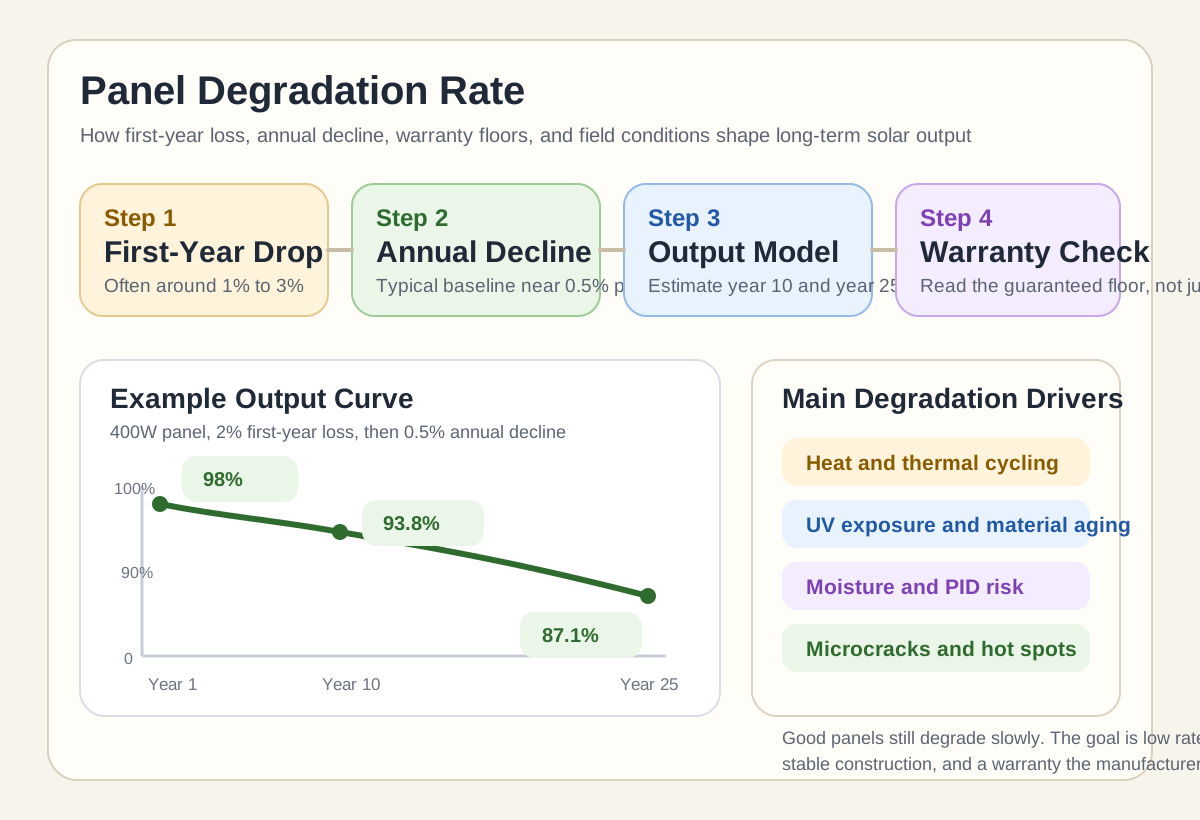
Worked Example, 400W Panel With 2% First-Year Loss and 0.5% Annual Loss
Section titled “Worked Example, 400W Panel With 2% First-Year Loss and 0.5% Annual Loss”Let us use a simple example:
- original panel rating =
400W - first-year loss =
2% - annual loss after that =
0.5%
That gives you:
- end of year
1= about392W - end of year
10= about375W - end of year
25= about348W
As a share of original output, that is roughly:
- year
1=98% - year
10=93.8% - year
25=87.1%
That is why a panel can degrade steadily and still remain highly useful decades later.
The module is not dead at year 25.
It is just producing less than its original rating.
How 0.5% and 0.8% Start to Separate Over Time
Section titled “How 0.5% and 0.8% Start to Separate Over Time”Small annual differences do not look dramatic in year two or year three.
They become much more meaningful over long ownership periods.
That is why year-25 output is such a useful comparison point.
Here is a simplified view using a first-year drop plus ongoing annual decline.
| Year | 0.5% annual loss after year 1 | 0.8% annual loss after year 1 | What it tells you |
|---|---|---|---|
| 1 | About 98% | About 97% | Early warranty floors often look similar |
| 10 | About 94% | About 90% to 92% | Long-term gap begins to matter |
| 25 | About 87% to 88% | About 80% to 83% | Warranty strength becomes a serious differentiator |
This is why low degradation is not just a spec-sheet vanity metric.
It changes the total lifetime energy the panel can deliver.
Why Warranty Curves Matter, but Should Not Be Treated as Reality by Default
Section titled “Why Warranty Curves Matter, but Should Not Be Treated as Reality by Default”Performance warranty is not the same thing as measured field output.
It is a manufacturer guarantee floor.
That distinction matters.
A panel can outperform the warranty curve.
A panel can also underperform in the real world for reasons the warranty does not fully cover, such as:
- installation damage
- persistent soiling
- shading changes
- hot spots
- microcracks
- balance-of-system losses that are not actually module degradation
So the right way to read a degradation warranty is:
this is the minimum the manufacturer says it will stand behind, not a promise that your system will track that exact curve in operation.
Product Warranty vs Performance Warranty
Section titled “Product Warranty vs Performance Warranty”These are different protections, and buyers often blur them together.
Product Warranty
Section titled “Product Warranty”This covers defects in materials and manufacturing.
Typical terms are often around 12 to 25 years, depending on the module tier and brand.
Performance Warranty
Section titled “Performance Warranty”This covers long-term output retention.
Typical structures might promise:
- high output retention after year
1 - a linear decline after that
- a final floor at year
25or year30
If you are comparing two panels, the useful question is not just:
which one has a 25-year warranty?
It is:
which one retains more guaranteed output at the end of that period, and how credible is the company standing behind it?
The Main Drivers of Faster Degradation
Section titled “The Main Drivers of Faster Degradation”RatedPower, NREL, Paradise Energy, and other technical explainers point to a familiar group of degradation drivers.
High operating temperatures accelerate stress on module materials.
That is one reason hot roofs and desert sites often show harsher aging behavior than cool, temperate installations.
UV Exposure
Section titled “UV Exposure”Long-term ultraviolet exposure slowly stresses encapsulants, backsheets, and other polymer layers.
This is one of the quiet background drivers of module aging.
Moisture and PID
Section titled “Moisture and PID”Potential induced degradation, or PID, becomes more relevant in humid, high-voltage, or poorly controlled system conditions.
It can reduce performance materially if module design and system grounding strategy are weak.
Thermal Cycling and Mechanical Stress
Section titled “Thermal Cycling and Mechanical Stress”Panels expand and contract as temperatures swing.
Over years, that repeated cycling can contribute to solder fatigue, cell stress, and microcracks.
Microcracks, Hot Spots, and Long-Tail Failures
Section titled “Microcracks, Hot Spots, and Long-Tail Failures”Not all degradation is smooth and predictable.
Some panels experience hidden cell damage, localized hot-spot behavior, or crack growth that creates worse-than-expected long-tail underperformance.
That is part of why real fleet performance can spread wider than a clean warranty curve suggests.
Climate Can Change the Meaning of the Same Warranty
Section titled “Climate Can Change the Meaning of the Same Warranty”This is an underrated point.
Two panels with the same paper warranty may age differently in:
- a cool northern climate
- a humid coastal climate
- a hot dusty inland site
- a rooftop with poor ventilation
That does not make the warranty meaningless.
It just means climate and installation quality influence whether the real project behaves like the brochure case or the stress case.
How to Evaluate a Panel’s Degradation Terms on a Quote
Section titled “How to Evaluate a Panel’s Degradation Terms on a Quote”If you are comparing real products, check these items in order:
- What is the first-year degradation allowance?
- What is the later annual degradation rate?
- What output is guaranteed at year
25or year30? - Is the performance warranty linear and clearly stated?
- Does the manufacturer have a credible service and claims track record?
That sequence is much more useful than just comparing headline efficiency.
What a Good Degradation Profile Looks Like in Practice
Section titled “What a Good Degradation Profile Looks Like in Practice”For modern premium modules, buyers generally feel more confident when they see:
- modest first-year loss
- annual degradation closer to
0.3%to0.5% - year-25 retention in the high-
80%range - a manufacturer with a long product warranty as well as a strong performance warranty
At the other end, a weaker profile usually looks like:
- a larger first-year drop
- annual decline closer to
0.7%or0.8% - a year-25 floor around
80% - less confidence in claims support
That does not automatically make the cheaper module a bad buy.
It just means the lifetime-value case has to be judged more carefully.
Why Degradation Should Be Part of ROI Math
Section titled “Why Degradation Should Be Part of ROI Math”This is where the topic becomes financial rather than purely technical.
Long-term savings depend on how much energy the array delivers over time.
So if one module retains more output in years 15 through 30, that can improve:
- lifetime kWh production
- long-term bill offset
- export value
- replacement timing
- resale confidence
That is why degradation rate belongs in ROI modeling, not just warranty fine print.
Related Guides in Focus Solar
Section titled “Related Guides in Focus Solar”- Solar Panels
- Panel Efficiency Explained
- How to Read a Panel Datasheet
- Monocrystalline vs Polycrystalline Panels
- 550W vs 600W Panels
Watch or Read More
Section titled “Watch or Read More”Key Takeaways
Section titled “Key Takeaways”- A panel degradation rate tells you how output falls over time, not whether the module suddenly stops working.
0.5%per year is a strong baseline assumption for long-term modeling, but first-year loss should usually be modeled separately.- A panel with lower annual degradation can deliver materially more energy by year
25, even if the difference looks small early on. - Performance warranty is a guaranteed floor, not a perfect forecast of real-world system output.
- Long-term panel value depends on degradation, warranty quality, installation quality, and climate together.