Pricing & ROI
Commercial Solar Cost
Learn what commercial solar costs in 2025 and 2026, how price per watt changes by project size, and how incentives and financing reshape the business case.
Commercial solar almost always looks cheaper than residential solar on a per-watt basis, but that does not mean it is simpler to buy.
A business is usually dealing with a larger system, a more complicated tariff, more stakeholders, and more financing options. That means the number on the first proposal page is only the start of the conversation.
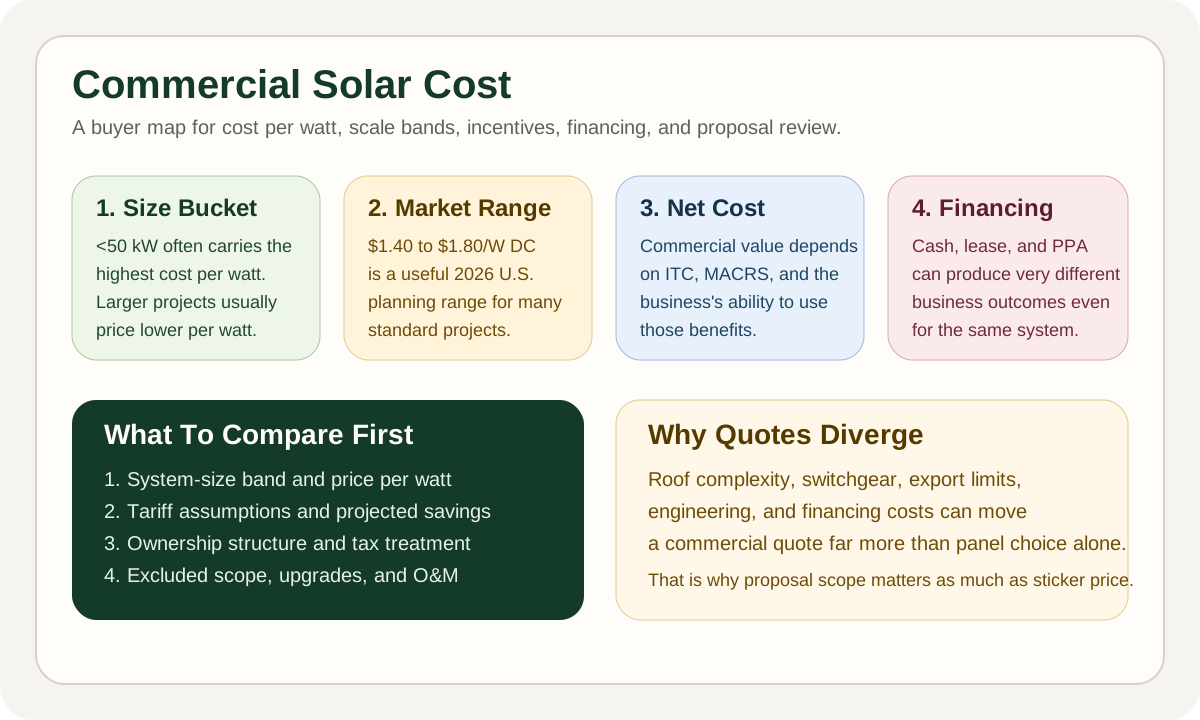
This guide breaks down the practical commercial cost ranges businesses are seeing in 2025 and 2026, explains how size changes the economics, shows how ITC, MACRS, leases, and PPA structures affect the real business case, and highlights what to check before comparing proposals.
Quick Cost Snapshot
Section titled “Quick Cost Snapshot”The biggest pattern in commercial solar pricing is simple: larger systems usually cost less per watt.
United States
Section titled “United States”Current U.S. market guides for commercial systems commonly place installed pricing around:
$1.40 to $1.80/W DC for many standard commercial projectsBroader market references still show a wider all-in range depending on project size and complexity:
$1.83 to $3.50/W before incentivesThose two ranges are not contradictory. The narrower one usually reflects more standard mid-scale commercial projects. The wider one captures smaller commercial systems, more complex sites, and projects with tougher soft-cost burdens.
United Kingdom
Section titled “United Kingdom”Recent UK business-focused guides commonly put commercial solar around:
£700 to £1,000 per kWThat means small office, retail, or SME projects can land anywhere from the low five figures to much larger capital budgets depending on site size and installation type.
Australia
Section titled “Australia”Australian references for 30 kW to 100 kW commercial systems commonly land around:
AUD $30,000 to $80,000As in other markets, the total depends heavily on roof type, switchboard work, export constraints, and whether storage is part of the scope.
Why Commercial Solar Looks Cheaper Per Watt
Section titled “Why Commercial Solar Looks Cheaper Per Watt”Commercial solar benefits from scale.
As systems get bigger, fixed soft costs such as sales effort, engineering, permitting, project management, mobilization, and some electrical labor are spread across more watts. That is why a 100 kW rooftop project can look dramatically cheaper per watt than a 10 kW or 20 kW small-business installation.
This is one of the most important framing points for buyers:
- Lower
$/Wdoes not mean lower total risk - Lower
$/Wdoes not guarantee better savings - Lower
$/Wonly becomes meaningful once tariff assumptions and project scope are understood
What Current Benchmark Sources Show
Section titled “What Current Benchmark Sources Show”The most defensible way to talk about commercial pricing is to combine official benchmark context with live market ranges.
The U.S. Department of Energy’s 2024 Q1 benchmark page explains the official modeling framework and currently publishes a representative commercial benchmark for a 3 MW agrivoltaics system at about $1.51/W DC modeled market price, alongside a 100 MW utility-scale benchmark at about $1.12/W DC.
That official benchmark is useful because it shows the direction of travel:
- commercial-scale solar is materially cheaper per watt than residential
- utility-scale is cheaper still
- size and project form factor change costs substantially
For practical rooftop and business-property projects, current market sources such as GreenLancer and BENY are often more useful for buyer-facing planning because they give more relatable size bands.
Commercial Cost by System Size
Section titled “Commercial Cost by System Size”One of the clearest ways to evaluate a commercial quote is to place it into the right scale bucket.
Micro Commercial: Below 50 kW
Section titled “Micro Commercial: Below 50 kW”This bucket often includes small offices, shops, restaurants, churches, and small mixed-use buildings.
Typical reference range:
$2.45 to $3.25/WThese projects often look expensive per watt because they still carry many of the same soft-cost steps as bigger jobs, but without enough scale to dilute them.
Mid-Size Commercial: 50 kW to 250 kW
Section titled “Mid-Size Commercial: 50 kW to 250 kW”This range is common for warehouses, medium retail, schools, light industrial, and larger SMEs.
Typical reference range:
$1.80 to $2.45/WThis is where commercial solar starts to look much more efficient on a per-watt basis.
Large Commercial: 250 kW to 1 MW
Section titled “Large Commercial: 250 kW to 1 MW”Typical reference range:
$1.60 to $2.15/WAt this size, engineering, interconnection, and procurement complexity usually rise, but cost per watt often keeps improving.
Industrial or Portfolio Scale: Above 1 MW
Section titled “Industrial or Portfolio Scale: Above 1 MW”Typical reference range:
$1.45 to $1.80/WAt this point, the curve starts flattening. The project is still getting bigger, but the easiest scale savings have mostly already been captured.
A Practical Example: 100 kW Commercial Solar
Section titled “A Practical Example: 100 kW Commercial Solar”100 kW is a useful reference point because it sits in the middle of many real business conversations.
One current commercial guide puts a 100 kW system at about:
$200,000 before incentivesThat is roughly:
$2.00/WThis is not a universal rule. It is simply a useful midpoint example for understanding how mid-scale commercial pricing can behave.
What Is Actually Included in a Commercial Solar Quote
Section titled “What Is Actually Included in a Commercial Solar Quote”A proper commercial solar quote usually includes:
- Solar modules
- Inverters
- Mounting and structural hardware
DCandACelectrical balance-of-system parts- Monitoring
- Engineering and design
- Permitting and interconnection work
- Installation labor
- Commissioning
Commercial proposals may also include:
- Structural review
- Switchboard or transformer upgrades
- Protective relays or export-limit controls
- Roof remediation coordination
- Ongoing operations and maintenance
- Battery storage
That is why two bids with the same kW size can be far apart in total price. Scope differences matter just as much as wattage.
What Pushes Commercial Pricing Higher or Lower
Section titled “What Pushes Commercial Pricing Higher or Lower”Several variables move commercial pricing significantly.
System size
Section titled “System size”This is usually the biggest driver of $/W.
Roof and site complexity
Section titled “Roof and site complexity”Complicated roofs, parapets, limited access, aging roof membranes, and structural reinforcement all raise cost.
Electrical infrastructure
Section titled “Electrical infrastructure”Switchgear upgrades, service constraints, interconnection studies, and export limitations can materially change the project budget.
Soft costs
Section titled “Soft costs”Recent market commentary notes that module pricing has fallen sharply, even to around $0.30/W DC in some spot-market discussions, while labor, permitting, and financing costs have risen. That means soft costs are now a larger share of the commercial project total.
Financing structure
Section titled “Financing structure”Cash, debt, lease, and PPA structures can change how a project looks economically even when the hardware and installer are identical.
Tariff structure
Section titled “Tariff structure”Commercial projects are often justified by a mix of kWh savings, demand-charge reduction, and tariff-shaping benefits. A site with the wrong load profile may see weaker savings even if the install price looks attractive.
Residential vs Commercial: The Real Difference
Section titled “Residential vs Commercial: The Real Difference”Residential systems often live around the upper end of the solar pricing ladder because they are small, rooftop-specific, and highly fragmented operationally.
Commercial systems often land lower on $/W, but they ask more from the buyer:
- more capital
- more procurement discipline
- more utility analysis
- more contract review
- more tax and accounting review
That is why commercial ROI can look stronger on paper while the buying process still feels more demanding.
Tax Incentives and Why They Matter
Section titled “Tax Incentives and Why They Matter”Commercial buyers often care less about sticker price and more about net cost after tax treatment.
The most stable point to rely on here is the IRS guidance.
The IRS says qualified clean energy facilities, property, and energy storage technology placed in service after December 31, 2024 may be eligible for 5-year MACRS depreciation. It also states that these assets are considered 5-year property under the relevant cost-recovery rules.
That makes accelerated depreciation one of the most important levers in commercial solar economics.
ITC and stacked value
Section titled “ITC and stacked value”Commercial market guides in 2026 still treat the federal investment tax credit as the primary upfront tax lever for many projects, with additional bonus-credit pathways sometimes available depending on project facts.
Boston Solar’s 2026 commercial incentive explainer describes a common framing:
ITCdelivers a direct tax creditMACRSreduces taxable income over a5-yearaccelerated schedule- with a
30%ITC, the depreciable basis is reduced so the business depreciates85%of total system cost
That same source says some commercial entities can recover roughly 60% to 70% of project value in the first year when these benefits are stacked. That is a planning reference, not a universal guarantee.
Financing Structures: Cash, Lease, or PPA
Section titled “Financing Structures: Cash, Lease, or PPA”Commercial solar is often as much a financing decision as an equipment decision.
Cash Purchase
Section titled “Cash Purchase”Cash purchase usually offers:
- full ownership
- maximum long-term savings
- direct access to tax incentives if the business can use them
Current commercial financing guides describe cash purchase as the path to the highest long-term returns, but also the highest upfront capital requirement.
A lease usually means:
- no large upfront capital outlay
- fixed recurring payments
- the third-party owner keeps the tax benefits
Recent financing guides say lease terms commonly run around 15 to 25 years, with end-of-term purchase options in many structures.
A PPA usually means:
- the solar developer owns the system
- the host customer buys the electricity
- pricing is typically set below current utility rates
Current financing guides commonly describe PPA rates as around 10% to 20% below grid pricing, with contracts often lasting 15 to 20 years or longer. Greentech Renewables also explains the host-model structure clearly: the host provides roof or land, while the provider installs, owns, operates, and maintains the system.
How Financing Changes the Real Cost
Section titled “How Financing Changes the Real Cost”This is the part many headline cost articles skip.
The same 250 kW project can be:
- a capital asset owned by the business
- an operating-style lease commitment
- a long-term energy services agreement under
PPA
Those are three very different commercial decisions.
Cash purchase usually wins on lifetime economics if the business can use the incentives.
Lease and PPA structures usually win on capital preservation and ease of entry, but the developer or lessor keeps much of the tax upside.
How to Evaluate a Commercial Proposal
Section titled “How to Evaluate a Commercial Proposal”A commercial quote should be judged on more than $/W.
Strong proposal-review sources consistently point buyers toward the same questions.
Experience
Section titled “Experience”Does the installer have a track record with comparable project sizes, building types, and local utilities?
Equipment flexibility
Section titled “Equipment flexibility”Is the installer locked to a single vendor, or can the design adapt to the actual project needs?
Scope completeness
Section titled “Scope completeness”Does the quote include engineering, modeling, permits, interconnection, taxes, safety equipment, roof coordination, and commissioning?
Modeling rigor
Section titled “Modeling rigor”Are the production and savings assumptions conservative, documented, and tied to actual utility data?
Namaste Solar’s commercial proposal checklist is especially useful here. It emphasizes project portfolio, equipment flexibility, complete turnkey scope, and the rigor of utility analysis and production modeling.
Common Pricing Mistakes Commercial Buyers Make
Section titled “Common Pricing Mistakes Commercial Buyers Make”- Comparing
$/Wwithout checking project size category - Treating a lease,
PPA, and cash-purchase quote like equivalent offers - Ignoring tariff design and demand-charge exposure
- Assuming every tax incentive applies cleanly to every entity
- Missing excluded scope such as switchboard work or roof coordination
- Using aggressive production models without checking the assumptions
A Good Default Comparison Framework
Section titled “A Good Default Comparison Framework”Most commercial proposals get much easier to read when you use this order.
- Place the project in the right system-size bucket
- Check
$/Wagainst the right commercial range - Confirm whether the quote is cash, debt, lease, or
PPA - Review the exact scope, including interconnection and electrical upgrades
- Check tax treatment and depreciation assumptions with a qualified advisor
- Compare projected savings using the actual utility tariff and load profile
That keeps you from mistaking a superficially cheap quote for a genuinely strong one.
Related Guides in Focus Solar
Section titled “Related Guides in Focus Solar”- Commercial Solar Buying Guide
- Solar System Cost Guide
- Questions to Ask a Supplier
- How to Choose a Solar System
- Solar System Sizing
Watch or Read More
Section titled “Watch or Read More”Key Takeaways
Section titled “Key Takeaways”- Commercial solar usually costs less per watt than residential solar because scale spreads soft costs more efficiently.
- A practical 2026 U.S. commercial planning range is often around
$1.40to$1.80/W DC, though smaller or more complex projects can price materially higher. - Mid-scale systems such as
100 kWcommonly sit around the part of the market where commercial$/Wstarts looking meaningfully better than small-system pricing. ITCandMACRScan dramatically change the net economics, but tax treatment should always be validated for the specific project.- The best commercial quote is not just the lowest
$/W. It is the quote with the clearest scope, the right financing structure, and believable tariff-based savings assumptions.
Sources Used for This Page
Section titled “Sources Used for This Page”This page was expanded using current market references and direct verification of time-sensitive benchmark and tax guidance, especially the following sources.
- U.S. Department of Energy, Solar Photovoltaic System Cost Benchmarks
- IRS, Cost Recovery for Qualified Clean Energy Facilities, Property and Technology
- GreenLancer, Commercial Solar Panel Cost Breakdown and Incentives 2026
- BENY, Commercial Solar Installation Cost
- Pure Power Solutions, Average Cost of Commercial Solar Installation
- BritGreen, Commercial Solar Cost UK
- Easy Being Green, Commercial Solar Panel Costs in 2025
- Boston Solar, MACRS vs ITC for Massachusetts Businesses
- STG Solar, Commercial Solar Financing Models Compared
- Greentech Renewables, What Is Commercial Solar Finance?
- Namaste Solar, How to Assess a Commercial Solar Project Proposal
- YouTube, What Do Commercial Solar Panels Cost?