System Design
System Voltage Selection
Learn how to choose between 12V, 24V, and 48V solar systems by comparing current, cable size, efficiency, expansion potential, and real application fit.
System voltage selection is really a decision about current.
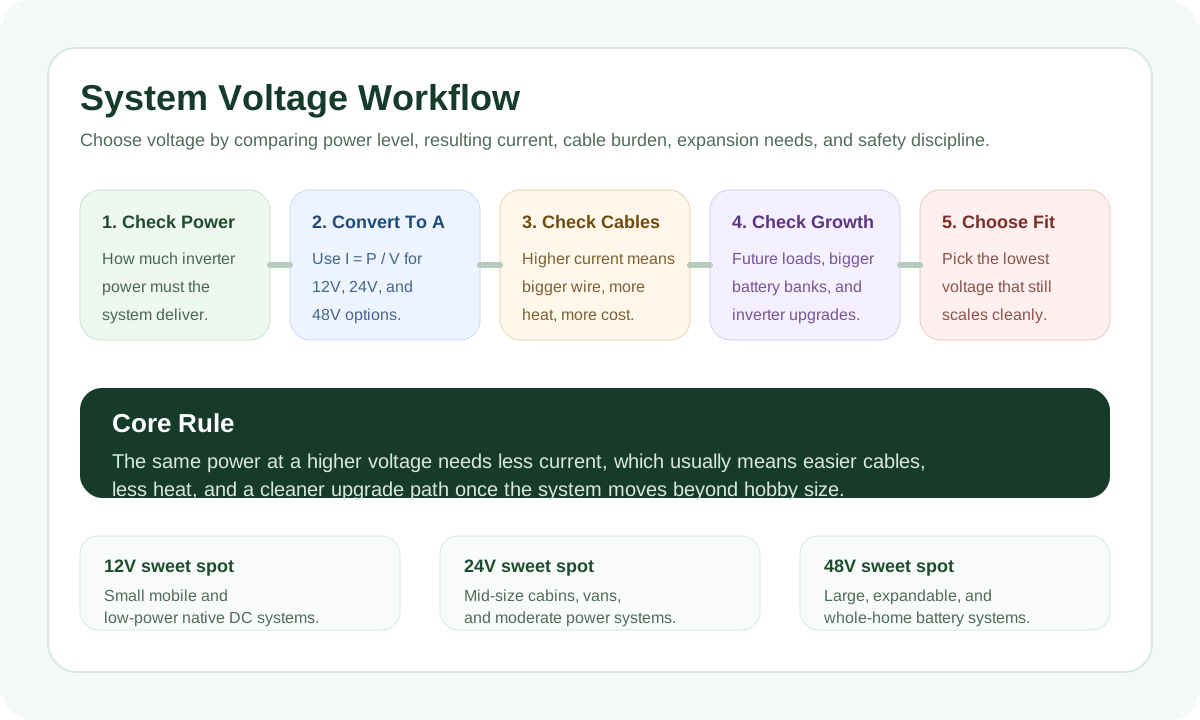
That is the core idea behind 12V, 24V, and 48V solar design. When the system has to deliver the same power, a higher voltage means lower current. Lower current means thinner cables, less resistive heating, and easier scaling once the project grows beyond very small loads.
This is why voltage choice matters so much in off-grid and battery-backed systems. It does not just affect the battery bank. It changes cable cost, inverter behavior, installation complexity, and how easily the whole system can expand later.
This guide explains the 12V versus 24V versus 48V decision path, when each still makes sense, and why 48V has become the default for most larger systems.
The Core Relationship, Power, Voltage, and Current
Section titled “The Core Relationship, Power, Voltage, and Current”The engineering logic behind voltage choice starts with a very simple formula:
Current = power / voltageFor the same power output, a higher system voltage reduces current directly.
Take a 5000 W system:
| System voltage | Required current | Current relative to 12V |
|---|---|---|
12V | 416.67 A | 1x |
24V | 208.33 A | 1/2x |
48V | 104.17 A | 1/4x |
That is the real reason higher-voltage systems are easier to scale.
The current falls dramatically, and once current falls, cable size pressure, heating, and voltage-drop problems fall with it.
Why Higher Voltage Helps So Much
Section titled “Why Higher Voltage Helps So Much”Lower current improves the system in several ways at once:
- Smaller required cable cross-section
- Lower resistive heating
- Lower voltage drop over the same run length
- Easier inverter and battery integration at higher power
- Better scalability as loads grow
Because resistive loss follows I2R, reducing current has an outsized benefit. If current drops to one quarter, the theoretical resistive loss component drops far more dramatically than most beginners expect.
That is why voltage choice and cable sizing are tightly linked. If you have already read Cable Sizing, this page is the design decision that often explains why battery cables become unmanageable at low voltage.
The Practical Rule of Thumb
Section titled “The Practical Rule of Thumb”In broad off-grid and battery-backed design, practical field guidance often looks like this:
| System power | Common recommended voltage | Typical use case |
|---|---|---|
Less than 1000 W | 12V | Small RV setups, boats, basic lighting, portable systems |
Around 1000 to 2000 W | 24V | Mid-size RVs, small cabins, modest off-grid systems |
Above 2000 W | 48V | Larger cabins, homes, serious backup, commercial storage |
This is not a law of physics, but it is a strong planning rule because it reflects where current levels start becoming awkward and expensive.
12V, Where It Still Makes Sense
Section titled “12V, Where It Still Makes Sense”12V is not obsolete. It is still the right answer in some situations.
Best fit for 12V
Section titled “Best fit for 12V”- Small mobile systems
- RV and van electrical systems that already run on
12V - Boats with native
12Vloads - Very small off-grid systems under a few hundred watts
- Pure
DCloads like lighting, USB charging, routers, and small fans
Why people still choose it
Section titled “Why people still choose it”- Huge ecosystem of compatible devices
- Lowest learning barrier
- Easy integration with automotive and mobile gear
- Lower component complexity on tiny systems
Where it starts to break down
Section titled “Where it starts to break down”Once the system grows toward 1 kW and beyond, current rises quickly. That drives up cable size, connector stress, and voltage-drop risk.
So 12V still has real value, but its comfort zone is small.
24V, The Middle Ground
Section titled “24V, The Middle Ground”24V often becomes attractive when the project has outgrown 12V but is not yet large enough to justify a full move to 48V.
Best fit for 24V
Section titled “Best fit for 24V”- Medium-size RV or van builds
- Small off-grid cabins
- Small workshops or field shelters
- Systems around
1to2 kW
Why it works well
Section titled “Why it works well”- Current is cut roughly in half compared with
12V - Cable size and voltage-drop demands become easier
- Still offers a wider device ecosystem than some
48Vsystems - Often feels like a manageable step up for DIY users
One real-world example often cited in the van and mobile space shows how the same inverter can require much lighter battery cables in 24V form than in 12V form. That is not a minor detail. In a confined vehicle, cable weight, bend radius, and terminal size all matter.
48V, Why It Became the Default for Larger Systems
Section titled “48V, Why It Became the Default for Larger Systems”48V has effectively become the standard answer once a solar system becomes serious.
Why 48V wins for bigger systems
Section titled “Why 48V wins for bigger systems”- Current falls to one quarter of the
12Vcase at the same power - Cable size pressure drops sharply
- High-power inverter options are more common
- Expansion is easier
- Battery-bank architecture is cleaner at larger scale
This is why many systems above about 2 kW naturally drift toward 48V, and why many 5 kW+ inverter platforms are designed around it from the start.
Typical best fit for 48V
Section titled “Typical best fit for 48V”- Off-grid homes
- Larger remote cabins
- Whole-home battery backup
- High-power inverter setups
- Commercial or semi-commercial storage
It is not only more efficient. It is also usually the cleanest long-term path once the system is expected to grow.
Comparing 12V, 24V, and 48V
Section titled “Comparing 12V, 24V, and 48V”The broad trade-off usually looks like this:
| Dimension | 12V | 24V | 48V |
|---|---|---|---|
| Efficiency at larger power | Lowest | Better | Best |
| Cable cost | Highest | Moderate | Lowest |
| Device compatibility | Widest | Broad | Stronger in dedicated solar hardware |
| DIY simplicity for tiny systems | Easiest | Moderate | Usually more system-oriented |
| Expansion potential | Weakest | Moderate | Strongest |
| Best power range | Small | Medium | Large |
This is why voltage choice is not a debate about the best number in the abstract. It is a question of which voltage fits the system scale.
Why Cable Costs Change So Fast
Section titled “Why Cable Costs Change So Fast”System voltage often shows up most visibly in the battery-to-inverter cable set.
For the same inverter power:
12Vdemands very high current24Vreduces that current by half48Vreduces it to one quarter of the12Vcase
That means:
- Thicker copper at low voltage
- Heavier and more expensive lugs
- Harder routing and termination
- More sensitivity to voltage drop
This is why low-voltage systems can look cheaper at first but become more expensive once cable and balance-of-system parts are counted honestly.
Why 48V Is Easier to Expand
Section titled “Why 48V Is Easier to Expand”Expansion is not only about adding more battery.
It is also about how easy the system is to manage as power levels rise.
At higher system voltage:
- Current remains more manageable
- Larger inverter options open up
- Battery strings are often easier to organize cleanly
- BMS balancing and system architecture tend to scale better
That is why people often outgrow 12V and then outgrow 24V if the system evolves from hobby size into serious household infrastructure.
Safety Changes With Voltage Too
Section titled “Safety Changes With Voltage Too”Higher voltage improves efficiency, but it also requires more care.
12V is forgiving. 48V is still considered low voltage in many contexts, but it is no longer something to treat casually when wiring batteries, fuses, disconnects, and inverter inputs.
In practice, that means:
- Better attention to isolation and disconnects
- Cleaner battery protection design
- More disciplined cable and fuse selection
- More care around terminals and maintenance work
So the trade-off is real. Higher voltage is usually better for performance and scalability, but it asks for more disciplined installation practice.
A Practical Decision Framework
Section titled “A Practical Decision Framework”Use this order and the answer usually becomes obvious.
- Start with the system’s expected continuous power, not only today’s smallest load
- Check whether the system is mobile, stationary, or expected to expand later
- Compare the current required at
12V,24V, and48V - Check cable size, inverter availability, and battery-bank architecture
- Choose the lowest voltage that still keeps current and expansion manageable
That last line matters.
The goal is not to chase the highest voltage for its own sake. The goal is to avoid running a large system at an awkwardly low voltage.
Quick Scenarios
Section titled “Quick Scenarios”Scenario 1, small van build
Section titled “Scenario 1, small van build”- Small inverter
- Mostly
12Vnative loads - Limited total power
Best fit, usually 12V
Scenario 2, medium cabin
Section titled “Scenario 2, medium cabin”- A few appliances
- Some battery storage
- More than basic lighting but not full-house scale
Best fit, often 24V
Scenario 3, off-grid home or large backup system
Section titled “Scenario 3, off-grid home or large backup system”- Multi-kilowatt inverter
- Meaningful battery bank
- Expansion likely
Best fit, usually 48V
Common Voltage Selection Mistakes
Section titled “Common Voltage Selection Mistakes”- Choosing
12Vbecause it feels simpler even when inverter power is already too high - Looking only at battery price and ignoring cable cost
- Expanding a low-voltage system until current becomes difficult to manage
- Forgetting future loads like EV charging, pumps, or larger appliances
- Assuming all devices will be equally easy to source at every voltage level
Most voltage-regret problems come from growth. The system that felt fine at the beginning becomes awkward once the owner asks it to do more.
Where This Page Connects to the Rest of the Design
Section titled “Where This Page Connects to the Rest of the Design”System voltage is not an isolated decision. It affects several other design pages directly:
That is why voltage should usually be chosen early in the design process rather than patched in after the hardware list is already built.
Related Guides in Focus Solar
Section titled “Related Guides in Focus Solar”- Cable Sizing
- Battery Sizing
- Inverter Sizing
- Solar System Sizing
- How to Choose an Inverter
- Off-Grid Buying Guide
Watch or Read More
Section titled “Watch or Read More”Key Takeaways
Section titled “Key Takeaways”- System voltage choice is really a current-management decision.
- Higher voltage reduces current, cable size pressure, and resistive loss at the same power level.
12Vstill makes sense for small mobile and low-power systems.24Vworks well as a middle ground for modest off-grid and mobile builds.48Vis usually the cleanest choice for larger, expandable, or whole-home systems.
Sources Used for This Page
Section titled “Sources Used for This Page”This page was expanded using the research notes and source list provided for this project, especially the following references.
- Renogy, 12V, 24V, or 48V
- PowMr, 12V vs 24V vs 48V Solar System Guide
- FarOutRide, 12V vs 24V vs 48V Van Electrical System
- Vatrer Power, Which Voltage Is Best for Your Solar System
- ShopSolar, 24V vs 48V Solar Systems
- SVCENERGY, 48V Battery the Future of Solar
- Nohma, Best Voltage for an Off-Grid Electrical System
- PretaPower, Difference Between 12V 24V and 48V Inverters
- YouTube, How to Choose 12V vs 24V vs 48V