Pricing & ROI
Solar ROI Analysis
Learn how to calculate solar ROI over the full life of a system, including degradation, rising utility prices, and the difference between ROI, payback, NPV, and IRR.
Solar payback and solar ROI get used interchangeably all the time.
They should not.
Payback asks one narrow question:
when do cumulative savings catch up to what you spent?
ROI asks the larger question:
after the system has run for years, how much financial value did it really create relative to the money you put in?
And once you start asking that larger question, you have to deal with things simple payback mostly ignores: panel degradation, utility-rate inflation, discount rates, and the fact that a dollar saved in year twenty is not worth the same as a dollar saved today.
This guide walks through the practical solar ROI framework first, then steps up into NPV and IRR, and finally shows why solar can compare surprisingly well with other long-term investments, while still being a very different kind of asset.
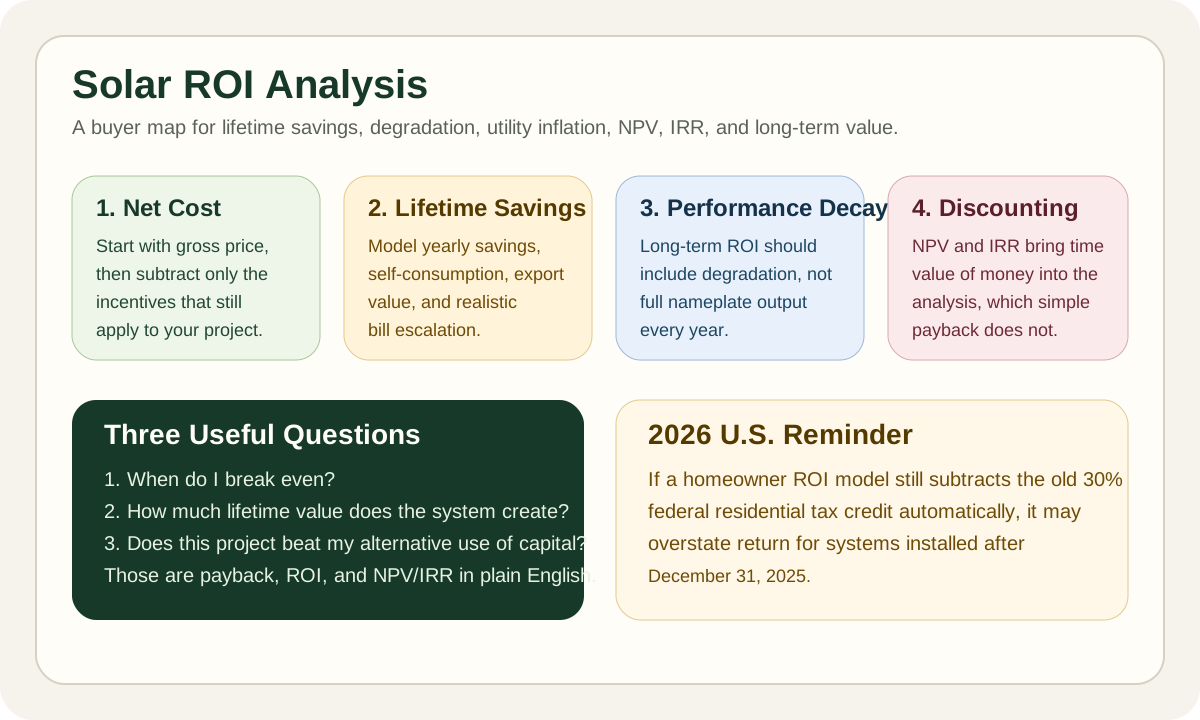
Start With the Big Distinction
Section titled “Start With the Big Distinction”These four metrics are related, but they are not the same.
| Metric | What it answers |
|---|---|
Payback | How long until cumulative savings catch up to cost |
ROI | How much total return the project produces relative to what you spent |
NPV | Whether future savings are worth more than the upfront investment after discounting time value of money |
IRR | The annualized discount rate that makes the project’s NPV equal to zero |
If you only use payback, you can screen quickly.
If you want to compare solar to other investments, or compare two solar projects with different cost and savings shapes, you need at least ROI, and often NPV or IRR as well.
The Simple ROI Formula
Section titled “The Simple ROI Formula”EnergySage gives one of the clearest homeowner-friendly ROI formulas:
ROI = (Total Savings / Installation Cost) x 100That formula is simple, intuitive, and useful for first-pass comparison.
EnergySage’s worked average example uses:
- an average system cost after the federal tax credit of
$20,550 - annual savings of
$2,935 - a
25-yearpanel warranty window - annual efficiency loss of
0.5%
Using those assumptions, it calculates:
- total
25-yearsavings of about$69,137 ROIof about336.6%- annualized return of about
13.46%
That is a striking number, and it is one reason solar sometimes looks surprisingly competitive against traditional investments.
A More Practical Lifetime Framework
Section titled “A More Practical Lifetime Framework”The simple formula is great for orientation, but real solar ROI usually needs a fuller lifetime framing:
lifetime bill savings+ export compensation+ applicable incentives- installation cost- financing cost- maintenance and replacement cost= net lifetime valueThat is the version that starts to feel like a real investment model instead of a quick rule of thumb.
In practical terms, solar ROI is strongest when these conditions line up:
- high electricity prices
- strong daytime self-consumption
- realistic upfront cost
- durable equipment
- low degradation
- favorable export or net-metering rules
Why ROI and Payback Diverge
Section titled “Why ROI and Payback Diverge”This is the point many buyers miss.
A system can have:
- a decent payback period
- but weak long-term
ROI
or:
- a longer payback period
- but very strong long-run value
That is because payback only asks when you break even. It does not ask what happens for the 15 or 20 years after that.
If a system pays back in 9 years and keeps producing savings for another 16+ years, that back half of the life is where the investment case really matures.
A Worked EnergySage-Style Example
Section titled “A Worked EnergySage-Style Example”EnergySage’s current article shows the math cleanly enough that it is worth restating in practical form.
Start with:
Installation cost = $20,550Year 1 savings = $2,935Annual degradation = 0.5%Analysis window = 25 yearsThen calculate total savings over the system life by reducing the output value slightly each year for degradation.
EnergySage says that produces:
Total 25-year savings = about $69,137Then:
ROI = $69,137 / $20,550 x 100 = 336.6%That is a powerful example because EnergySage explicitly notes it is conservative: it does not include rising utility prices across the full period.
Degradation Is Small, But It Belongs in the Model
Section titled “Degradation Is Small, But It Belongs in the Model”If you ignore degradation entirely, your ROI model will overstate long-term output.
The most useful benchmark here is still NREL.
Its analytical review of photovoltaic degradation rates says:
- the median reported degradation rate is about
0.5%/year - the average reported rate across all data is about
0.8%/year - the majority of reported rates are below
1%/year
That is why modern residential financial models often use something around 0.5%/year as a baseline degradation assumption.
Solar Choice’s calculator assumptions make this concrete:
- overall system efficiency assumed at
75% - output falls from about
97%of nominal capacity in year 1 - to about
82%in year 25
That is a good reminder that “25-year ROI” is not based on full-nameplate output every single year.
Why Utility Inflation Makes Solar Look Better Over Time
Section titled “Why Utility Inflation Makes Solar Look Better Over Time”One of the biggest weaknesses of simple ROI or payback models is that they often assume electricity prices stay flat.
Real life usually does not.
If grid electricity becomes more expensive over time, each future solar kilowatt-hour becomes more valuable. That pushes lifetime savings up and typically improves both ROI and effective payback.
This is one reason EnergySage calls its own simple ROI example conservative. It does not assume future utility-rate escalation across the full period.
So in practice:
- flat-rate models are easier to explain
- escalation-aware models are usually more realistic
Self-Consumption Matters More Than Many Buyers Expect
Section titled “Self-Consumption Matters More Than Many Buyers Expect”A solar system creates the best financial result when the electricity it produces offsets electricity you would otherwise buy at the full retail utility rate.
That means self-consumption is often the hidden ROI lever.
If your system exports a lot of energy under weak export-credit rules, your total lifetime value can fall meaningfully even if the array is technically “performing.”
This is why two systems with the same kW size and same annual production can still produce very different ROI.
The value of the kWh matters just as much as the number of kWh.
Batteries Can Help Value, But Often Hurt Pure ROI
Section titled “Batteries Can Help Value, But Often Hurt Pure ROI”Battery storage is where ROI analysis becomes more nuanced.
For many residential buyers:
- batteries improve resilience
- batteries can improve self-consumption
- batteries can help with time-of-use optimization
But batteries also add significant capital cost.
That means a solar-plus-battery project can be:
- better for energy independence
- better for backup
- but worse on simple payback or simple
ROI
This is why battery value should often be discussed as a mix of financial return and resilience value, not just one number.
NPV: The More Realistic Value Test
Section titled “NPV: The More Realistic Value Test”If ROI tells you how big the gain is, NPV tells you whether the future gain is worth more than the upfront cost after accounting for the time value of money.
Aurora Solar gives one of the clearest definitions:
NPV is the sum of discounted future cash flows over the system life minus the initial investment.
Aurora’s breakdown defines the moving pieces like this:
N= project lifetimei= each year in the project lifeCash Flow= system cost in year 0, then the difference between pre-solar and post-solar bills in years 1 through 25d= discount rate
In practical terms, the NPV formula is:
NPV = sum of discounted cash flows over the project lifeand those cash flows include:
- the upfront system cost in year
0 - any incentive impact in year
0 - annual utility savings in years
1through25
If NPV is positive, the project creates value above your chosen discount rate.
If NPV is negative, your money would likely be better deployed elsewhere at that required rate of return.
IRR: The Annualized Return Lens
Section titled “IRR: The Annualized Return Lens”Aurora Solar also gives the cleanest definition of IRR.
IRR is:
- similar to
NPVbecause it uses discounted future cash flows - not measured in dollars
- measured as a percentage return
Aurora says IRR is calculated by setting NPV to zero and solving for the discount rate.
That makes IRR useful when you want to compare:
- one solar project versus another
- solar versus another investment option
- solar versus a financing hurdle rate
This is the point where solar starts looking much more like a capital-allocation decision and much less like a simple utility-bill upgrade.
Why NPV and IRR Usually Beat Simple Payback
Section titled “Why NPV and IRR Usually Beat Simple Payback”Aurora’s framework is helpful here because it makes the weakness of simple payback obvious.
Simple payback:
- ignores the time value of money
- ignores that savings in later years are worth less than savings today
- can make long-tail savings look more equal than they really are
NPV and IRR do a better job because they:
- discount future cash flows
- work over the full project life
- let you compare solar to other investments on a more consistent financial basis
If you are doing a serious residential or commercial financial analysis, this is the point where you should stop using payback alone.
Solar vs the Stock Market: Useful, But Not Perfect
Section titled “Solar vs the Stock Market: Useful, But Not Perfect”EnergySage’s current comparison is one of the strongest data points available for homeowner-facing ROI language.
It says:
- solar annualized return in its example: about
13.46% S&P 500average return over the last20 years: about8.4%
That makes solar look very strong on a percentage basis.
But this is not a perfect apples-to-apples comparison.
Solar is:
- tied to the property
- illiquid
- dependent on your utility bill and local rules
- not something you can sell in one click like an index fund
Stocks are:
- liquid
- market-priced daily
- far more volatile
- easier to rebalance or exit
So the right takeaway is not “solar is a stock substitute.”
It is this:
solar can be a very strong long-term household capital project, especially when it offsets expensive utility electricity.
Solar vs Other Home Improvements
Section titled “Solar vs Other Home Improvements”EnergySage also makes another useful point.
Compared to many home upgrades such as window replacement or insulation, solar often reaches financial break-even much faster. It notes that payback on those other upgrades is often measured in decades, while average solar payback is often under 10 years.
That does not mean those upgrades are bad.
It means solar often behaves more like a high-savings energy asset than a conventional comfort upgrade.
The 2026 U.S. Incentive Reality Changes ROI Math
Section titled “The 2026 U.S. Incentive Reality Changes ROI Math”This matters because many older ROI examples still assume the old homeowner federal tax credit is available.
Solar.com’s January 14, 2026 tax-credit FAQ says the homeowner-claimed federal residential solar tax credit, 25D, was terminated on December 31, 2025.
That means:
- systems installed in 2025 could still qualify for the full
30% - systems installed after December 31, 2025 do not qualify for a direct homeowner federal residential solar tax credit
So if you are doing a 2026 homeowner ROI analysis and the spreadsheet still subtracts the old 30% homeowner credit automatically, the model is likely too optimistic.
That does not kill the value case for solar.
It just means the net-cost assumptions have to be current.
A Better Residential ROI Workflow
Section titled “A Better Residential ROI Workflow”If you want a stronger real-world solar ROI model, use this order.
- Start with the gross installed system cost
- Subtract only the incentives that really apply to your install date and ownership structure
- Estimate year 1 savings using actual electricity rates and realistic production
- Reduce production modestly each year for degradation
- Decide whether utility prices are modeled flat or escalating
- Add export-credit assumptions conservatively
- Include maintenance, inverter replacement risk, or financing cost if relevant
- Then calculate
ROI, and if the project is material enough, calculateNPVandIRR
That workflow is slower than “divide cost by savings,” but it gives you a much more decision-grade answer.
Common Mistakes Buyers Make
Section titled “Common Mistakes Buyers Make”- Treating payback and
ROIas interchangeable - Ignoring degradation in long-term models
- Assuming flat electricity prices forever
- Using old incentive assumptions in 2026-era homeowner models
- Comparing solar to stocks without accounting for liquidity and volatility differences
- Treating battery storage like a pure return booster when its value is often mixed between savings and resilience
A Good Default Comparison Framework
Section titled “A Good Default Comparison Framework”Most solar financial comparisons get clearer when you use this order.
- Check net upfront cost
- Check first-year savings
- Check degradation assumption
- Check export-credit and self-consumption assumptions
- Check whether utility prices are held flat or escalated
- Check
ROI - If the decision is meaningful, check
NPVandIRR
That sequence keeps you from putting false precision on top of weak assumptions.
Related Guides in Focus Solar
Section titled “Related Guides in Focus Solar”- Solar Payback Period
- Solar System Cost Guide
- 5kW Solar System Cost
- 10kW Solar System Cost
- Commercial Solar Cost
Watch or Read More
Section titled “Watch or Read More”Key Takeaways
Section titled “Key Takeaways”ROIis not the same as payback. Payback tells you when you break even.ROItells you how much value the project creates over its life.- EnergySage’s current worked example shows about
336.6%totalROIover25 years, or about13.46%annualized, under its assumptions. NPVandIRRare more realistic than simple payback because they account for discounted future cash flows.NRELstill supports using about0.5%/yearas a strong baseline degradation assumption in long-run models.- In 2026 U.S. homeowner modeling, outdated assumptions about the old homeowner
30%federal tax credit can makeROIlook better than it really is.
Sources Used for This Page
Section titled “Sources Used for This Page”This page was expanded using current ROI references and direct verification of the most time-sensitive assumptions, especially the following sources.