Components
Panel Efficiency Explained
Understand what solar panel efficiency means, how it is measured, and when it matters a lot for your system design.
Solar panel efficiency sounds like one of the biggest numbers on the spec sheet.
And in some situations, it really is a big deal.
But in other situations, buyers obsess over efficiency when the more important questions are:
- how much roof space is actually available
- how the module behaves in heat
- what the installed
$/Wlooks like - whether the panel fits the inverter and layout cleanly
That is why panel efficiency is important, but not in the simplistic way people often assume.
This guide explains what efficiency actually measures, how it is calculated, why it matters most on tight roofs, and when it stops being the deciding factor.
What Solar Panel Efficiency Actually Means
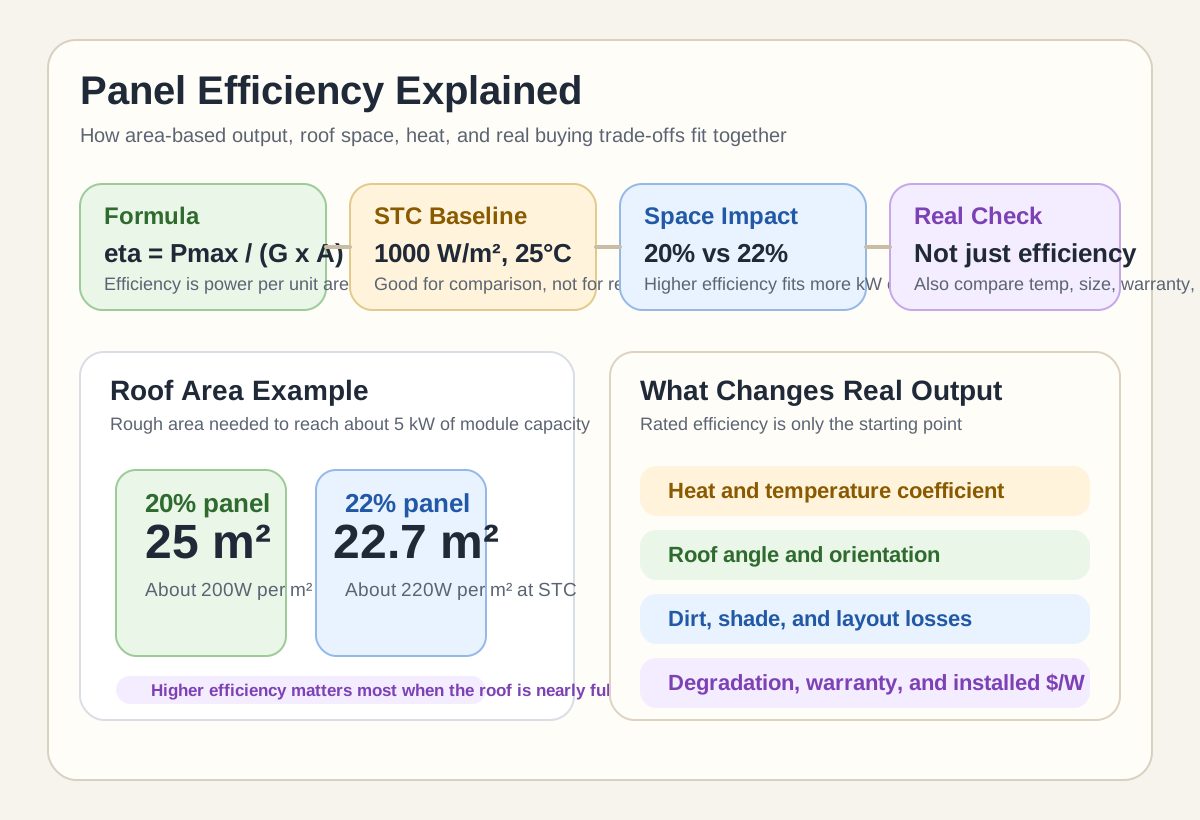
Section titled “What Solar Panel Efficiency Actually Means”Panel efficiency is the percentage of incoming solar irradiance a panel converts into electrical power per unit area.
That is why it is an area-based metric.
It is not a claim that the system turns 22% of all sunlight hitting your roof into usable household energy after every real-world loss.
It is a module-level rating under standardized test conditions.
A practical formula is:
eta = (Pmax / (G x A)) x 100%Where:
Pmaxis maximum power underSTCGis irradiance, usually1000 W/m²Ais the panel area
So if a module has 20% efficiency, that means that under standard lab conditions it converts about one-fifth of the incoming solar energy on its surface into electrical output.
The Quick Mental Model, 20% Efficiency Means About 200W Per Square Meter at STC
Section titled “The Quick Mental Model, 20% Efficiency Means About 200W Per Square Meter at STC”This is the easiest way to think about it.
If irradiance is 1000 W/m² and the module is 20% efficient, then one square meter of panel area produces about:
1000 x 0.20 = 200WAt 22% efficiency, that rises to about:
1000 x 0.22 = 220WThat is why efficiency matters most when space is limited.
The higher-efficiency panel gives you more wattage from the same roof footprint.
Why Efficiency Matters So Much on Small or Awkward Roofs
Section titled “Why Efficiency Matters So Much on Small or Awkward Roofs”This is the part buyers should usually care about most.
If the roof is small, broken up, or full of setbacks, every square meter counts more.
That is where a difference between 20% and 22% starts to feel real.
For example, if you want around 5 kW of module capacity:
- at
20%efficiency, you need about25 m² - at
22%efficiency, you need about22.7 m²
That does not sound huge until the roof is right on the edge.
On a constrained home roof, that difference can decide whether the design fits comfortably or forces compromises around vents, hips, walkways, or fire setbacks.
Why Efficiency Matters Less on Big Open Roofs
Section titled “Why Efficiency Matters Less on Big Open Roofs”Now the other side.
If the roof is large and simple, efficiency becomes less decisive.
That is because an open roof can often absorb the extra area needed by a slightly lower-efficiency module without changing the whole project.
In that situation, buyers may get more value by focusing on:
- installed
$/W - temperature coefficient
- degradation
- product warranty
- electrical compatibility
That is why a lower-efficiency panel is not automatically a worse buy on a warehouse roof or a roomy ground-mount site.
Sometimes it is just the more economical one.
STC Efficiency Is a Lab Rating, Not a Promise of Year-Round Field Efficiency
Section titled “STC Efficiency Is a Lab Rating, Not a Promise of Year-Round Field Efficiency”This distinction matters a lot.
Efficiency is usually measured at STC, or Standard Test Conditions:
1000 W/m²irradiance25°Ccell temperature- air mass
1.5
That is a standardized benchmark, which is useful because it lets buyers compare modules on common ground.
But real roofs do not live in STC.
Field performance changes with:
- heat
- roof tilt and orientation
- dirt and soiling
- shading
- wiring and inverter losses
- seasonal irradiance changes
So a panel with 22% rated efficiency is not walking around your roof delivering 22% field efficiency all day.
It is giving you a clean lab-based reference point for power density.
Temperature Is One of the Biggest Reasons Real Output Moves Away From the Efficiency Label
Section titled “Temperature Is One of the Biggest Reasons Real Output Moves Away From the Efficiency Label”This is where buyers often confuse panel efficiency with real operating performance.
A high-efficiency panel still loses output as cell temperature rises.
That is why temperature coefficient matters so much.
If a panel has a Pmax temperature coefficient around -0.35%/°C, then hotter operating conditions can pull real power meaningfully below the headline STC number.
That is why in hot climates, the smarter question is often not just:
which panel is more efficient?
It is:
which panel keeps more of its output when the roof is running hot?
A Simple Example of Why Heat Matters
Section titled “A Simple Example of Why Heat Matters”Suppose you have a panel rated at 20% efficiency under STC.
If cell temperature rises well above the 25°C reference point, and the module carries a typical temperature penalty, real output can fall enough that the field-equivalent performance feels more like the high teens rather than the headline number.
That does not mean the efficiency rating was fake.
It means the rating was measured in the lab, while the roof is operating in the real world.
Modern Efficiency Ranges Buyers Usually See
Section titled “Modern Efficiency Ranges Buyers Usually See”The exact numbers vary by product line, but the current market roughly clusters like this.
| Module type | Common efficiency range | Typical role |
|---|---|---|
Monocrystalline PERC | About 19.5% to 21.5% | Mainstream residential and commercial rooftop modules |
N-TOPCon | About 22% to 23.5% | Stronger power density and newer premium mainstream modules |
HJT | About 23% to 24%+ | Higher-end products with a noticeable premium |
| Polycrystalline | Usually lower, often mid-to-high teens | Much less common in new premium installs |
Those ranges help explain why modern rooftop buyers see so many mono, TOPCon, and premium high-density modules in current quotes.
Why High Efficiency Does Not Automatically Mean Best Value
Section titled “Why High Efficiency Does Not Automatically Mean Best Value”This is probably the most important buying conclusion on the page.
Higher efficiency often costs more.
Sometimes that premium is worth it.
Sometimes it is not.
The premium makes the most sense when:
- roof space is tight
- the project is trying to maximize capacity on limited area
- the buyer wants fewer modules for a cleaner layout
- the higher-efficiency product also brings better warranty or temperature behavior
It makes less sense when:
- roof area is abundant
- cost per watt matters more than power density
- the higher-efficiency module adds price without solving a real design constraint
That is why a smart buyer does not ask for the most efficient panel by reflex.
They ask whether higher efficiency actually solves their project’s main limitation.
Efficiency Is Not the Same as System Quality
Section titled “Efficiency Is Not the Same as System Quality”This is another easy trap.
A module with slightly lower efficiency can still be the better panel choice if it offers:
- better temperature behavior
- lower degradation
- stronger warranty support
- better installed economics
- better fit for the inverter and roof layout
So efficiency belongs in the comparison, but it should not dominate the whole decision.
When Efficiency Is the Right Thing to Prioritize
Section titled “When Efficiency Is the Right Thing to Prioritize”There are clear cases where buyers should care a lot.
Tight Residential Roofs
Section titled “Tight Residential Roofs”If usable roof area is limited, a higher-efficiency module can be the difference between a comfortable design and an undersized system.
Premium Aesthetic Layouts
Section titled “Premium Aesthetic Layouts”Sometimes fewer, more powerful modules help create a cleaner roof arrangement.
That is not just cosmetic. It can also reduce layout awkwardness.
Projects Trying to Max Out a Specific Roof
Section titled “Projects Trying to Max Out a Specific Roof”If the design goal is to fit as much capacity as possible onto one roof face, efficiency matters directly.
When Other Specs Matter More Than Efficiency
Section titled “When Other Specs Matter More Than Efficiency”There are also clear cases where it should move down the priority list.
Large Open Roofs
Section titled “Large Open Roofs”If space is easy to find, $/W often matters more.
Hot Climates
Section titled “Hot Climates”Temperature coefficient can matter more than a small efficiency gap.
Long-Term Value Comparisons
Section titled “Long-Term Value Comparisons”Degradation rate and warranty support may matter more over 25 years than a small day-one efficiency advantage.
Compatibility-Driven Designs
Section titled “Compatibility-Driven Designs”If inverter voltage or current limits, mounting constraints, or module dimensions are the real bottleneck, efficiency is only one part of the answer.
A Better Way to Use Efficiency on Real Quotes
Section titled “A Better Way to Use Efficiency on Real Quotes”If you are comparing actual module options, read efficiency alongside:
- wattage
- dimensions and weight
- temperature coefficient
- degradation rate
- product and performance warranty
- installed
$/W
That is what turns efficiency from a marketing number into a practical design metric.
Related Guides in Focus Solar
Section titled “Related Guides in Focus Solar”- Solar Panels
- How to Read a Panel Datasheet
- Panel Degradation Rate
- 550W vs 600W Panels
- Monocrystalline vs Polycrystalline Panels
Watch or Read More
Section titled “Watch or Read More”Video Walkthrough
Section titled “Video Walkthrough”Key Takeaways
Section titled “Key Takeaways”- Panel efficiency measures how much power a module produces per unit area under
STC. - It matters most on roofs where usable space is limited.
- Higher efficiency usually helps with power density, not necessarily with cheapest installed cost.
- Real-world output depends on heat, orientation, dirt, shading, and the rest of the system, not just the efficiency label.
- A strong buying decision compares efficiency together with temperature coefficient, degradation, warranty, dimensions, and
$/W.